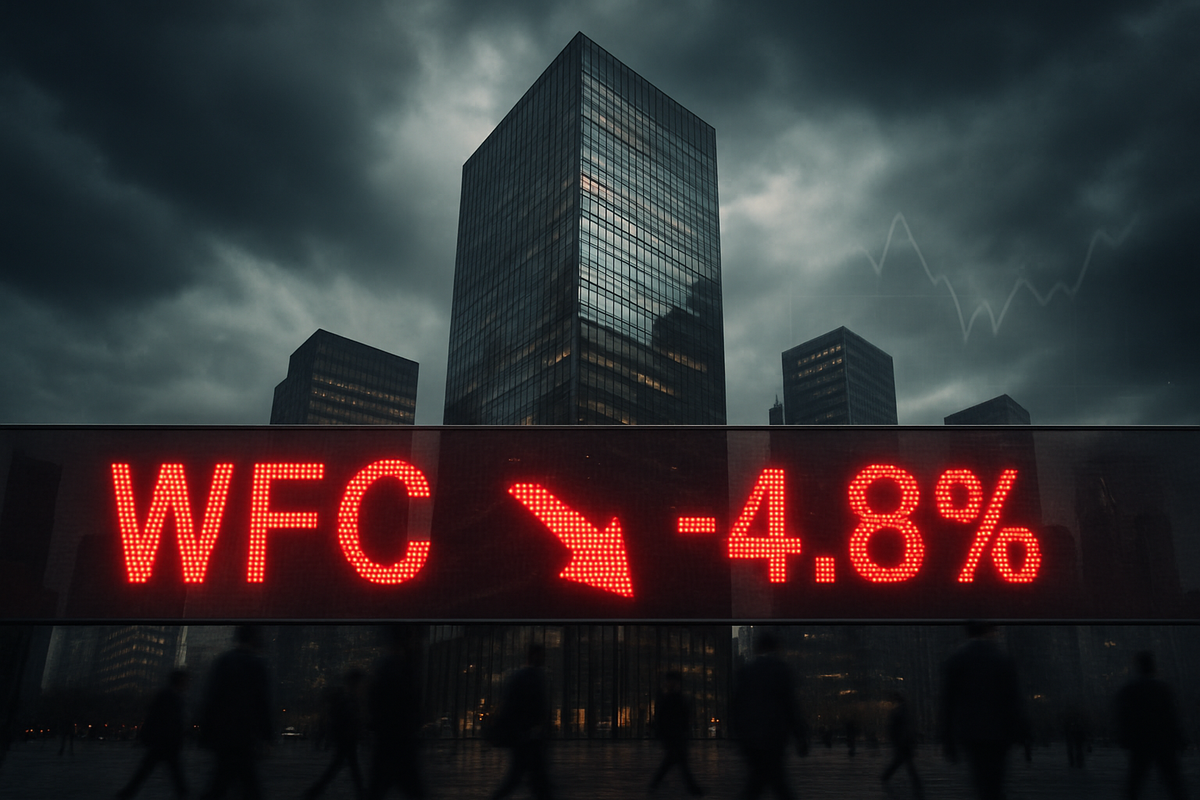
The dawn of the 2026 earnings season has brought a sobering reality check for one of America's largest lenders. On April 14, 2026, shares of Wells Fargo & Company (NYSE: WFC) tumbled 4.8% following the release of its first-quarter financial results. While the bank managed to beat expectations on earnings per share, the market’s focus remained laser-focused on a critical shortfall in net interest income (NII). The disappointing figures served as a jarring reminder that even with the regulatory "handcuffs" of its long-standing asset cap finally removed, the bank remains vulnerable to the shifting tides of the current interest rate environment.
The sell-off in Wells Fargo shares underscored a growing rift within the banking sector. As the Federal Reserve maintains a "higher-for-longer" stance in response to persistent inflationary pressures, investors are increasingly differentiating between institutions that can effectively pass on rate hikes to borrowers and those struggling with the rising costs of retaining deposits. For Wells Fargo, the Q1 miss highlights a persistent challenge in optimizing its balance sheet in a year that many hoped would mark a definitive turnaround for the San Francisco-based giant.
Net Interest Income Shortfall Dampens Growth Hopes
The central figure in Wells Fargo’s Q1 report was a net interest income of $12.1 billion, which fell short of the $12.3 billion consensus estimate analysts had set. This metric—which measures the gap between what a bank earns on loans and what it pays out to depositors—is the lifeblood of retail banking. The shortfall was particularly stinging given that the bank saw its loan book grow by 11% year-over-year, surpassing the $1 trillion mark for the first time since early 2020. Despite this volume growth, the "yield" on those loans was compressed by the "deposit beta"—the necessity of paying higher interest rates to keep customers from moving their cash into high-yield money market funds.
The timeline leading up to this moment was one of high expectations. Throughout late 2025 and early 2026, investors had bid up Wells Fargo stock on the premise that the June 2025 removal of the $1.95 trillion asset cap would allow the bank to finally compete on a level playing field. CEO Charlie Scharf had spent years overhauling the bank’s internal controls and closing out a series of punishing consent orders, the last of which was finalized in March 2026. However, the first-quarter results demonstrated that the freedom to grow assets does not automatically translate into efficient profit margins, especially when operating costs continue to climb.
Initial market reactions were swift and unforgiving. By midday on April 14, Wells Fargo was the worst-performing stock among its "Big Four" peers. Traders pointed to the bank's provision for credit losses, which jumped nearly 22% to $1.14 billion, as a sign of defensive positioning. While the bank reported an adjusted earnings per share of $1.60—beating the $1.58 estimate—investors largely ignored the bottom-line beat, viewing it as a result of cost-cutting measures rather than the sustainable, core income growth they had been promised.
A Tale of Two Tiers: Winners and Losers in the Sector
The performance of Wells Fargo stood in stark contrast to its largest rival, JPMorgan Chase & Co. (NYSE: JPM), which also reported on April 14. JPMorgan posted what analysts described as a "blockbuster" beat on both profit ($16.5 billion) and revenue ($50.5 billion). While JPM shares saw a modest decline of approximately 1% due to management’s cautious decision to trim full-year NII guidance to $103 billion, the bank’s ability to dominate the investment banking and markets segments provided a cushion that Wells Fargo lacked. JPMorgan’s scale and diversified revenue streams have allowed it to weather the "squeeze" on retail deposits far better than its more consumer-focused competitors.
Bank of America Corporation (NYSE: BAC) felt the ripple effects of the Wells Fargo miss, with its shares slipping 4.2% in sympathy ahead of its own earnings report scheduled for April 15. Investors are increasingly wary of Bank of America’s massive portfolio of low-yield, long-term bonds—a legacy of the 2020-2021 ultra-low rate era—which continues to weigh on its net interest margin. Meanwhile, Citigroup Inc. (NYSE: C) has seen a more tempered reaction, as its ongoing internal restructuring efforts have made its stock price more sensitive to internal milestones than macro NII trends. The widening gap between the "haves" and "have-nots" in the banking sector is now largely defined by who can grow their loan books without eroding their margins.
The "Higher for Longer" Reality and the March Oil Shock
The broader significance of Wells Fargo's NII miss cannot be understood without looking at the macro-economic backdrop of early 2026. The Federal Reserve, led by Jerome Powell, has held the benchmark federal funds rate steady in the 3.50% to 3.75% range. Hopes for a "pivot" to lower rates were dashed in March 2026, when a significant oil supply shock—driven by escalating tensions in the Middle East—pushed Brent crude prices toward $120 per barrel. This spike sent the Consumer Price Index (CPI) to a stubborn 3.3%, forcing the Fed to signal that rate cuts would likely be delayed until at least the fourth quarter of 2026.
This environment has created a "pincer movement" for retail-heavy banks. On one side, the inverted yield curve has made it difficult to generate profit from traditional lending. On the other, the March inflation spike has intensified the competition for deposits. As consumers and businesses demand higher yields on their savings to keep pace with rising energy costs, banks like Wells Fargo are finding that the "cheap" deposits of the past decade have vanished. This historical precedent is reminiscent of the late 1970s, where persistent inflation forced banks to constantly chase a moving target in terms of cost-of-capital, often at the expense of their net interest margins.
The Road Ahead: Strategic Pivots and Market Challenges
Looking forward, Wells Fargo faces a critical juncture. The immediate challenge is to prove that its "post-asset cap" growth is not just growth for the sake of volume, but growth that is accretive to shareholders. Analysts expect the bank to pivot toward its Corporate and Investment Bank (CIB) and wealth management divisions—areas where it has significant room to gain market share now that it is no longer constrained by regulatory limits. In the short term, however, the bank must manage a rising tide of credit losses as the higher-for-longer rate environment puts pressure on commercial real estate and credit card borrowers.
The potential for a strategic adaptation is there. CFO Michael Santomassimo noted during the earnings call that while NII is under pressure, the bank is being more "aggressive" in pursuing high-quality deposits. If the Fed does eventually begin a cutting cycle in late 2026, Wells Fargo could see a relief in deposit costs that outpaces the decline in loan yields, potentially leading to a "margin recovery" in 2027. However, until the energy-driven inflation stabilizes, the bank will be forced to operate in a defensive crouch, prioritizing balance sheet stability over aggressive expansion.
Final Assessment: What Investors Should Watch
The takeaway from Wells Fargo’s Q1 2026 performance is that regulatory freedom is a necessary, but not sufficient, condition for market outperformance. The 4.8% drop in share price reflects a market that has shifted its focus from "When will the cap be lifted?" to "What can you do with it now that it is?" While the bank has successfully navigated its legal and regulatory hurdles, it is now subject to the same unforgiving macro-economic laws as its peers, without the "diversification shield" enjoyed by JPMorgan Chase.
Investors should closely watch two key indicators in the coming months: the bank’s "deposit beta" trajectory and its ability to capture market share in high-margin sectors like investment banking. If Wells Fargo can stabilize its NII while leveraging its newly expanded balance sheet, the current dip may be viewed as a buying opportunity. However, if inflation remains sticky and deposit costs continue to climb, the road to recovery for the "Stagecoach Bank" may be longer and more arduous than many anticipated at the start of the year.
This content is intended for informational purposes only and is not financial advice.