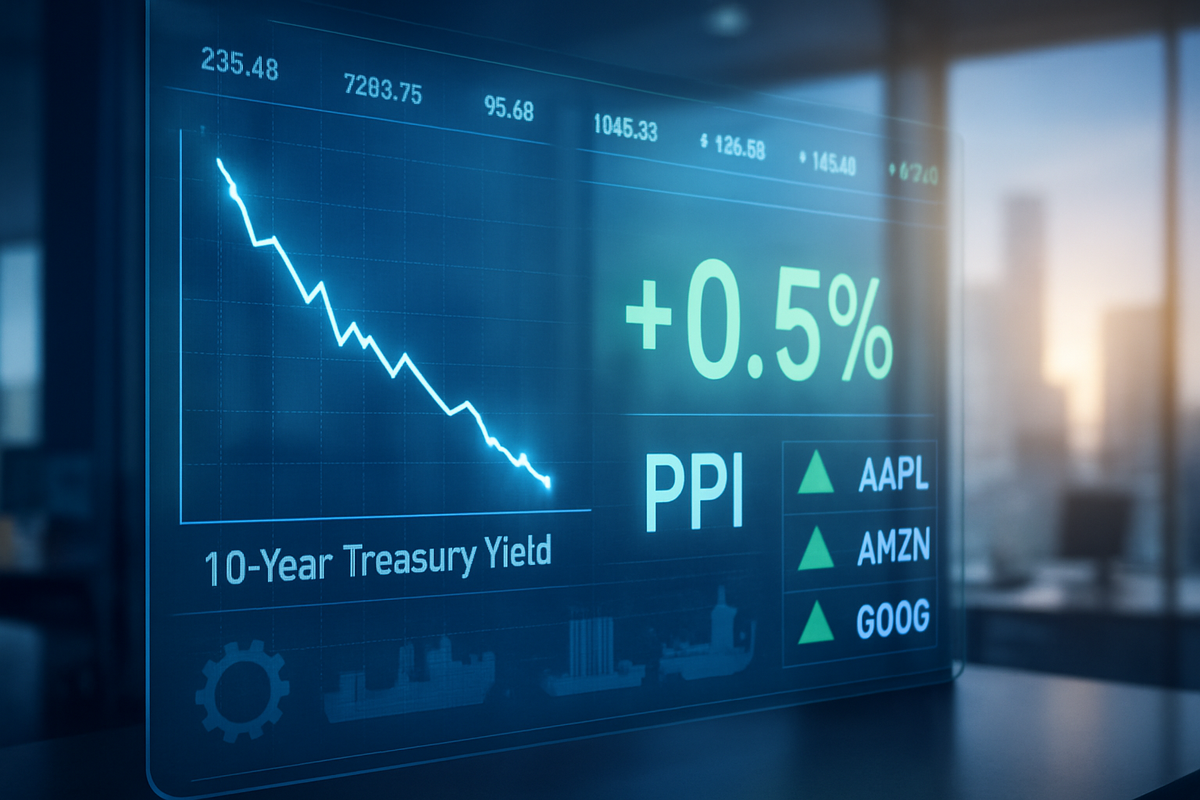
The U.S. Producer Price Index (PPI) for March arrived at a cooler-than-anticipated +0.5% month-over-month, providing a much-needed sigh of relief for Wall Street and potentially clearing the runway for the Federal Reserve to consider a more dovish stance in the coming months. While a 0.5% increase remains elevated compared to historical averages, it came in significantly below the consensus forecast of +0.8%, which many analysts had feared following a late-winter surge in raw material costs and energy volatility.
The immediate reaction across the financial landscape was swift and decisive. The 10-year Treasury yield, a critical benchmark for everything from mortgages to corporate debt, slid nearly 12 basis points to settle near 4.15% shortly after the data release. This cooling of yields suggests that bond traders are aggressively recalibrating their expectations, moving away from the "higher-for-longer" narrative that has dominated the discourse throughout early 2026 and shifting toward a timeline that includes a potential rate cut as early as mid-summer.
Relief at the Wholesale Level: Breaking Down the March Surprise
The March PPI report released this morning by the Bureau of Labor Statistics revealed that while prices at the producer level are still rising, the pace of that acceleration is losing momentum. The +0.5% reading follows a more turbulent January and February, where supply chain hiccups in the semiconductor and heavy machinery sectors threatened to reignite the inflationary fires of years past. Analysts had braced for a "hot" print, fearing that rising maritime freight costs and a tightening labor market in the manufacturing sector would force producers to pass on even higher costs to consumers.
Instead, the data suggests that the "pipeline inflation" that often leads to higher consumer prices (CPI) is beginning to stabilize. Key components of the report showed a notable deceleration in services, which rose only 0.2%, offsetting a more stubborn 0.7% rise in energy goods. This "mixed but moderate" result is being viewed by economists as the "Goldilocks" scenario—inflation that is high enough to suggest economic activity but cool enough to prevent the Federal Reserve from reaching for another interest rate hike.
The timeline leading up to today’s release has been fraught with anxiety. Throughout the first quarter of 2026, Federal Reserve officials, including Chair Jerome Powell, have maintained a cautious, data-dependent stance, frequently warning that they required "greater confidence" that inflation was returning to the 2% target. Today's PPI print serves as a critical pillar of that confidence. Market participants are now eagerly awaiting tomorrow's Consumer Price Index (CPI) data to see if this wholesale moderation has successfully trickled down to the retail level.
Winners and Losers: Growth Stocks Lead the Charge While Banks Brace for Margin Pressure
The primary beneficiaries of today’s data are the high-growth technology and AI-related companies that populate the Nasdaq. When Treasury yields fall, the "discount rate" used to value future earnings also drops, making stocks with long-term growth profiles more attractive. Apple Inc. (Nasdaq: AAPL) and Microsoft Corp. (Nasdaq: MSFT) both saw their shares climb more than 2% in early trading, while the semiconductor darling NVIDIA Corp. (Nasdaq: NVDA) surged as investors bet that a more dovish Fed would support continued capital expenditure in AI infrastructure.
Conversely, the banking sector is facing a more nuanced and potentially difficult environment. Major financial institutions like JPMorgan Chase & Co. (NYSE: JPM) and Bank of America Corp. (NYSE: BAC) saw their share prices trade flat to slightly down as the 10-year yield retreated. This is largely due to concerns over "net interest margin" (NIM) compression. If long-term yields fall while short-term rates remain anchored by the Fed’s current policy, the yield curve flattens, reducing the profitability of the "borrow short, lend long" model that sustains traditional banking.
Additionally, small-cap companies, represented by the Russell 2000 Index, showed signs of life following the report. These firms are typically more sensitive to borrowing costs than their mega-cap counterparts. With the 10-year yield cooling, the prospect of lower interest rates offers a lifeline to smaller businesses that have been struggling under the weight of high debt-servicing costs throughout 2025.
The Broader Significance: A Shift in the Inflation Narrative
Today’s PPI data fits into a broader industry trend of "disinflationary normalization." After the extreme volatility seen in the mid-2020s, the global economy appears to be settling into a new equilibrium. The +0.5% print, while not perfect, represents a significant improvement from the +1.0% and +1.2% spikes seen during the supply chain crises earlier this decade. It suggests that the Federal Reserve's restrictive monetary policy is finally effectively cooling the "engines of production" without causing a hard landing or a full-scale industrial recession.
The ripple effects of this data will likely be felt in the currency markets as well. A more dovish Fed outlook typically weakens the U.S. Dollar relative to other major currencies, which could provide a boost to multi-national corporations that earn a significant portion of their revenue abroad. Furthermore, if the Fed signals a pivot in their next meeting, it could set a historical precedent for how the central bank handles "sticky" inflation—opting for a patient, gradual descent rather than the aggressive "shock and awe" tactics of 2022-2023.
From a policy perspective, this report may ease the pressure on the Biden administration as it navigates the economic optics of 2026. High producer prices often translate into high grocery and gasoline prices, both of which are politically sensitive. A cooling PPI gives the administration more room to argue that their industrial and energy policies are beginning to pay dividends in the form of price stability.
What’s Next: Watching the Fed and the "Last Mile" of Inflation
In the short term, all eyes remain on the Federal Open Market Committee (FOMC) and their upcoming meeting in May. While today’s PPI is a strong "dovish" signal, the Fed is unlikely to act on a single data point. Investors will be looking for a change in the Fed’s post-meeting statement, specifically searching for the removal of phrases like "additional firming may be appropriate." If the April CPI data also comes in cool, a June rate cut becomes the base-case scenario for the majority of Wall Street analysts.
The long-term challenge remains the "last mile" of the inflation fight. Bringing inflation from 4% down to 2% has historically proven more difficult than the initial drop from 9% to 4%. Producers may find that while commodity prices are stabilizing, labor costs remain high due to a structural shortage of skilled trade workers in the U.S. This could create a "floor" for PPI that prevents it from dropping much lower than +0.3% or +0.4% MoM for the remainder of the year.
Strategic pivots are already underway. Corporate treasurers who were waiting for a dip in yields to issue new debt are likely to move quickly in the coming weeks. We may see a "rush to market" for corporate bond issuance as companies look to lock in these lower yields before any potential rebound in inflation data occurs.
Summary and Investor Takeaways
The March PPI report of +0.5% is a pivotal moment for the 2026 market narrative. By coming in cooler than the +0.8% expectation, it has effectively "de-risked" the immediate inflation outlook and provided a catalyst for a rally in both bonds and growth stocks. The decline in the 10-year Treasury yield is a clear signal that the market is beginning to price in the end of the Fed's tightening cycle, potentially ushering in a more favorable environment for equities.
Moving forward, the market will likely remain in a "data-dependent" holding pattern. While today was a win for the bulls, the path to a 2% inflation target remains narrow. Investors should maintain a balanced portfolio, keeping a close watch on high-growth tech stocks that benefit from falling yields, while remaining cautious about the banking sector’s potential margin squeeze.
The key takeaway is that the "inflation fever" is breaking, but the patient—the U.S. economy—still requires careful monitoring. In the coming months, watch for the Fed’s rhetoric to shift from "inflation fighting" to "growth preservation." If that transition happens smoothly, 2026 could shape up to be a banner year for the markets.
This content is intended for informational purposes only and is not financial advice.