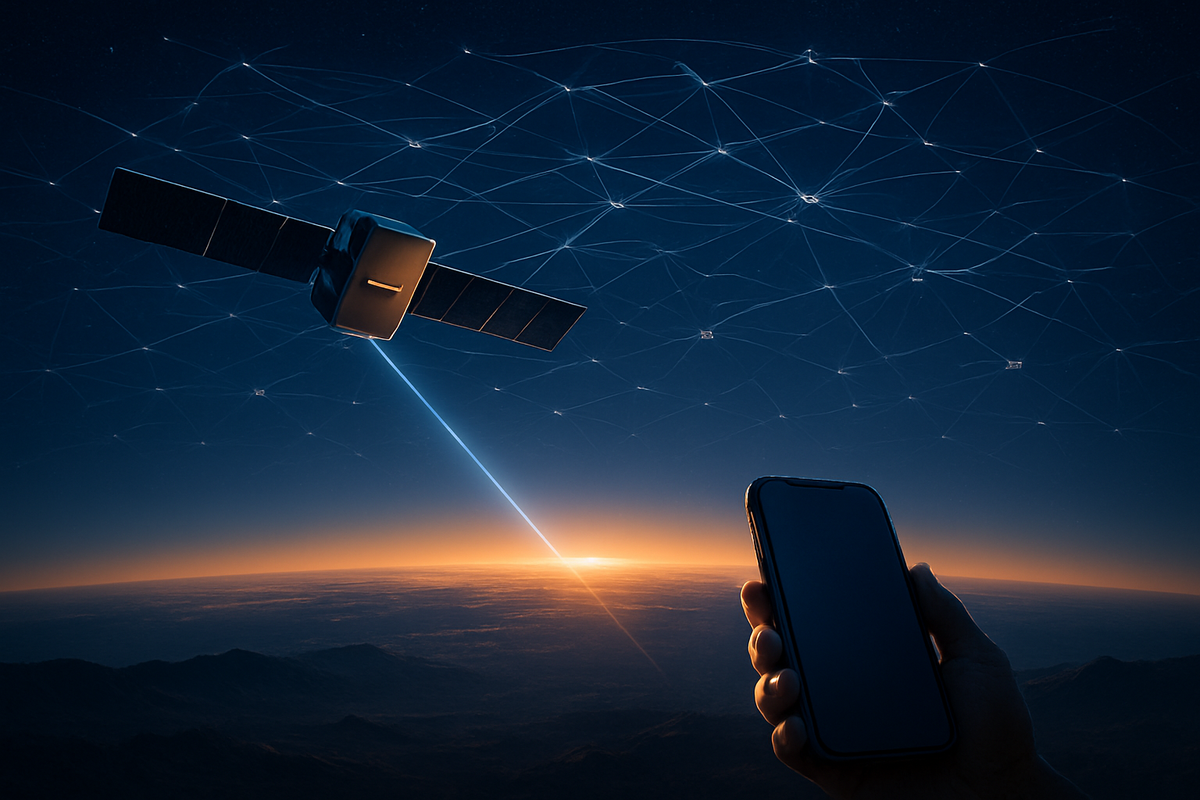
In a move that has fundamentally restructured the space economy, Amazon.com Inc. (NASDAQ: AMZN) announced yesterday, April 14, 2026, a definitive agreement to acquire satellite communications pioneer Globalstar Inc. (NYSE American: GSAT) for approximately $11.6 billion. The acquisition, valued at $90 per share, marks Amazon’s most aggressive play yet to challenge SpaceX’s dominance in the low Earth orbit (LEO) sector. Following the official announcement, shares of Globalstar surged 9.6%, reaching an 18-year high of $89.20 as investors cheered the massive premium and the strategic certainty provided by the tech titan.
This acquisition arrives at a critical juncture for Amazon’s satellite initiative, which was rebranded as "Amazon Leo" late last year. By absorbing Globalstar, Amazon gains immediate access to a seasoned operational fleet and, more importantly, a coveted portfolio of global S-band spectrum licenses. For the public and the market, this represents a shift from "Project Kuiper" being a theoretical competitor to a vertically integrated powerhouse capable of delivering direct-to-device (D2D) connectivity to billions of smartphones worldwide.
A Timeline of the Galactic Deal
The official merger announcement on April 14 was the culmination of weeks of intense market speculation. Rumors first surfaced on April 1, 2026, in a Financial Times report detailing high-level talks between Amazon CEO Andy Jassy and Globalstar leadership. Those initial reports sent Globalstar shares climbing 16% in a single session. The finalized deal, a mix of cash and Amazon common stock, offers Globalstar shareholders a significant exit after years of the company serving as the backbone for niche satellite features.
Key stakeholders have already signaled their support for the transition. Apple Inc. (NASDAQ: AAPL), which previously held a 20% stake in Globalstar and utilized its network for emergency satellite services, has signed a separate, long-term agreement with Amazon. Under this new alliance, Amazon Leo will now power the "Emergency SOS" and satellite messaging features for the iPhone and Apple Watch ecosystems. This partnership effectively neutralizes potential friction between the two tech giants, ensuring Apple maintains its satellite lead while Amazon secures a massive, ready-made user base for its nascent constellation.
Initial market reactions have been overwhelmingly positive for the principals involved, though the broader industry is still reeling. While Globalstar’s 9.6% jump stole the headlines, Amazon’s own stock remained resilient, up 1.2% as analysts praised the "spectrum shortcut" the deal provides. By acquiring existing licenses, Amazon avoids the multi-year regulatory slog of bidding for new frequencies, a move that many see as essential given the company’s looming FCC deadlines.
Winners and Losers in the New Space Race
The primary winner in this consolidation is undoubtedly Globalstar and its long-term investors, who have seen the stock price more than triple in 2026 alone. However, Apple also emerges as a significant victor. By transitioning from a junior partner in a small satellite firm to a preferred client of the Amazon Leo network, Apple secures future-proofed bandwidth for more data-intensive satellite features, such as satellite-based FaceTime and real-time navigation in "dead zones."
Conversely, independent satellite operators are facing a harsh new reality. AST SpaceMobile (NASDAQ: ASTS) saw its stock plummet 25% following the news. Investors are increasingly concerned that AST SpaceMobile, despite its technical head start in D2D technology, lacks the capital and the "Prime" ecosystem to compete with an Amazon-Apple-Globalstar triumvirate. While Iridium Communications Inc. (NASDAQ: IRDM) saw a brief speculative bump of 17.5% on hopes of a similar buyout from Google or Microsoft, the pressure is now on for these independent players to either scale rapidly or find a deep-pocketed suitor.
SpaceX and its Starlink service also face a formidable new challenger. While Starlink remains the clear leader in terms of sheer numbers—with over 10,000 satellites in orbit compared to Amazon Leo’s current count of approximately 241—Amazon’s acquisition of Globalstar gives it a more "controlled" path to D2D services. Unlike Starlink, which must partner with individual carriers like T-Mobile US Inc. (NASDAQ: TMUS) to use terrestrial spectrum, Amazon now owns the spectrum itself, potentially allowing for a more seamless global rollout of satellite-to-phone services without the need for regional carrier negotiations.
The Significance of Vertical Integration in Orbit
This event fits into a broader industry trend of vertical integration, where tech giants are no longer content to simply lease capacity but instead want to own the entire "stack"—from the satellites in the sky to the chips in the handsets. The Amazon-Globalstar merger effectively ends the experimental era of satellite-to-phone connectivity. It signals that the future of global telecommunications will be dominated by a duopoly of infrastructure giants: SpaceX and Amazon.
Regulatory implications remain the largest "wild card." Amazon is currently under pressure from the Federal Communications Commission (FCC) to meet its July 30, 2026, deadline to have half of its 3,232-satellite constellation in orbit. With only 241 production satellites currently operational, the Globalstar acquisition serves as a powerful argument for a deadline extension. Amazon can now claim that its acquisition of Globalstar’s existing assets provides "immediate public interest benefits," potentially swaying regulators who are keen to see a viable American competitor to Starlink’s dominance.
Historical precedents for this deal can be found in the early days of the cellular industry, where spectrum-rich but capital-poor regional carriers were eventually swallowed by giants like AT&T and Verizon. We are seeing a galactic-scale repetition of this pattern. The acquisition also highlights a growing rift between the "old space" satellite companies, which focused on broadcast and specialized hardware, and "new space" companies that view satellites as just another layer of the global internet and cloud infrastructure.
Navigating the 2027 Horizon
Looking ahead, the short-term focus will be on the regulatory approval process. The deal is expected to close in early 2027, pending reviews of spectrum license transfers and orbital debris mitigation plans. In the interim, Amazon must drastically accelerate its launch cadence. The market will be watching closely as Amazon leverages its recent contracts with United Launch Alliance and even its rival SpaceX to put more "Leo" satellites into the sky before the end of the year.
For consumers, the most significant shift will likely emerge in late 2027 or early 2028. We may see the introduction of "Prime Satellite," a premium tier of Amazon’s subscription service that provides worldwide emergency and basic data connectivity, regardless of cellular coverage. This would represent a massive pivot in how mobile data is sold and consumed, moving away from local carrier contracts toward global, platform-based connectivity.
Strategic adaptations will also be required from traditional mobile carriers. If Amazon and Apple can provide ubiquitous, basic connectivity via their own satellite networks, the "coverage map" ceases to be a competitive advantage for companies like T-Mobile or AT&T. These carriers may be forced to further integrate with satellite providers or focus entirely on high-density 5G/6G urban infrastructure, leaving the "rest of the world" to the LEO constellations.
Conclusion: A Final Assessment
The Amazon-Globalstar merger is more than just a corporate acquisition; it is the starting gun for the second phase of the satellite internet revolution. By spending $11.6 billion, Amazon has purchased something more valuable than satellites: time and spectrum. This deal ensures that Project Kuiper—now Amazon Leo—will have the regulatory and technical foundation to compete for the billions of devices currently in pockets around the world.
For investors, the coming months will be a period of "watch and wait" regarding Amazon’s launch execution. The 9.6% jump in Globalstar is a clear vote of confidence, but the true test lies in whether Amazon can successfully merge its high-bandwidth LEO ambitions with Globalstar’s existing D2D capabilities. Key metrics to monitor include the successful deployment of the next 500 Amazon Leo satellites and any further filings regarding the 2028 D2D service rollout.
As of April 15, 2026, the sky is no longer the limit; it is the new battlefield for the world's largest technology companies. The consolidation seen today likely won't be the last, as the race to provide truly global, un-interrupted connectivity becomes the central theme of the late 2020s tech economy.
This content is intended for informational purposes only and is not financial advice.