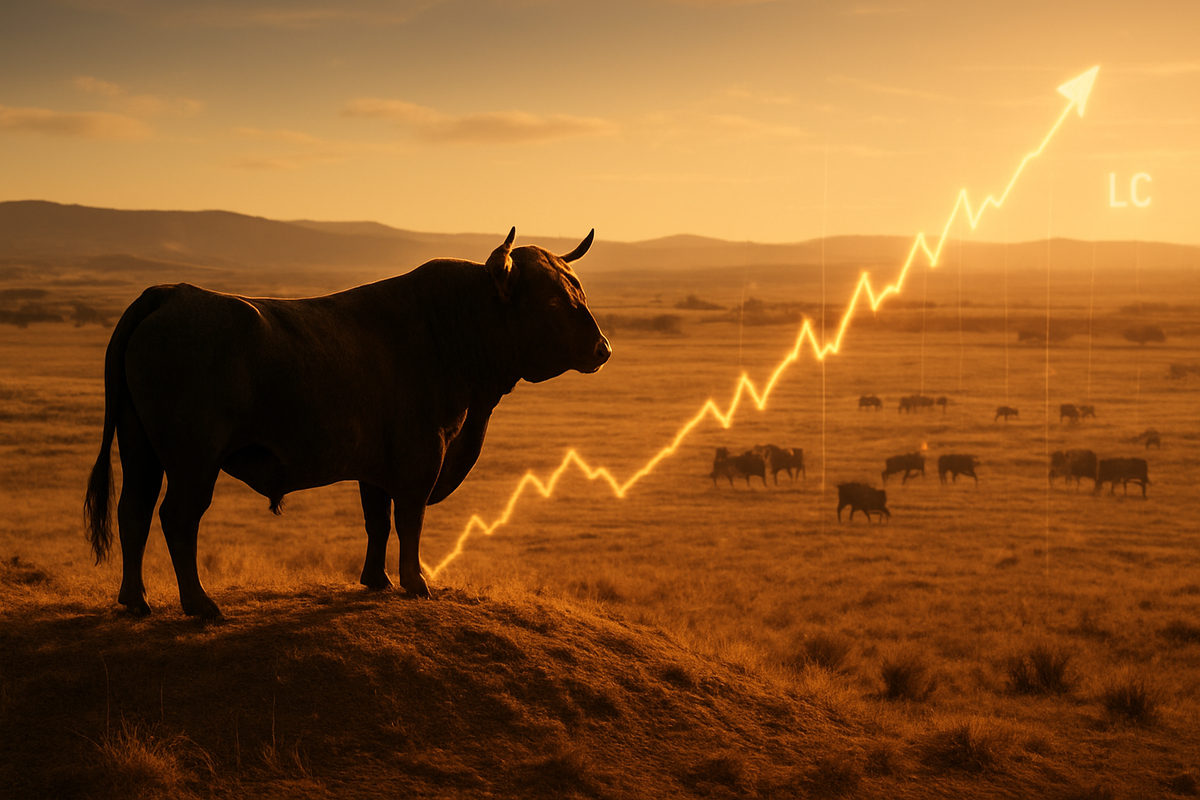
The American cattle market has entered uncharted territory this spring, with feeder cattle futures surging to a staggering record of $355 per hundredweight. This historic rally is the culmination of a "perfect storm" of supply-side constraints: a multi-year drought that forced massive herd liquidations, an 18-month trade disruption with Mexico, and a national cattle inventory that has officially dropped to its lowest level since 1951. As of April 15, 2026, the scarcity of beef has transformed from a regional concern into a systemic market shift, fundamentally altering the profit models of the nation's largest meatpackers and restaurant chains.
The immediate implications are stark. For the first time in modern history, the U.S. beef supply chain is operating at less than 85% capacity, driving "packer margins"—the spread between the cost of cattle and the price of processed beef—into deep negative territory. While the record-high futures offer a windfall for the few ranchers who managed to retain their stock through the recent droughts, the broader industry is reeling. Consumers are now facing retail prices for ground beef that frequently exceed $7.00 per pound, while premium cuts have pushed toward a psychological threshold of $15.00 per pound at traditional grocers.
The Perfect Storm: A Timeline of the Great Contraction
The road to $355 feeder cattle began in the summer of 2022, when a persistent "mega-drought" across the Southern Plains forced ranchers to sell off their breeding stock early. By early 2024, the U.S. cattle inventory had already fallen to roughly 87 million head, a level not seen in seven decades. However, the situation reached a breaking point in late 2024 and early 2025. A sudden outbreak of the New World Screwworm in Mexico led the USDA to implement an emergency ban on live cattle imports from America’s southern neighbor. This move effectively removed over one million head of feeder cattle from the U.S. supply chain, creating a vacuum that domestic producers have been unable to fill.
Throughout 2025, the market watched with growing alarm as the annual "calf crop"—the number of calves born in a year—fell to just 32.9 million, the smallest since the onset of World War II. As we move through April 2026, the scarcity has been exacerbated by a long-awaited shift in weather. Better grazing conditions in the Midwest have finally encouraged some ranchers to begin "heifer retention"—the process of keeping young females for breeding rather than selling them for beef. Paradoxically, this attempt to rebuild the herd for the future has further tightened the current supply, as those animals are pulled from the immediate market, sending futures prices on their current vertical trajectory.
Corporate Fallout: Margin Squeezes and Strategic Pivots
The impact of this supply shock is being felt unevenly across Wall Street. For major meat processors like Tyson Foods (NYSE: TSN), the cattle shortage has been bruising. Tyson, which derives a significant portion of its revenue from beef, reported staggering losses in its beef segment throughout late 2025 as the price they pay for live cattle far outpaced the price they could command for boxed beef. In response, Tyson has accelerated a multi-billion dollar pivot toward automation and its "Prepared Foods" and "Chicken" divisions to offset the volatility of the cattle cycle.
In contrast, global giants like JBS S.A. (NYSE: JBS) have fared slightly better by leveraging their international footprint. With the U.S. herd at record lows, JBS has increased its reliance on its Australian and Brazilian operations to satisfy global beef demand, effectively "hedging" against the domestic U.S. shortage. Meanwhile, in the restaurant sector, the strategy has been one of survival. Texas Roadhouse (NASDAQ: TXRH) has become a focal point for analysts; the company has famously chosen to "eat" the inflation, raising menu prices by less than 2% even as their beef costs surged by nearly 10%. This "traffic-first" strategy has kept their dining rooms full, but it has compressed restaurant-level margins to their lowest levels in a decade.
Other players are feeling the heat as well. Darden Restaurants (NYSE: DRI), which owns LongHorn Steakhouse, has shifted its marketing focus toward higher-margin poultry and pork items, while retail giants like Walmart (NYSE: WMT) and Costco (NASDAQ: COST) are increasingly looking to private-label beef programs and direct-to-rancher contracts to ensure consistent supply for their butcher cases.
Wider Significance: Demand Elasticity and the New Regulatory Landscape
The current crisis is rewriting the rules of beef demand. Historically, beef was considered "price elastic," meaning consumers would quickly switch to chicken or pork as prices rose. However, data from 2025 and early 2026 suggests a surprising resilience in beef demand. Despite record prices, the American consumer's appetite for "Choice" and "Prime" grade beef has remained robust, a trend analysts attribute to a high-protein dietary shift among younger generations. This inelasticity has allowed prices to reach these record heights without a total collapse in sales volume—so far.
On the policy front, the $355 futures mark has reinvigorated the debate over market concentration. On January 1, 2026, the USDA officially began enforcing the "Product of USA" labeling rule, which mandates that only beef born, raised, and slaughtered in the U.S. can bear the label. While intended to support domestic ranchers, the rule has arguably contributed to the price spike by limiting the "blending" of cheaper international beef into domestic ground beef supplies. Furthermore, the persistent price gap between what consumers pay and what ranchers receive (despite record futures) has led to renewed calls in Congress for the "Cattle Price Discovery and Transparency Act," aiming to break the "Big Four" processors' grip on price setting.
What Comes Next: The Long Road to Recovery
Looking ahead, the market is entering a "waiting game" that could last years. Unlike poultry, which can be replenished in weeks, or hogs, which take months, the biological lag of the cattle cycle means it will take at least three to four years of consistent herd rebuilding before beef production significantly increases. Experts suggest that cattle prices may remain at these elevated plateaus through 2027 and 2028.
For investors, the next 12 to 18 months will require a focus on "efficiency plays." Companies that can master supply chain logistics or offer alternative protein solutions will likely gain market share. We may also see a surge in "precision ranching" technology, as the high value of each individual animal makes it economically viable for ranchers to invest in advanced health monitoring and genetic optimization tools. The market will also be closely watching the USDA’s quarterly "Cattle on Feed" reports; any sign that heifer retention is slowing down would be a signal that the peak in prices may finally be in sight.
Summary and Investor Outlook
The surge of live and feeder cattle futures to record highs in April 2026 marks the peak of a historic contraction in the American agricultural heartland. With the national herd at a 75-year low, the industry is navigating a structural shift rather than a temporary spike. Key takeaways for the market include the continued margin pressure on domestic-heavy processors like Tyson Foods and the relative resilience of casual dining brands like Texas Roadhouse that have successfully maintained customer loyalty through the crisis.
Moving forward, the cattle market will likely act as a persistent driver of food inflation, keeping the Federal Reserve’s "higher-for-longer" interest rate narrative relevant. Investors should watch for the upcoming July USDA Inventory Report and monitor corn and soybean prices, as a rise in feed costs could derail the fragile herd-rebuilding process currently underway. For now, the "King of Meats" remains in a supply-driven bull market with no immediate ceiling in sight.
This content is intended for informational purposes only and is not financial advice.