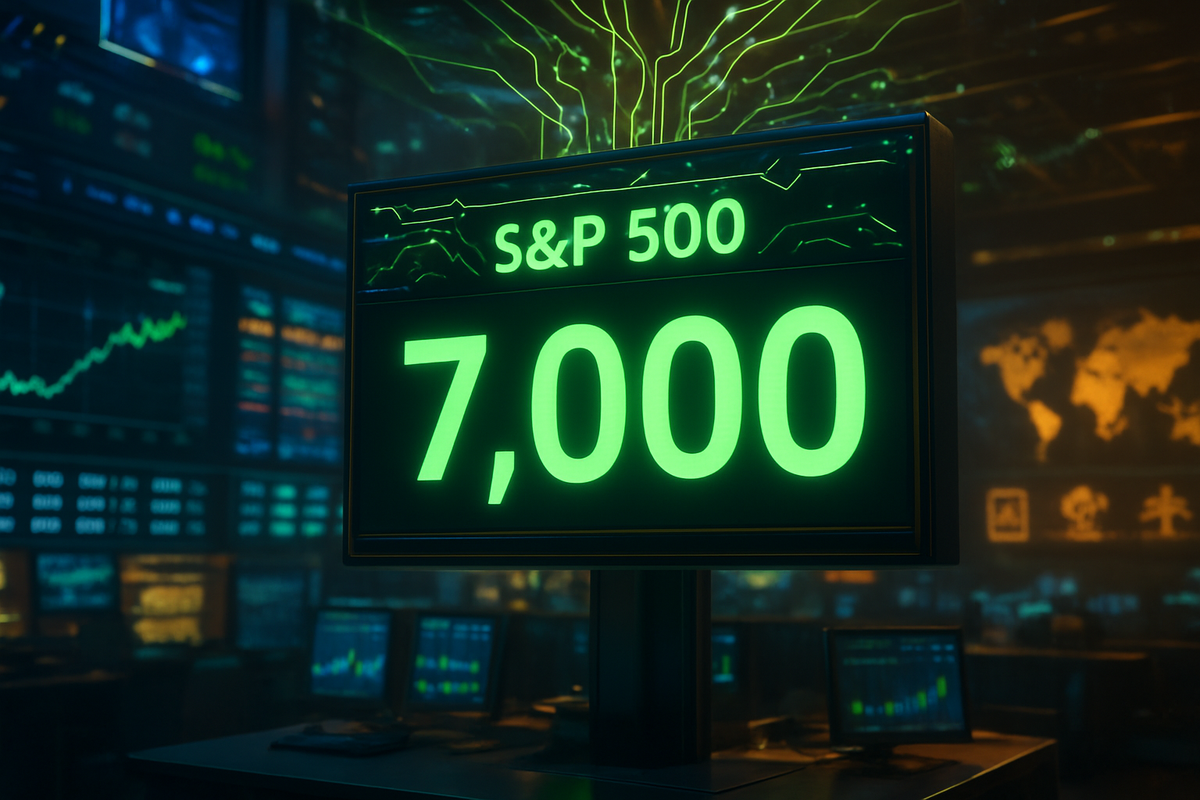
In a display of remarkable resilience that has caught many institutional bears off guard, the S&P 500 (^SPX) crossed the psychologically significant 7,000 level today, April 15, 2026. This mark represents the first time the index has traded above 7,000 since its peak in late January, signaling a robust recovery from a volatile first quarter characterized by energy shocks and a cooling labor market. As of mid-day trading, the index is hovering just points away from its all-time intraday high of 7,002.28, a record set on January 28, 2026.
The rally is particularly striking given the bleak macroeconomic backdrop of the last six weeks. Recent reports indicated that U.S. GDP growth was revised down to a mere 0.7% for the previous quarter, while the Consumer Price Index (CPI) recently spiked to 3.3% following a massive surge in energy prices. Despite these headwinds and the ongoing geopolitical instability in the Middle East, investors have flooded back into equities, particularly in the technology and financial sectors. This "wall of worry" climb suggests that the market’s focus has shifted from macro-fears to the concrete earnings potential of the next generation of artificial intelligence and a revitalized dealmaking environment on Wall Street.
A Spring Awakening: The Road Back to 7,000
The journey to today’s milestone has been a harrowing one for investors. After the S&P 500 peaked on January 28, the market was hit by a "perfect storm" of negative catalysts. In February, the tech sector was rocked by the so-called "SaaSpocalypse," a period where traditional software-as-a-service companies saw valuations crater as autonomous "Agentic AI" began to threaten the traditional per-seat licensing models. This was followed closely by a military escalation in the Middle East that led to a temporary blockade of the Strait of Hormuz, sending crude oil prices north of $110 per barrel and sparking fears of 1970s-style stagflation.
By early March, the index had retreated nearly 9% from its highs, bottoming out as unemployment figures hit a four-year high of 4.4%. However, the tide began to turn in late March following the stabilization of energy markets and a series of "blowout" preliminary earnings reports from hardware giants. The passage of the One Big Beautiful Bill Act (OBBBA) in mid-2025 also provided a structural floor for the market, as the permanence of corporate tax cuts began to be fully priced into long-term earnings models.
Key stakeholders, including major hedge funds and sovereign wealth funds, appear to have used the March dip as a generational buying opportunity. Initial reactions from floor traders at the New York Stock Exchange suggest that the move above 7,000 is backed by high trading volume, a technical indicator often used to confirm the validity of a breakout. While the Federal Reserve has remained hawkish, signaling only one or two potential rate cuts for the remainder of 2026, the market seems to have decoupled from interest rate sensitivity in favor of pure growth narratives.
Sector Titans: The Drivers of the 7,000 Breakout
The primary engines of this rally are found in the "Intelligence and Infrastructure" sectors. Nvidia Corp. (NASDAQ: NVDA) continues to be the market’s north star, with its stock trading near YTD highs as it begins mass shipping of its new "Rubin" architecture. As the "foundry of the intelligence age," Nvidia’s 75% gross margins have made it the ultimate hedge against inflation for many fund managers. Similarly, Microsoft Corp. (NASDAQ: MSFT) has seen a sharp reversal from its 21% YTD decline earlier this spring. Investors have regained confidence in Microsoft as it successfully integrated "Project Operator" autonomous agents across its commercial backlog, proving that it could pivot from seat-based revenue to outcome-based AI services.
On the financial front, the "Big Banks" have provided the necessary ballast for the S&P 500. JPMorgan Chase & Co. (NYSE: JPM) reported record trading revenue in Q1 2026, capitalizing on the extreme volatility in the oil and bond markets. Meanwhile, the Goldman Sachs Group Inc. (NYSE: GS) has signaled a "dealmaking renaissance," reporting a nearly 50% surge in investment banking fees as private equity firms finally began deploying their trillions in "dry powder" after a dormant 2025.
Conversely, the losers of this period remain the legacy software firms and consumer staples that have been unable to pass on rising energy costs to a softening labor market. Alphabet Inc. (NASDAQ: GOOGL) has faced continued pressure, with investors questioning its $180 billion capex guidance for 2026. While the broader index is rising, the internal divergence is stark: the market is ruthlessly rewarding companies with high capital efficiency and punishing those caught in the transition to the "Agentic AI" era.
The Significance of the "Resilience Trade"
This move past 7,000 is more than just a numerical milestone; it represents a fundamental shift in market psychology. In previous cycles, a spike in CPI combined with a rise in unemployment—the classic stagflation signal—would have sent the S&P 500 into a protracted bear market. Today’s breakout suggests that the market is viewing AI-driven productivity gains as a deflationary force strong enough to counteract rising nominal costs.
This event fits into the broader industry trend of "Agentic AI" adoption, where software is no longer a tool used by humans but an autonomous actor performing complex business tasks. This shift is rendering traditional economic metrics, like "output per hour," difficult to measure, leading some analysts to argue that GDP is being understated in the modern era. The ripple effects are being felt across global competitors, as European and Asian markets struggle to keep pace with the U.S. tech-heavy indices, further cementing the "American Exception" in global finance.
Historically, this period draws comparisons to the late 1990s, though with a critical difference: the current leaders are generating massive free cash flow rather than trading on "eyeballs" and hype. However, the regulatory landscape remains a wild card. With the Department of Justice’s ongoing antitrust actions against big tech and the looming implementation of the OBBBA’s trade provisions, the policy environment is as volatile as the market itself.
What Lies Ahead: Chasing the All-Time High
The immediate question for investors is whether the S&P 500 can find the momentum to eclipse the January 28 record of 7,002.28. Short-term possibilities include a period of "consolidation," where the index trades sideways as it digests the gains of the last two weeks. However, if Q1 earnings season continues to exceed expectations, a breakout toward 7,200 by early summer is not out of the question.
Strategic pivots will be required for those still holding "defensive" portfolios heavy in utilities and consumer staples. If the 7,000 level holds, we may see a massive "short squeeze" as bears are forced to cover their positions, potentially fueling a parabolic move upward. The primary challenge remains the Federal Reserve; if the Fed interprets the market’s strength as a sign that the economy is overheating, they may move from "higher for longer" to "even higher," a scenario that could abruptly end the party.
Market Outlook and Final Thoughts
The S&P 500’s return to the 7,000 level is a testament to the transformative power of the technology and financial sectors in the 2026 economy. The key takeaway for investors is the market’s apparent immunity to "traditional" bad news. While geopolitical tensions and high inflation remain real-world problems, the stock market has decided that the earnings power of the "Intelligence Age" is the more compelling story.
Moving forward, the market appears poised for further gains, but the path will likely remain volatile. Investors should keep a close eye on the 10-year Treasury yield and the price of crude oil, as any further spikes there could test the market's newfound resolve. For now, the bulls are back in control, and the 7,002.28 all-time high is squarely in the crosshairs.
This content is intended for informational purposes only and is not financial advice.