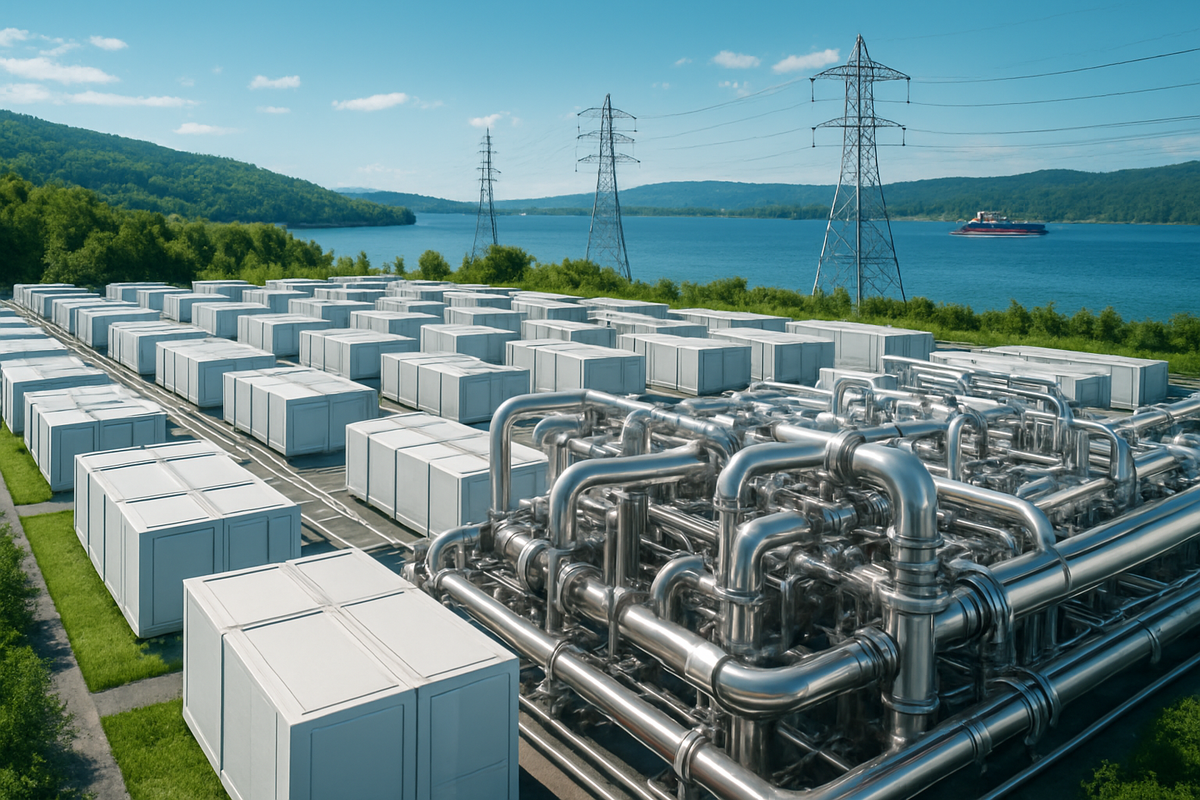
In a move that signals a massive shift toward industrial-scale decarbonization, Plug Power (NASDAQ: PLUG) has been selected by Hy2gen Canada Inc. to provide a 275 MW GenEco PEM electrolyzer system for the "Courant" project in Baie-Comeau, Québec. The announcement, made on April 2, 2026, represents one of the largest electrolyzer contracts in the company’s history and marks a pivotal moment for North America’s green hydrogen economy.
The deal highlights Plug Power’s growing influence in the production of green chemicals, as the hydrogen generated will be utilized to manufacture low-carbon ammonia and decarbonized ammonium nitrate. This initiative directly targets the "hard-to-abate" sectors of mining and agriculture, providing a domestic, sustainable alternative to carbon-intensive imported fertilizers and industrial explosives.
Scaling Up: The Courant Project and the Path to Baie-Comeau
The selection of Plug Power for the Courant project is the result of years of preliminary planning and engineering. Following a successful feasibility phase handled by Technip Energies, the project has now moved into the Front-End Engineering Design (FEED) stage with Plug’s GenEco technology at its core. The site in Baie-Comeau was strategically chosen for its proximity to the Hydro-Québec (NYSE: HQB - Note: Hydro-Québec is government-owned and does not trade as a public stock, but its bonds are widely held) grid and deep-water port access, facilitating both domestic distribution and potential future exports.
Plug Power will supply its proprietary Proton Exchange Membrane (PEM) electrolyzer technology, which is designed for modular scalability. These units will be manufactured at Plug’s state-of-the-art Rochester Gigafactory, proving that the facility can pivot from small-scale fuel cells to utility-scale industrial equipment. The project timeline is aggressive: following the FEED award today, a Final Investment Decision (FID) is expected by late 2026, with construction slated to begin in 2027 and full commissioning by 2029.
Market reaction has been swift and optimistic. Shares of Plug Power climbed over 7% in intraday trading, reaching a range of $2.30 to $2.40. Investors are viewing this contract as a "proof of concept" for Plug’s long-term viability, especially as the company works toward its goal of achieving positive EBITDA by the end of the 2026 fiscal year. Despite lingering concerns regarding the company’s historical cash burn and an April 3 legal deadline for a securities fraud class action, the 275 MW award provides much-needed fundamental support for the bull case.
Winners and Losers in the Green Hydrogen Land Grab
The primary winner in this announcement is undoubtedly Plug Power (NASDAQ: PLUG), which has faced skepticism regarding its ability to close large-scale electrolyzer deals. This contract solidifies its position as a top-tier global supplier and diversifies its revenue stream away from its traditional focus on material handling equipment for companies like Amazon (NASDAQ: AMZN) and Walmart (NYSE: WMT). By moving into the green chemical sector, Plug is tapping into a market with significantly higher volume requirements.
Hy2gen Canada Inc. and its parent company, Hy2gen AG, also emerge as key winners. By securing the technological backbone for the Courant project, they are positioning themselves as leaders in the Canadian energy transition. Similarly, the Québec government gains a flagship project to showcase its "Green Hydrogen and Bioenergy Strategy," attracting further industrial investment to the province. Conversely, competitors such as Nel ASA (OTC: NLLSF) and ITM Power (OTC: ITMPF) may feel the pressure, as Plug Power’s successful deployment at this scale could establish a "gold standard" for PEM technology in North American industrial projects.
However, the "losers" could potentially be traditional carbon-heavy ammonia producers who rely on steam methane reforming (SMR). As green hydrogen costs continue to fall and carbon taxes rise, traditional producers may find it increasingly difficult to compete with localized, decarbonized alternatives in the mining and agricultural sectors.
A Blueprint for Decarbonizing Heavy Industry
The significance of the 275 MW Québec project extends far beyond Plug Power’s balance sheet. It fits into a broader global trend of using hydrogen as a bridge to decarbonize industries that cannot be easily electrified. Producing green ammonium nitrate for mining explosives is a prime example of how hydrogen can clean up the supply chain of critical minerals—minerals that are themselves essential for the global energy transition, such as lithium and nickel.
Furthermore, the project reinforces the importance of "green hubs" where renewable energy sources, like Hydro-Québec’s hydroelectric power, intersect with industrial infrastructure. This follows a historical precedent set by European projects like the Port of Rotterdam’s hydrogen backbone. By integrating electrolysis directly into the chemical manufacturing process, the Courant project bypasses many of the transportation and storage hurdles that have historically slowed hydrogen adoption.
The regulatory environment in Canada has also played a crucial role. Federal and provincial incentives for clean energy technology have made Québec an attractive destination for these capital-intensive projects. This deal may serve as a catalyst for other provinces and U.S. states to accelerate their own hydrogen incentive programs to remain competitive in the race for "green" manufacturing.
The Road Ahead: FID and the 2030 Vision
In the short term, all eyes will be on the execution of the FEED contract and the upcoming Final Investment Decision in late 2026 or early 2027. Plug Power must demonstrate that it can meet the engineering requirements and deliver the modular units on schedule. Any delays in the Rochester Gigafactory’s output or unforeseen technical hurdles in the integration with the Hydro-Québec grid could dampen the current enthusiasm.
Long-term, the success of the Courant project could lead to a strategic pivot for Plug Power, where it becomes as much an industrial engineering firm as a technology provider. The company will likely seek to replicate the Québec model in other regions with abundant renewable energy, such as the Nordic countries or the American Pacific Northwest. The ultimate challenge will be achieving profitability; while massive contracts look good on the headline, the margins on utility-scale electrolyzer deployments will be under heavy scrutiny by analysts in the coming years.
Closing Thoughts: A Watershed Moment for Hydrogen
The selection of Plug Power for the 275 MW Courant project is a definitive marker for the maturity of the green hydrogen industry. It moves the conversation from "pilot projects" and "feasibility studies" to actual industrial-scale implementation. For Plug Power, it is a validation of its "Gigafactory" strategy and its ability to compete for the largest contracts in the world.
As the market moves forward, investors should keep a close watch on the company’s quarterly earnings to see how the revenue from this FEED contract begins to hit the books. Furthermore, the progress of the Hydro-Québec connection and any further partnerships in the mining or fertilizer sectors will be key indicators of the project's long-term impact. While risks remain, the 275 MW win in Québec has undeniably placed Plug Power at the forefront of the race to decarbonize the global industrial base.
This content is intended for informational purposes only and is not financial advice.