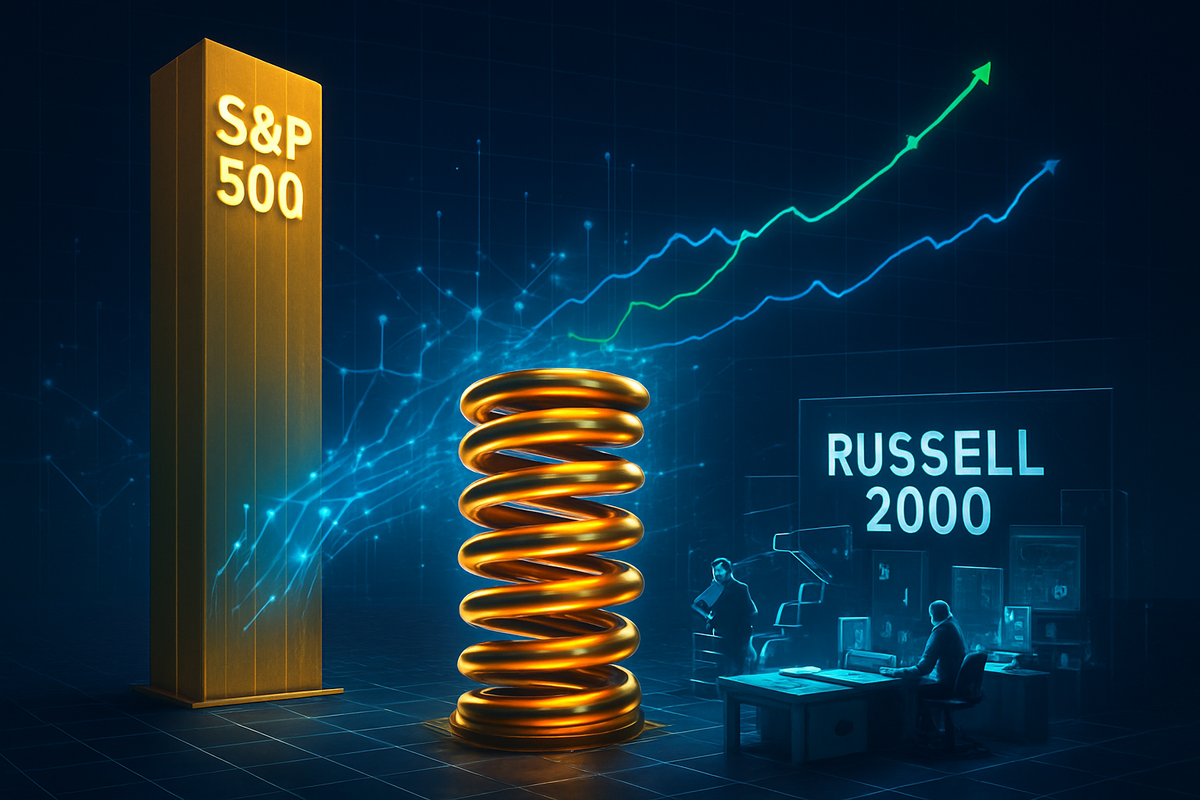
As of April 3, 2026, the American equity market is witnessing a historic "Great Rotation" that many analysts believe could define the latter half of the decade. For the first time in over a quarter-century, the valuation gap between the S&P 500 (INDEXSP:INX) and the Russell 2000 (INDEXRUSSELL:RUT) has reached a 25-year extreme. While the tech-heavy titans of the S&P 500 continue to command premium valuations, the small-cap sector is trading at a record 31% discount, creating what institutional traders are calling a "coiled spring" effect ready to snap.
This massive disparity isn't just a statistical anomaly; it represents a fundamental shift in how the market views productivity. While the 2023–2024 period was dominated by the creators of artificial intelligence, the current 2026 landscape is defined by the users of AI. Analysts argue that a "productivity-led catch-up" is now underway, as smaller firms finally reap the rewards of AI-integrated workflows, potentially closing the performance gap that has frustrated small-cap investors for years.
The Great Valuation Divide: A 25-Year Extreme
The current market environment reflects a divergence not seen since the peak of the dot-com bubble in 1999. As we enter the second quarter of 2026, the S&P 500 is trading at a forward price-to-earnings (P/E) ratio of approximately 28.2x, propped up by the enduring, though plateauing, dominance of mega-cap tech. Conversely, the Russell 2000 remains at a modest 19.5x. This 31% discount marks a radical departure from the historical norm where small caps—touted for their higher growth potential—usually commanded a premium.
This valuation chasm is the result of a multi-year "higher-for-longer" interest rate environment that spanned 2023 through mid-2025. Smaller companies, which typically carry more floating-rate debt, were disproportionately punished by the Federal Reserve's tightening cycle. However, following a series of rate cuts in late 2025 that brought the federal funds rate down to the 3.50%–3.75% range, the tide has begun to turn. The January 2026 "15-session winning streak" for the Russell 2000—the longest such streak since 1996—served as a technical confirmation that the market's internal mechanics are shifting.
The primary catalyst for this shift is the "AI Dividend." In the previous two years, market gains were concentrated in the providers of hardware and infrastructure, such as Nvidia (NASDAQ: NVDA) and Microsoft (NASDAQ: MSFT). Today, the focus has shifted to "The S&P 493" and the Russell 2000. Because small-cap companies often operate with thinner profit margins, even a 5% gain in efficiency through AI automation can lead to a 20% or 30% jump in net income. This disproportionate impact on the bottom line is fueling the thesis that small caps are the most attractive "productivity play" of 2026.
Winners and Losers in the K-Shaped Recovery
The "Great Rotation" is not lifting all boats equally. A "K-shaped" recovery has emerged within the small-cap universe, largely dictated by a company’s ability to navigate the "2026 Maturity Wall." With roughly $1.35 trillion in debt scheduled for refinancing this year, the "winners" are high-quality firms with stable cash flows, while the "losers" are the so-called "zombie companies" that relied on the era of zero-interest rates to survive.
In the biotech sector, the resurgence has been nothing short of explosive. Small-cap biotech firms are benefiting from a massive wave of M&A activity as Big Pharma looks to fill "patent cliffs." The recent $5.6 billion acquisition of Apellis Pharmaceuticals (NASDAQ: APLS) by Biogen (NASDAQ: BIIB) is a prime example of the premium being paid for small-cap innovation. Furthermore, AI has revolutionized drug discovery, cutting research cycles from years to months, allowing smaller firms to compete with giants.
Regional banks and industrials are also emerging as significant beneficiaries. Small-cap lenders like SouthState Corporation (NASDAQ: SSB) and Regions Financial Corporation (NYSE: RF) are seeing stabilized net interest margins as the yield curve steepens. Meanwhile, small-cap industrials are riding the tailwinds of the "One Big Beautiful Bill Act" (OBBBA) of 2025, which incentivized domestic manufacturing and R&D expensing. Companies like Mueller Water Products (NYSE: MWA) are seeing record order books as infrastructure and reshoring projects finally break ground.
Significance of the Productivity-Led Shift
The current valuation gap is significant because it signals the end of the "easy money" era and the beginning of the "efficiency era." For the past decade, market leadership was determined by who could grow the fastest regardless of cost. In 2026, leadership is being determined by who can optimize the best. This shift toward a productivity-led market has deep implications for the broader industry, forcing even the largest tech companies to justify their lofty valuations with more than just growth projections.
Historically, periods of extreme valuation discounts like the one we are seeing today have been followed by multi-year cycles of small-cap outperformance. Following the 2000 bubble, small-cap value stocks outpaced large-cap growth for nearly seven years. While the 2026 market is more technologically advanced, the psychological and mathematical principles of mean reversion remain the same. This rotation suggests that investors are moving away from "safety at any price" in large caps and toward "value through efficiency" in small caps.
There are also significant policy implications at play. The permanent R&D expensing provisions in recent legislation have effectively subsidized the digital transformation of small-cap America. By allowing smaller firms to write off AI investments immediately, the government has accelerated the closing of the productivity gap between the "haves" (large-cap tech) and the "have-nots" (small-cap industrials and services).
What Comes Next: Short-Term Volatility vs. Long-Term Mean Reversion
In the short term, investors should expect continued volatility as the "Maturity Wall" claims its victims. Not every company in the Russell 2000 will survive the transition to 6% refinancing rates. We will likely see a surge in small-cap bankruptcies among firms that failed to modernize, contrasting sharply with the record earnings of "Quality" small caps. This internal cleansing of the index is a necessary, albeit painful, step for long-term health.
Strategically, the next 12 to 18 months will likely see a pivot in investor sentiment toward "active management." While passive indexing worked during the large-cap bull run, the K-shaped nature of the 2026 small-cap recovery favors stock-pickers who can identify companies with clean balance sheets and high AI-adoption rates. The opportunity for alpha—returns above the market average—is currently higher in the Russell 2000 than at any point in the last two decades.
Potential scenarios for the remainder of 2026 include a "melt-up" in small-cap value if the Federal Reserve continues its easing cycle, or a more gradual "grind higher" if inflation remains sticky. However, the sheer size of the valuation discount provides a significant margin of safety. Even if the S&P 500 remains flat, the Russell 2000 could see a 15-20% gain simply by returning to its historical valuation average.
A New Era for Small-Cap Investors
The "coiled spring" of the small-cap market is finally beginning to release. The combination of record valuation discounts, a more favorable interest rate environment, and the transformative power of AI-driven productivity has created a perfect storm for the Russell 2000. While the "Magnificent Seven" will likely remain core holdings for many, the engine of market growth is shifting toward the thousands of smaller companies that power the broader economy.
Investors moving forward should focus on "Quality Small Cap" factors: strong cash flow, manageable debt maturity schedules, and clear AI implementation strategies. The era of broad, uncritical index buying in large-cap tech is giving way to a more nuanced, value-oriented approach. The "Great Rotation" of 2026 is not just a temporary trade; it is a structural realignment of the market toward productivity and fundamental value.
The coming months will be critical as the second-quarter earnings season reveals which small-cap firms are truly capturing the "AI Dividend." Watch for M&A activity in the biotech and tech sectors, as well as capital expenditure trends in industrials. For those who have been waiting for the small-cap catch-up, the wait appears to be over.
This content is intended for informational purposes only and is not financial advice.