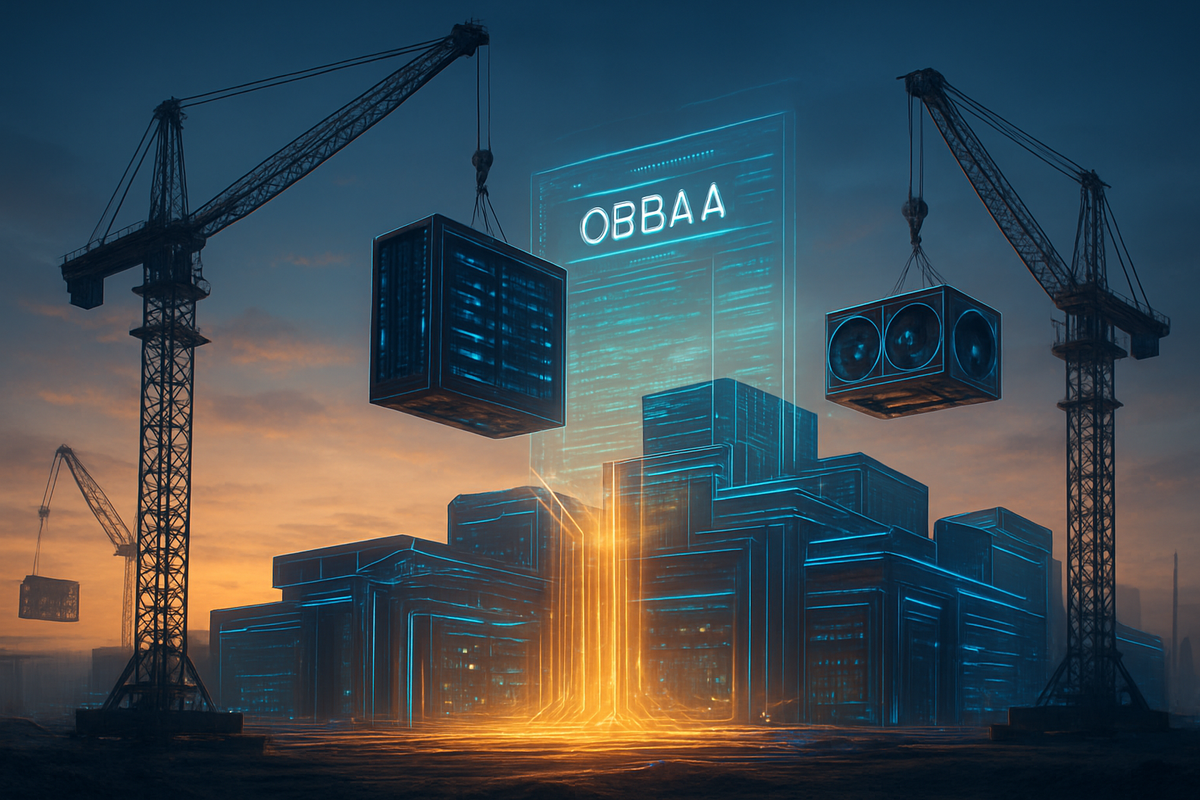
As of April 3, 2026, the financial markets are grappling with a paradigm shift in corporate spending, triggered by the "One Big Beautiful Bill" (OBBBA). This landmark tax package, signed into law on July 4, 2025, has effectively weaponized the U.S. tax code to accelerate the domestic artificial intelligence infrastructure. By restoring permanent 100% bonus depreciation for hardware and R&D expensing, the federal government has essentially provided a 20% discount on the massive data centers being erected across the country. The result is a capital expenditure (CapEx) wave of historic proportions, with the "Magnificent Seven" projected to spend an eye-watering $740 billion this year alone.
The immediate implications for the market are dual-edged. While the tax shields provided by the OBBBA have significantly improved the internal rate of return (IRR) for long-term AI investments, they have also pressured near-term free cash flow (FCF) margins. Investors are currently navigating a "spending fatigue" phase, rewarding companies that can self-fund this expansion while punishing those forced to tap debt markets to keep pace. As the first major tax filings under the new law hit the IRS this spring, the sheer scale of the fiscal stimulus is becoming clear, with Goldman Sachs (NYSE: GS) raising its S&P 500 year-end target to 7,600 on the back of a projected $100 billion in corporate tax refunds.
The Legislative Catalyst: From Phase-Down to Permanent Expensing
The path to the OBBBA was paved by years of corporate lobbying and a growing bipartisan consensus that American AI sovereignty required massive domestic hardware investment. The 2017 Tax Cuts and Jobs Act (TCJA) had originally scheduled bonus depreciation to phase down, dropping to 0% by 2027. However, the OBBBA abruptly reversed this trend, making 100% expensing permanent for any qualifying hardware—including GPUs, CPUs, and networking equipment—placed in service after January 19, 2025. This allows tech giants to write off the entire cost of a multi-billion dollar data center in Year 1, rather than spreading that deduction over half a decade.
Key stakeholders, including the CEOs of the "Hyperscalers," were instrumental in framing this bill as a national security necessity. By restoring Section 174 R&D expensing alongside the hardware bonus, the bill addressed the "cash flow cliff" that had plagued tech companies since 2022. The market's initial reaction in late 2025 was one of euphoria, but as we move into the second quarter of 2026, that sentiment has matured into a rigorous analysis of who is spending wisely. The "AI Digestion" narrative has taken hold, where the focus has shifted from the size of the "tax gift" to the efficiency of the capital being deployed.
Winners and Losers in the CapEx Arms Race
Microsoft (NASDAQ: MSFT) has emerged as the clear winner in the OBBBA era. Despite a projected 2026 CapEx budget of $150 billion, Microsoft remains the only hyperscaler expected to grow its free cash flow—by an estimated 5% this year. Because a high percentage of Microsoft’s spend is directed toward "short-lived assets" like Nvidia (NASDAQ: NVDA) H200 and B100 GPUs, it is maximizing the 100% expensing rule more efficiently than its peers. Analysts at Evercore ISI have noted that Microsoft's disciplined capital allocation allows it to lead the infrastructure charge without diluting its industry-leading margins.
In contrast, Amazon (NASDAQ: AMZN) is testing the limits of investor patience. In February 2026, the company announced a staggering $200 billion CapEx budget, causing its stock to slide 9% as analysts projected FCF to hit $0 or turn negative for the fiscal year. While the OBBBA provides Amazon with a roughly $40 billion tax shield, the sheer scale of its "land grab" for AWS infrastructure exceeds its current operating cash flow. Meanwhile, Alphabet (NASDAQ: GOOGL) sits in the middle; with a $180 billion CapEx guide, it remains FCF positive thanks to a $127 billion cash hoard, proving that a strong balance sheet is the best companion to aggressive tax incentives.
The 'Gigawatt Ceiling' and Broader Industry Shifts
The OBBBA’s impact extends far beyond the balance sheets of Big Tech. By making capital effectively "cheap" through tax offsets, the bill has shifted the primary constraint of the AI boom from money to power. Morgan Stanley (NYSE: MS) analysts have dubbed this the "Gigawatt Ceiling." With funding secured via tax refunds, tech giants are now competing for energy procurement, leading to a massive surge in the valuations of independent power producers and nuclear energy firms. This has created a ripple effect where the "OBBBA trade" now includes utility and grid infrastructure stocks.
Historically, this resembles the railroad booms of the 19th century or the fiber-optic buildout of the late 1990s, where government-incentivized over-investment led to a surge in productivity long after the initial bubble burst. However, the OBBBA is unique in its focus on domestic R&D. By reversing the amortization requirements for research costs, the bill has encouraged companies to keep their most advanced AI development on U.S. soil, creating a regulatory moat that makes it increasingly expensive for competitors to move operations offshore.
Navigating the 'AI Digestion' Period
Looking ahead, the market enters a critical window. In the short term, the OBBBA will continue to fuel record-breaking quarterly earnings for hardware suppliers like Dell Technologies (NYSE: DELL) and Super Micro Computer (NASDAQ: SMCI). However, the "CapEx Hangover" is a looming risk for 2027. If the software revenue from these AI investments does not materialize by the time the initial tax-driven buying spree slows down, the market could see a significant correction in the tech sector.
Strategically, companies are already pivoting. We are seeing a move toward "self-designed" silicon to lower the cost basis of hardware, further maximizing the tax benefits of the OBBBA. The next twelve months will likely see a series of strategic acquisitions as the cash-rich winners of this tax cycle—primarily Microsoft and Alphabet—look to snap up smaller AI startups that lack the scale to benefit from the OBBBA’s capital-intensive incentives.
Conclusion: The New Fiscal Reality for Investors
The "One Big Beautiful Bill" has succeeded in its primary goal: ensuring that the physical backbone of the AI era is built in America. For investors, the key takeaway is that the "tax floor" has changed the math of tech valuation. Capital expenditure is no longer just a cost; under the OBBBA, it is a strategic tax-management tool that improves long-term IRR. However, the divergence between Microsoft’s FCF growth and Amazon’s cash-neutral "land grab" highlights the importance of stock selection in this new environment.
Moving forward, the market will be watching two things: the "revenue-to-CapEx" ratio and the ongoing energy crisis. As the fiscal tailwinds from the OBBBA become baked into valuations, the pressure will be on Big Tech to prove that these hundreds of billions in hardware will actually translate into bottom-line growth. For now, the "One Big Beautiful Bill" has kept the AI engine running at full throttle, but the road ahead requires careful navigation of the cash-flow realities it has created.
This content is intended for informational purposes only and is not financial advice