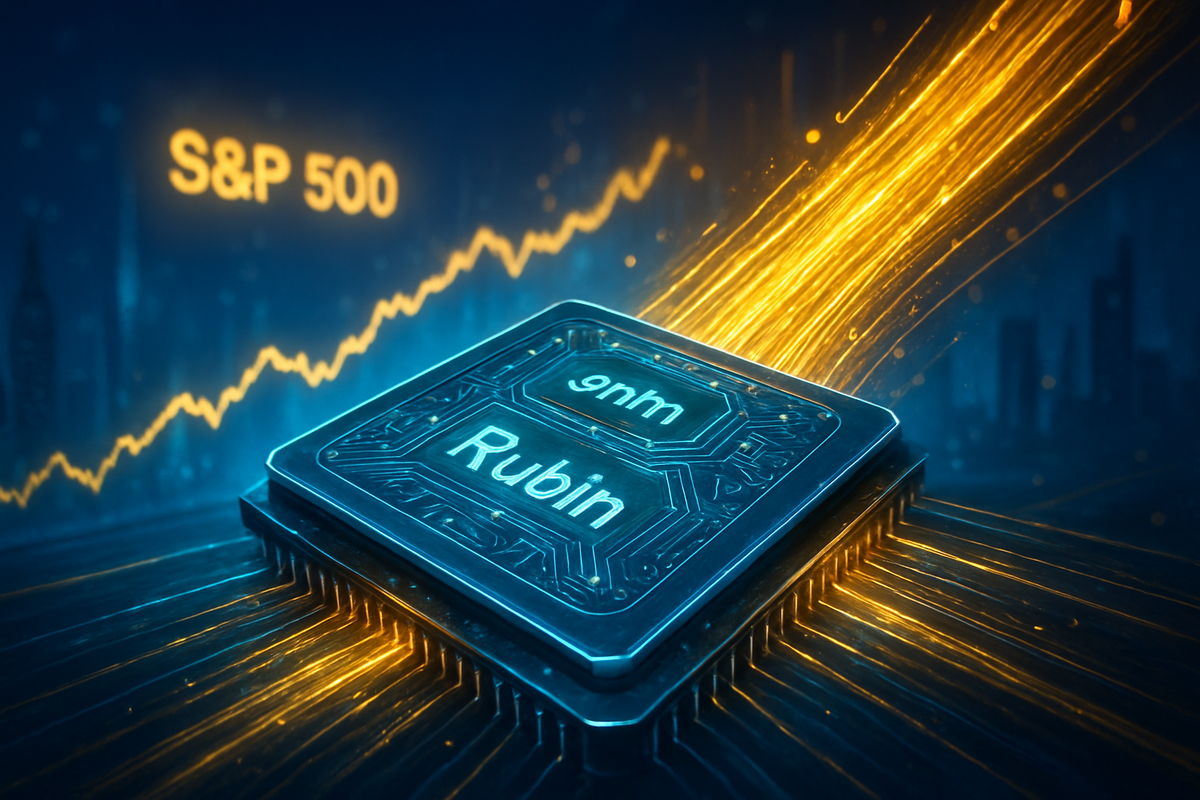
As of April 3, 2026, NVIDIA (NASDAQ: NVDA) has officially transcended its role as a mere semiconductor manufacturer to become the definitive engine of the global financial markets. Following a year where it accounted for nearly 16% of the S&P 500’s total returns, the company has kicked off the second quarter of 2026 with a technological and financial display of force that has left competitors and analysts alike in a state of awe. The catalyst for this latest surge is the formal transition to the "Rubin" platform, an architecture that promises to redefine AI compute efficiency just as the previous Blackwell generation becomes the industry standard for enterprise data centers.
The immediate implications of NVIDIA's current trajectory are staggering for the broader market. With the company now projected by major investment banks like Goldman Sachs to drive upwards of 46% of all S&P 500 profit growth in 2026, the index has effectively become a "single-stock economy." The market's health is now inextricably tied to NVIDIA’s ability to maintain its one-year product release cadence, a pace that has strained the global supply chain but rewarded those within NVIDIA’s inner circle with unprecedented capital inflows.
The Rubin Launch and the $23 Billion Supply Chain Surge
The primary driver of the current market fervor is the rollout of the Rubin platform, which NVIDIA began sampling to Tier-1 cloud providers in February 2026. Named after the pioneering astrophysicist Vera Rubin, the new architecture represents a significant leap from the Blackwell series, utilizing Taiwan Semiconductor Manufacturing Co. (NYSE: TSM) advanced 3nm (N3P) process. Early benchmarks suggest the Rubin GPU delivers a 2.5x increase in AI performance over its predecessor, achieving 50 PFLOPS of compute power. More importantly, it is the first platform to fully integrate HBM4 (High Bandwidth Memory 4), providing a massive 22 TB/s of bandwidth that addresses the primary bottleneck in large language model (LLM) inference.
Financial data released over the last month underscores the "unstoppable" nature of this momentum. In a recent disclosure, NVIDIA’s primary manufacturing partner, Hon Hai Precision Industry Co., Ltd. (OTC: HNHPF), also known as Foxconn, reported nearly $23 billion in monthly revenue for January 2026 alone, a figure largely attributed to the insatiable demand for AI server racks housing NVIDIA’s silicon. Simultaneously, NVIDIA’s own reports indicate it has reached a quarterly free cash flow milestone of $23 billion, a war chest that has enabled a massive $60 billion share repurchase program, further tightening the stock's supply and driving its valuation to new heights.
The timeline leading to this moment has been one of relentless execution. Since the late-2024 launch of Blackwell, NVIDIA has shortened its innovation cycle from two years to one. This "tock-tock" rhythm has forced the entire industry—from memory makers like SK Hynix (KRX: 000660) to cooling system providers—to align their capital expenditure with NVIDIA’s roadmap. Initial market reactions to the Rubin sampling have been overwhelmingly positive, with stock prices for key infrastructure partners jumping by double digits as they prepare for full-scale production in the second half of 2026.
Winners and Losers in the Wake of Rubin
The primary beneficiary of NVIDIA’s dominance remains Taiwan Semiconductor Manufacturing Co. (NYSE: TSM), which has seen High-Performance Computing (HPC) grow to represent 58% of its total sales. As the sole foundry for the Rubin 3nm chips, TSMC has become the ultimate gatekeeper of the AI revolution, raising its 2026 capital expenditure to a record $56 billion to keep pace with NVIDIA's orders. Similarly, SK Hynix (KRX: 000660) has secured its position as the dominant provider of HBM4 memory, reportedly capturing two-thirds of the initial demand for the Rubin platform, leaving rivals struggling to qualify their own high-bandwidth solutions.
In the server and infrastructure space, Super Micro Computer, Inc. (NASDAQ: SMCI) continues to ride NVIDIA’s coattails, leveraging its liquid-cooling expertise to support the massive heat loads generated by the new Vera Rubin racks. Smaller, specialized cloud providers like CoreWeave have also emerged as winners, recently announcing a $23 billion capital expenditure plan of their own to expand their fleet of NVIDIA GPUs, positioning themselves as the go-to alternative for developers who cannot secure capacity at the "Hyperscaler" clouds.
Conversely, the "losers" in this environment are those finding themselves marginalized by the CUDA software moat. Intel Corporation (NASDAQ: INTC) continues to struggle with its foundry transition and has seen its market share in the AI data center space remain stagnant despite the launch of its Gaudi 4 accelerators. While Advanced Micro Devices, Inc. (NASDAQ: AMD) has found success with its MI-series chips in the inference market, it still trails NVIDIA significantly in high-end training revenue. Furthermore, NVIDIA's contraction in the China market—where its share has fallen to 55% due to export restrictions—has created a vacuum that domestic players like Huawei are beginning to fill, representing a rare chink in the company’s global armor.
Broader Significance and Industry Trends
NVIDIA’s current dominance fits into a broader shift toward "Sovereign AI," where nations are building their own domestic AI infrastructure to ensure data security and economic competitiveness. This trend has moved the market beyond the initial "GenAI hype" phase into a phase of deep industrial integration. By launching Rubin just one year after Blackwell, NVIDIA is effectively preventing any competitor from gaining a foothold; by the time a rival releases a chip comparable to Blackwell, NVIDIA has already moved the goalposts with Rubin.
This rapid-fire innovation cycle has significant regulatory and policy implications. Lawmakers in both the U.S. and the EU are increasingly scrutinizing the "NVIDIA bottleneck," concerned that a single company holds the keys to the future of global productivity. However, as long as NVIDIA remains the primary contributor to the S&P 500’s growth, there is little appetite for aggressive antitrust action that could destabilize the broader financial markets. The historical precedent for this is limited; not even Cisco during the dot-com boom or Apple during the mobile revolution commanded such a high percentage of the market’s total earnings growth.
The ripple effects are also being felt in the energy sector. The power requirements for the Rubin platform are unprecedented, forcing a massive build-out of electrical grid infrastructure and driving demand for nuclear and renewable energy sources. Companies like Constellation Energy Corporation (NASDAQ: CEG) have seen their valuations rise as they strike deals to provide dedicated power to the data centers housing these high-performance clusters.
The Road Ahead: What Comes Next?
Looking toward the remainder of 2026 and into 2027, the focus will shift from the initial deployment of Rubin to the maturation of the software ecosystem surrounding it. Investors should expect NVIDIA to pivot more aggressively into the robotics and automotive sectors, using the Rubin architecture to power a new generation of autonomous machines. The rumored "Vera" roadmap for 2027 is already being discussed in hushed tones among developers, suggesting that NVIDIA has no intention of slowing down its one-year release cycle.
Strategic adaptations will be required from the "Hyperscalers" like Alphabet Inc. (NASDAQ: GOOGL) and Amazon.com, Inc. (NASDAQ: AMZN), who are caught in a delicate balance: they must buy NVIDIA’s latest silicon to remain competitive, yet they are simultaneously pouring billions into their own custom chips (TPUs and Trainium) to reduce their dependency on a single vendor. This tension will likely define the market dynamics of 2027, as the world waits to see if custom silicon can finally dent NVIDIA’s 80%+ market share.
Final Assessment for the Modern Investor
NVIDIA’s dominance as of April 2026 is a testament to the power of a vertical integration strategy combined with a relentless innovation cadence. The company has successfully turned its hardware into a platform, and its platform into an economy. With $23 billion in quarterly free cash flow and a stranglehold on the most critical components of the S&P 500's earnings, the company’s "unstoppable" momentum appears well-founded in both technological superiority and financial performance.
For investors, the coming months will require close monitoring of supply chain execution. Any delay in the mass production of HBM4 or yield issues at TSMC’s 3nm fabs could cause a temporary pullback in a stock that is currently priced for perfection. However, the sheer scale of the "Rubin Era" suggests that NVIDIA’s role as the engine of the global market is secure for the foreseeable future. The key takeaway is clear: in the AI-driven economy of 2026, as NVIDIA goes, so goes the market.
This content is intended for informational purposes only and is not financial advice.