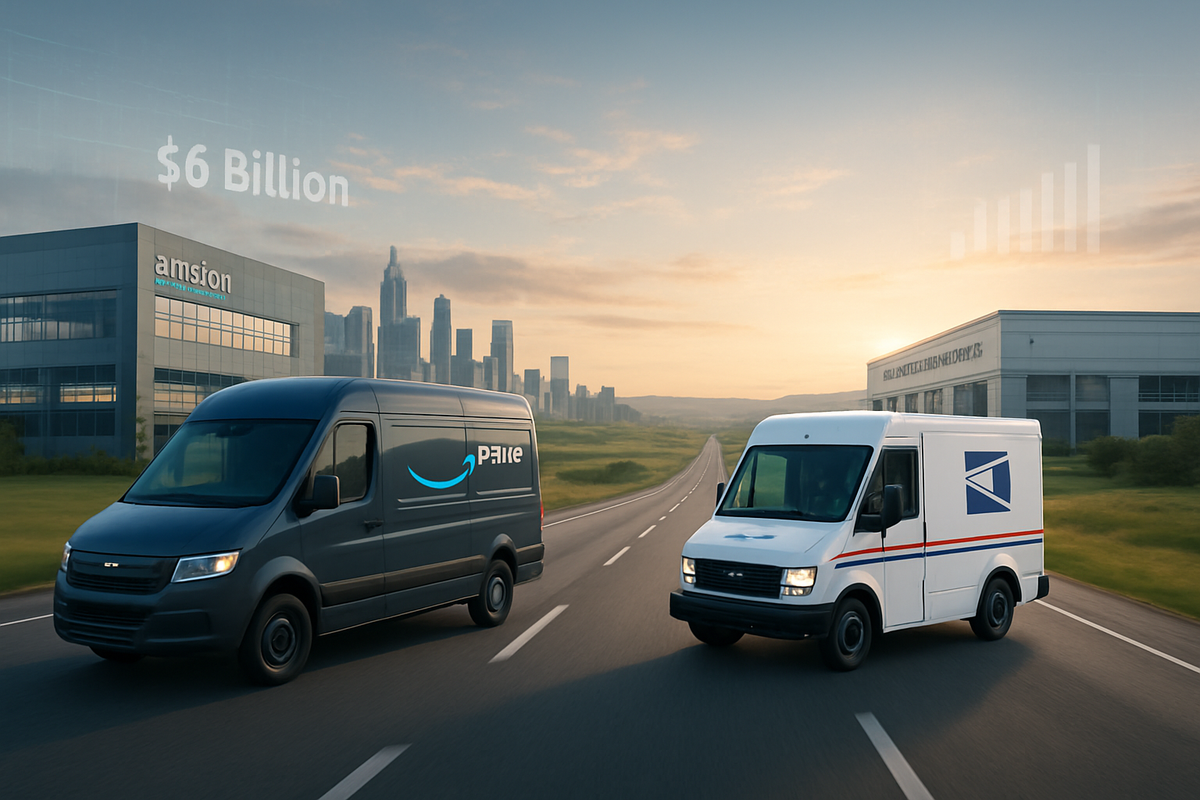
The long-running chess match between the world’s largest e-commerce entity and the nation’s primary mail carrier has reached a pivotal stalemate. On April 6, 2026, Amazon.com, Inc. (NASDAQ: AMZN) and the United States Postal Service (USPS) announced a tentative last-mile package-handling agreement that avoids a catastrophic "logistics divorce." The deal effectively reduces a previously threatened 66% volume cut by Amazon to a manageable 20% reduction, ensuring that the USPS continues to handle roughly 80% of Amazon’s current postal volume.
The implications of this compromise are immediate and profound. For the USPS, the agreement safeguards approximately $6 billion in annual revenue—a sum that accounts for nearly 8% of its total operating budget and is considered essential for the agency’s solvency through the end of the decade. For Amazon, the deal secures the "last-mile" reliability it requires to maintain its Prime delivery promises in rural and low-density regions where building a proprietary delivery fleet remains prohibitively expensive.
A High-Stakes Compromise in the "Deliver for America" Era
The negotiations leading up to this week's announcement were characterized by months of public posturing and private friction. At the heart of the conflict was the "Deliver for America" (DFA) plan, a decade-long modernization strategy initiated by former Postmaster General Louis DeJoy and continued by his successor, David Steiner. Under Steiner’s leadership, the USPS transitioned to a "competitive last-mile bidding system," essentially a reverse auction where major shippers must bid for access to postal delivery units. Amazon, which had long enjoyed preferential rates due to its massive scale, initially balked at the new market-priced terms, threatening to divert two-thirds of its volume to its own expanding "Amazon Logistics" network or to private competitors.
The timeline of the rift began in late 2025, when Amazon announced a $4 billion investment into its own rural delivery expansion, a move widely interpreted as a shot across the bow of the USPS. However, as the 2026 spring shipping season approached, the operational reality of bypassing the USPS’s 31,000 retail locations and 160 million delivery points proved daunting. The finalized agreement reflects a "middle path": Amazon will accept the higher market rates dictated by the Steiner administration's new bidding framework in exchange for a guaranteed "safety valve" during peak seasons and continued access to the most remote addresses in the United States.
Key stakeholders, including the Postal Regulatory Commission and various logistics unions, have signaled cautious optimism. The deal ensures that the USPS continues to handle over 1 billion packages annually for Amazon, preventing what analysts had described as an "existential peril" for the agency’s universal service obligation.
Winners and Losers: The Logistics Landscape Shifts
The primary winner in this agreement is arguably the USPS itself. By successfully calling Amazon's bluff regarding a total exit, the Postal Service has validated its new market-pricing model. The protected $6 billion in revenue is expected to be funneled directly into the agency’s transition toward an all-electric delivery fleet and the consolidation of its processing centers. Without this deal, the USPS would have likely faced a $9 billion deficit in the coming fiscal year, potentially forcing congressional intervention or drastic service cuts.
Amazon.com, Inc. (NASDAQ: AMZN) emerges with its logistics stability intact. While it will pay more per package than it did under previous negotiated service agreements (NSAs), it avoids the massive, immediate capital expenditure that would have been required to replace the USPS’s rural reach overnight. This "dual-track" strategy—expanding its own network while maintaining a deep partnership with the USPS—allows Amazon to scale at its own pace without risking the customer dissatisfaction that follows delayed or missed deliveries in non-urban areas.
Conversely, private carriers like United Parcel Service, Inc. (NYSE: UPS) and FedEx Corporation (NYSE: FDX) saw their stocks dip by approximately 1% following the news. Investors had speculated that a complete breakdown between Amazon and the USPS would result in a "volume windfall" for these private firms. However, the retention of the Amazon-USPS partnership closes that window. Analysts note that both UPS and FedEx have spent the last two years pivoting away from low-margin residential e-commerce anyway, focusing instead on high-margin healthcare and industrial logistics, meaning the "loss" of potential Amazon volume may be a blessing in disguise for their long-term margins.
Broader Industry Trends and Regulatory Ripples
This agreement marks a significant turning point in the "marketization" of the U.S. Postal Service. For decades, the USPS was viewed as a subsidized infrastructure for giant retailers. The 2026 deal signals that the agency is now successfully operating as a competitive corporate entity, capable of leveraging its unique network density to demand fair market value from even the most powerful tech giants. This shift is likely to set a precedent for other major shippers, such as Target and Walmart, who will now face similar market-priced bidding for their last-mile needs.
The deal also highlights a cooling of the "delivery wars." After years of aggressive vertical integration, Amazon appears to have recognized the diminishing returns of total logistics independence. The 20% volume cut is strategic; it allows Amazon to "cream-skim" high-density urban routes where its own drivers are most efficient, while leaving the high-cost, low-density routes to the USPS. This symbiotic—if tense—relationship is becoming the standard model for modern e-commerce: proprietary networks for density, and postal partnerships for reach.
What Comes Next: Rural Expansion and Automation
In the short term, market watchers should expect Amazon to continue its $4 billion rural infrastructure build-out, albeit at a more measured pace. The 20% volume reduction will likely be phased in over the next 18 months, giving the USPS time to adjust its labor schedules. For consumers, the increased costs Amazon is paying to the USPS may eventually manifest as higher Prime membership fees or a shift in "free shipping" thresholds as the company seeks to offset its rising logistics expenses.
Long-term, the focus will shift to automation. The USPS is currently in the middle of a massive rollout of its new "Sorting & Delivery Centers," which are designed to handle the exact type of high-volume package flow this agreement guarantees. Simultaneously, Amazon is accelerating its drone delivery and autonomous ground vehicle pilots in the very rural areas it is currently paying the USPS to service. The current agreement likely buys both parties 3–5 years of stability before the next technological disruption forces another round of renegotiations.
Summary and Investor Outlook
The April 2026 Amazon-USPS agreement is a landmark compromise that provides a fiscal bridge for the Postal Service and operational security for the world’s largest retailer. By reducing a 66% volume threat to a 20% reality, both entities have avoided a logistics vacuum that would have crippled U.S. e-commerce. The protection of $6 billion in postal revenue is the most significant takeaway for those concerned with the stability of national infrastructure.
Moving forward, investors should keep a close eye on the USPS's quarterly financial reports to see if the new "market-priced" bids from Amazon effectively narrow the agency's deficit. For Amazon (NASDAQ: AMZN), the focus remains on whether the company can maintain its industry-leading margins while paying higher rates for the "last mile." The era of "cheap" postal delivery for tech giants has officially ended, replaced by a more mature, competitive, and financially transparent partnership.
This content is intended for informational purposes only and is not financial advice.