As the Seattle Seahawks and New England Patriots prepare to take the field for Super Bowl LX at Levi’s Stadium in Santa Clara, California, a quiet financial revolution is unfolding in the stands and across the Golden State. Despite California’s long-standing and contentious ban on traditional sports betting, residents are currently pouring millions of dollars into a "legal loophole" that the state’s powerful gambling interests never saw coming.
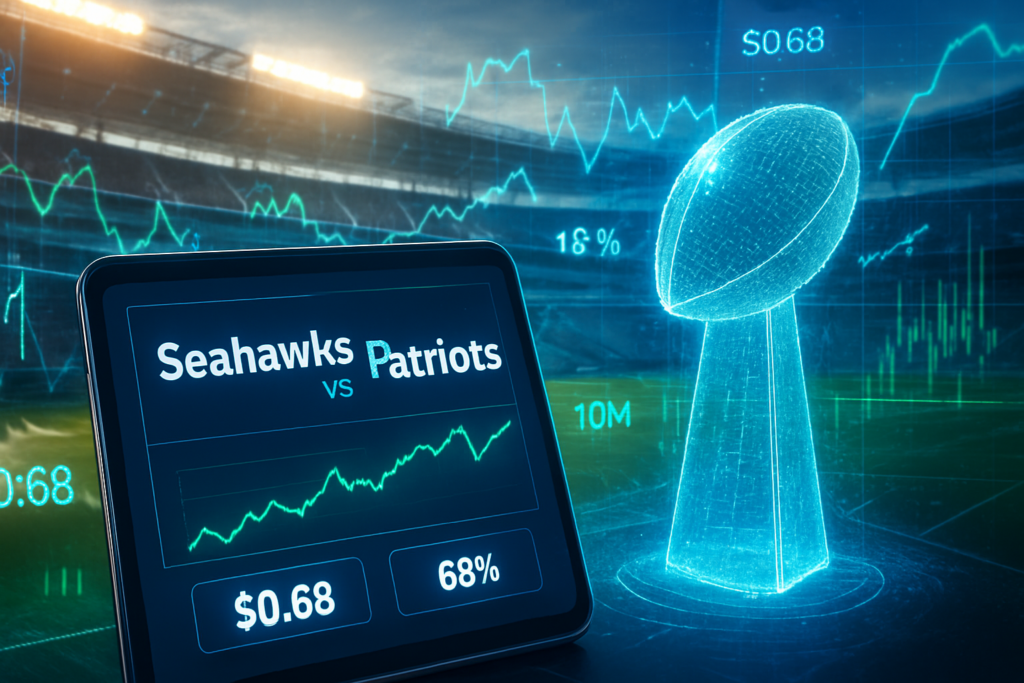
The focal point of this activity is Kalshi, a federally regulated prediction market that has effectively bypassed state prohibitions by offering "event contracts" rather than traditional wagers. As of February 1, 2026, market data shows the Seahawks favored with a 68% probability of victory, with shares trading at approximately $0.68. This market isn't just a niche hobby; it has become a massive financial engine, signaling a paradigm shift in how Americans interact with sporting outcomes in states where sportsbooks remain illegal.
The Market: What's Being Predicted
The headline event on Kalshi is the "Winner of Super Bowl LX" contract, which has seen its liquidity explode over the final weeks of the postseason. Trading volume for the Seahawks vs. Patriots matchup has officially surpassed $150 million, a staggering 450% increase from the volume recorded during Super Bowl LIX just one year ago. Unlike traditional sportsbooks like DraftKings Inc. (NASDAQ: DKNG) or Flutter Entertainment plc (NYSE: FLUT)—which are geofenced out of California—Kalshi’s status as a Designated Contract Market (DCM) allows it to operate under the oversight of the Commodity Futures Trading Commission (CFTC).
The market functions as a binary "Yes/No" proposition: will the Seattle Seahawks win? If a trader buys a "Yes" share at $0.68 and the Seahawks win, the contract pays out $1.00. If they lose, the contract expires at $0.00. Beyond the game-winner, the platform has expanded into hyper-specific prop markets, including:
- Super Bowl MVP: Significant volume has shifted toward Seahawks quarterback Sam Darnold and Patriots rookie sensation Drake Maye.
- Halftime Show Logistics: Markets are currently trading on whether Bad Bunny will perform specific hits or bring out unannounced guests.
- Economic Impact: Contracts predicting the local tax revenue generated for the city of Santa Clara and the stock performance of stadium sponsor Levi Strauss & Co. (NYSE: LEVI) on the Monday following the game.
Why Traders Are Betting
The surge in betting activity is driven by a unique confluence of fan enthusiasm and sophisticated hedging strategies. Because these are technically "derivatives" rather than "bets," they have attracted a different class of market participant. Institutional traders and "whales" are using the Seahawks-Patriots market to hedge against economic shifts related to the NFL’s $13 billion annual revenue stream.
The current odds—giving the Seahawks a clear edge—are being influenced by Seattle’s dominant defensive metrics and the "home-coast advantage." However, the Patriots' odds saw a 5% jump last week following news of a minor injury to Seattle’s starting left tackle. For Californians, the appeal is simpler: Kalshi represents the only legal, regulated avenue to have "skin in the game" without turning to offshore black-market sites or driving across the border to Arizona or Nevada. This "gray window" has turned prediction markets into a primary source of truth for real-time sentiment, often reacting faster to injury news than traditional sports media outlets.
Broader Context and Implications
The "California Loophole" is the result of a landmark shift in federal regulatory policy. Historically, the CFTC fought to keep sports out of prediction markets, but the tide turned in early 2026 under the leadership of newly appointed CFTC Chairman Michael Selig. Selig’s decision to withdraw proposed bans on sports event contracts has effectively signaled a "hands-off" approach from the federal government, arguing that the Commodity Exchange Act (CEA) grants the CFTC exclusive jurisdiction that preempts state gambling laws.
This has infuriated both state lawmakers and the NFL. The league, which has long guarded its intellectual property and integrity standards, has officially banned Kalshi and its competitor Polymarket from purchasing ad space during the Super Bowl LX broadcast on Comcast Corporation's (NASDAQ: CMCSA) NBC. Representative Salud Carbajal (D-CA) has been a vocal critic, arguing that these markets undermine California's sovereignty and lack the consumer protections mandated by state-regulated gaming commissions. Furthermore, California’s influential gaming tribes have filed multiple lawsuits, alleging that Kalshi is infringing on their exclusive rights to offer gaming in the state—a legal battle that is currently winding its way through the appellate courts.
What to Watch Next
All eyes are now on the 9th Circuit Court of Appeals, which is scheduled to hear a pivotal case regarding "federal preemption" in April 2026. This ruling will determine if California has the right to shut down Kalshi's operations despite its federal DCM status. If the court rules in favor of the state, the $150 million Seahawks-Patriots market could be the last of its kind in California. If it rules for Kalshi, it could force California to finally legalize and tax traditional sports betting to compete with the "federal loophole."
In the immediate term, traders should monitor the "Super Bowl MVP" markets. Historically, these markets are highly volatile in the 48 hours preceding kickoff as "insider" sentiment regarding game plans begins to leak. Additionally, any late-breaking news regarding the Levi’s Stadium turf conditions—a recurring theme in Santa Clara—could cause a 2-3% swing in the win-probability contracts.
Bottom Line
The $150 million pouring into the Seahawks vs. Patriots market is more than just a series of wagers; it is a live-fire test of the American regulatory framework. Kalshi has successfully utilized its federal status to crack open one of the most protected markets in the world, proving that where there is a demand for forecasting, capital will find a way to flow.
While the NFL and California lawmakers remain in a defensive crouch, the sheer volume of participation suggests that the public has already voted with their wallets. Whether Super Bowl LX ends with a Seahawks victory or a Patriots upset, the real winner may be the prediction market industry, which has finally moved from the fringes of political "election betting" into the heart of the American cultural mainstream.
This article is for informational purposes only and does not constitute financial or betting advice. Prediction market participation may be subject to legal restrictions in your jurisdiction.
PredictStreet focuses on covering the latest developments in prediction markets.
Visit the PredictStreet website at https://www.predictstreet.ai/.