Let’s dig into the relative performance of JPMorgan Chase (NYSE: JPM) and its peers as we unravel the now-completed Q4 diversified banks earnings season.
At their core, diversified banks take in deposits and engage in various forms of lending, which means revenue is generated through interest rate spreads (difference between loan and deposit rates) and fees. Other revenue comes from adjacent services such as wealth management, card and account fees, and products such as annuities. These institutions benefit from rising interest rates that improve NIMs (net interest margins), digital transformation reducing operational costs, and expanding wealth management services as populations age. However, they face headwinds including fintech competition disrupting traditional models (how disruptive is crypto?), stringent regulatory requirements increasing compliance costs, and cybersecurity threats requiring substantial technology investments. Economic downturns also pose risks through potential loan defaults and compressed margins during accommodative monetary policy periods.
The 7 diversified banks stocks we track reported a mixed Q4. As a group, revenues were in line with analysts’ consensus estimates.
While some diversified banks stocks have fared somewhat better than others, they have collectively declined. On average, share prices are down 2.9% since the latest earnings results.
JPMorgan Chase (NYSE: JPM)
Tracing its roots back to 1799 when its earliest predecessor was founded by Aaron Burr, JPMorgan Chase (NYSE: JPM) is a leading financial services company offering investment banking, consumer banking, commercial banking, and asset management services globally.
JPMorgan Chase reported revenues of $46.77 billion, up 6.9% year on year. This print was in line with analysts’ expectations, but overall, it was a slower quarter for the company with a significant miss of analysts’ EPS estimates and tangible book value per share in line with analysts’ estimates.
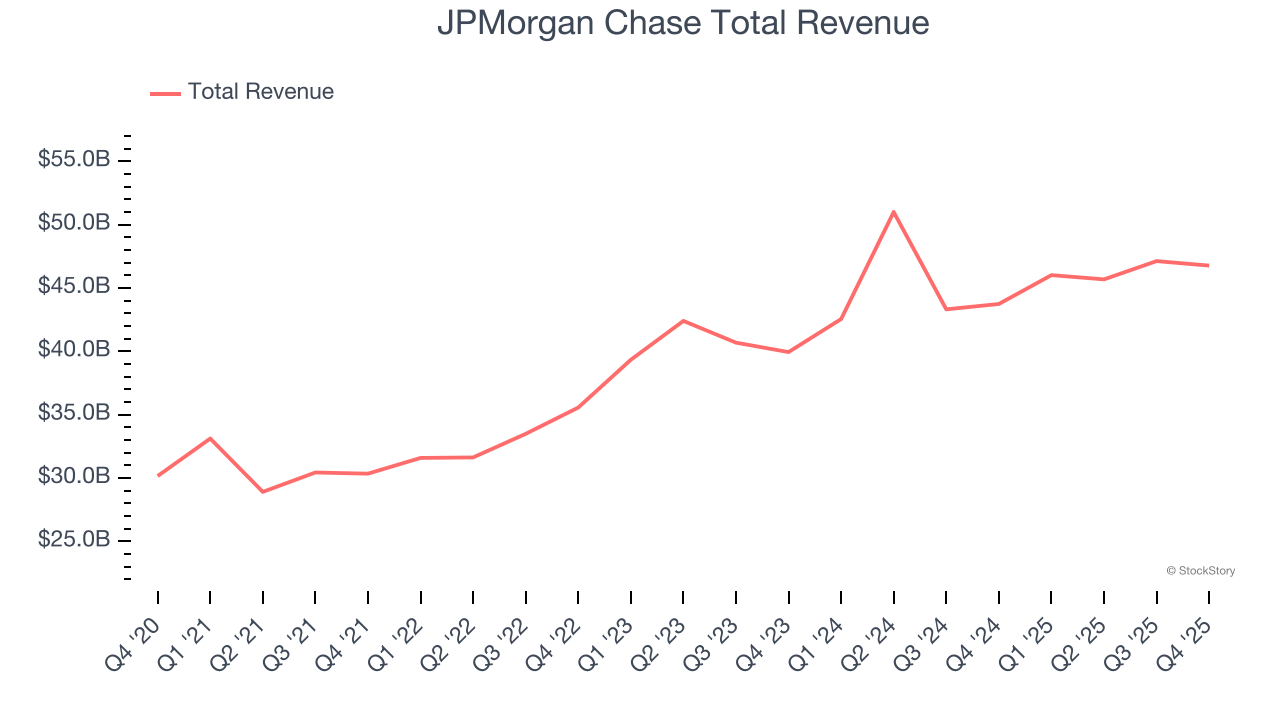
Unsurprisingly, the stock is down 8.2% since reporting and currently trades at $297.84.
Read our full report on JPMorgan Chase here, it’s free.
Best Q4: PNC Financial Services Group (NYSE: PNC)
Tracing its roots back to 1852 when Pittsburgh's industrial boom demanded stronger financial institutions, PNC (NYSE: PNC) is a diversified financial institution that provides retail banking, corporate banking, and asset management services through a coast-to-coast branch network.
PNC Financial Services Group reported revenues of $6.10 billion, up 9% year on year, outperforming analysts’ expectations by 2.2%. The business had a very strong quarter with a beat of analysts’ EPS estimates and an impressive beat of analysts’ tangible book value per share estimates.
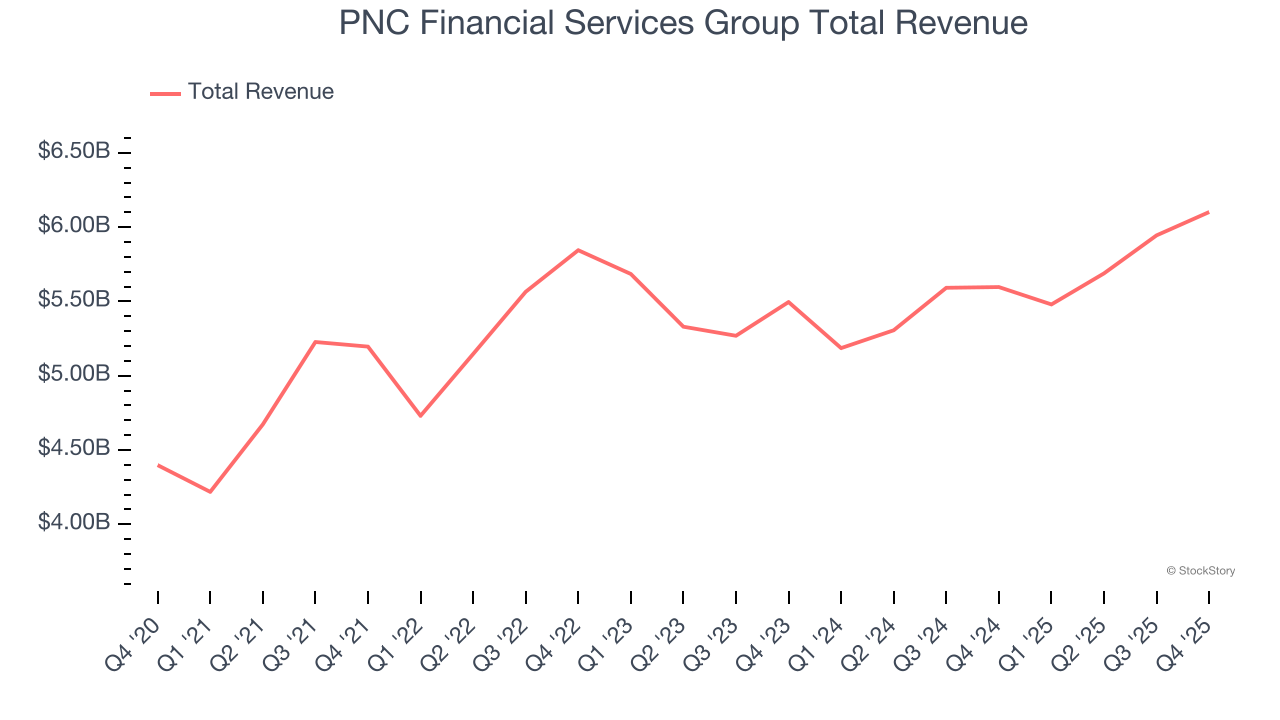
PNC Financial Services Group scored the fastest revenue growth among its peers. The market seems content with the results as the stock is up 3.3% since reporting. It currently trades at $222.20.
Is now the time to buy PNC Financial Services Group? Access our full analysis of the earnings results here, it’s free.
Weakest Q4: Citigroup (NYSE: C)
With operations in nearly 160 countries and a history dating back to 1812, Citigroup (NYSE: C) is a global financial services company that provides banking, investment, wealth management, and payment solutions to consumers, corporations, and governments.
Citigroup reported revenues of $19.9 billion, up 2.1% year on year, falling short of analysts’ expectations by 2.7%. It was a slower quarter as it posted a significant miss of analysts’ revenue estimates and a significant miss of analysts’ EPS estimates.
Citigroup delivered the weakest performance against analyst estimates and slowest revenue growth in the group. As expected, the stock is down 4.7% since the results and currently trades at $110.86.
Read our full analysis of Citigroup’s results here.
Wells Fargo (NYSE: WFC)
Founded during the California Gold Rush in 1852 to provide banking and express delivery services to miners and merchants, Wells Fargo (NYSE: WFC) is a diversified financial services company that provides banking, lending, investment, and wealth management services to individuals and businesses.
Wells Fargo reported revenues of $21.37 billion, up 4.4% year on year. This result missed analysts’ expectations by 1.3%. It was a slower quarter as it also produced a slight miss of analysts’ revenue estimates and a slight miss of analysts’ net interest income estimates.
The stock is down 9% since reporting and currently trades at $85.15.
Read our full, actionable report on Wells Fargo here, it’s free.
Truist Financial (NYSE: TFC)
Born from the 2019 merger of BB&T and SunTrust in one of the largest banking combinations since the 2008 financial crisis, Truist Financial (NYSE: TFC) is a bank holding company that offers a wide range of financial services including consumer and commercial banking, wealth management, insurance, and lending solutions.
Truist Financial reported revenues of $5.30 billion, up 3.6% year on year. This number met analysts’ expectations. Zooming out, it was a slower quarter as it logged a slight miss of analysts’ net interest income estimates and a narrow beat of analysts’ EPS estimates.
The stock is up 2% since reporting and currently trades at $50.14.
Read our full, actionable report on Truist Financial here, it’s free.
Want to invest in winners with rock-solid fundamentals? Check out our Top 5 Growth Stocks and add them to your watchlist. These companies are poised for growth regardless of the political or macroeconomic climate.
StockStory’s analyst team — all seasoned professional investors — uses quantitative analysis and automation to deliver market-beating insights faster and with higher quality.