Solar panel manufacturer First Solar (NASDAQ: FSLR) beat Wall Street’s revenue expectations in Q4 CY2025, with sales up 11.1% year on year to $1.68 billion. On the other hand, the company’s full-year revenue guidance of $5.05 billion at the midpoint came in 17.4% below analysts’ estimates. Its GAAP profit of $4.84 per share was 6.3% below analysts’ consensus estimates.
Is now the time to buy First Solar? Find out by accessing our full research report, it’s free.
First Solar (FSLR) Q4 CY2025 Highlights:
- Revenue: $1.68 billion vs analyst estimates of $1.57 billion (11.1% year-on-year growth, 7% beat)
- EPS (GAAP): $4.84 vs analyst expectations of $5.17 (6.3% miss)
- Adjusted EBITDA: $691.1 million vs analyst estimates of $712.1 million (41.1% margin, 2.9% miss)
- EBITDA guidance for the upcoming financial year 2026 is $2.7 billion at the midpoint, below analyst estimates of $3.17 billion
- Operating Margin: 32.6%, up from 30.2% in the same quarter last year
- Free Cash Flow Margin: 63.6%, up from 32.9% in the same quarter last year
- Market Capitalization: $25.98 billion
Company Overview
Headquartered in Arizona, First Solar (NASDAQ: FSLR) specializes in manufacturing solar panels and providing photovoltaic solar energy solutions.
Revenue Growth
Reviewing a company’s long-term sales performance reveals insights into its quality. Any business can put up a good quarter or two, but the best consistently grow over the long haul. Luckily, First Solar’s sales grew at an exceptional 14% compounded annual growth rate over the last five years. Its growth surpassed the average industrials company and shows its offerings resonate with customers, a great starting point for our analysis.
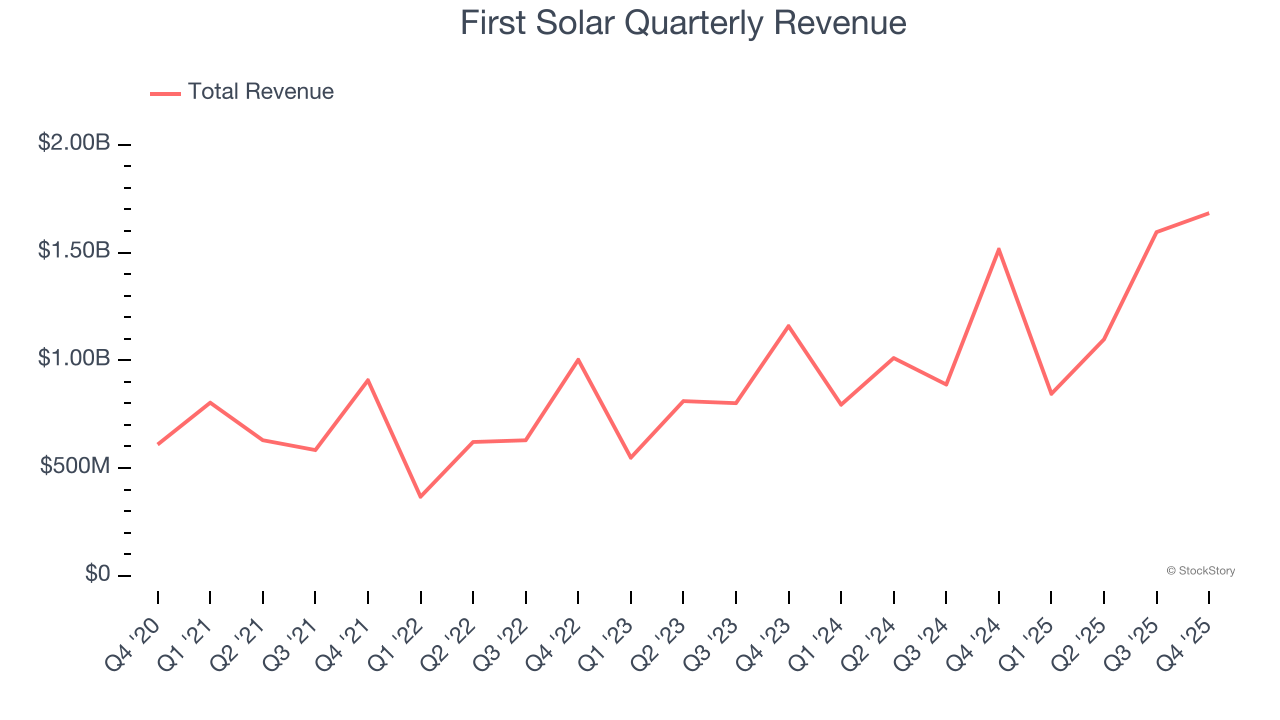
Long-term growth is the most important, but within industrials, a half-decade historical view may miss new industry trends or demand cycles. First Solar’s annualized revenue growth of 25.4% over the last two years is above its five-year trend, suggesting its demand was strong and recently accelerated. 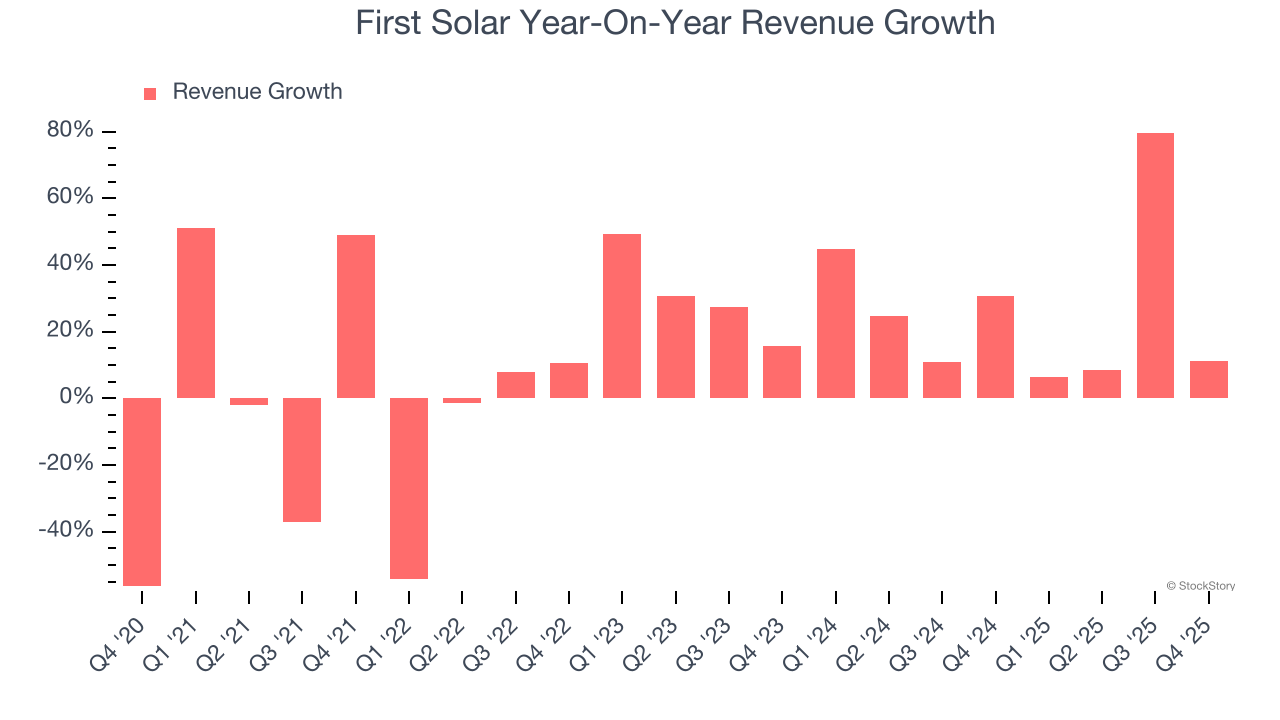
This quarter, First Solar reported year-on-year revenue growth of 11.1%, and its $1.68 billion of revenue exceeded Wall Street’s estimates by 7%.
Looking ahead, sell-side analysts expect revenue to grow 16.2% over the next 12 months, a deceleration versus the last two years. Still, this projection is admirable and suggests the market is forecasting success for its products and services.
Microsoft, Alphabet, Coca-Cola, Monster Beverage—all began as under-the-radar growth stories riding a massive trend. We’ve identified the next one: a profitable AI semiconductor play Wall Street is still overlooking. Go here for access to our full report.
Operating Margin
First Solar has been a well-oiled machine over the last five years. It demonstrated elite profitability for an industrials business, boasting an average operating margin of 24.1%. This result isn’t too surprising as its gross margin gives it a favorable starting point.
Looking at the trend in its profitability, First Solar’s operating margin rose by 10.5 percentage points over the last five years, as its sales growth gave it immense operating leverage.
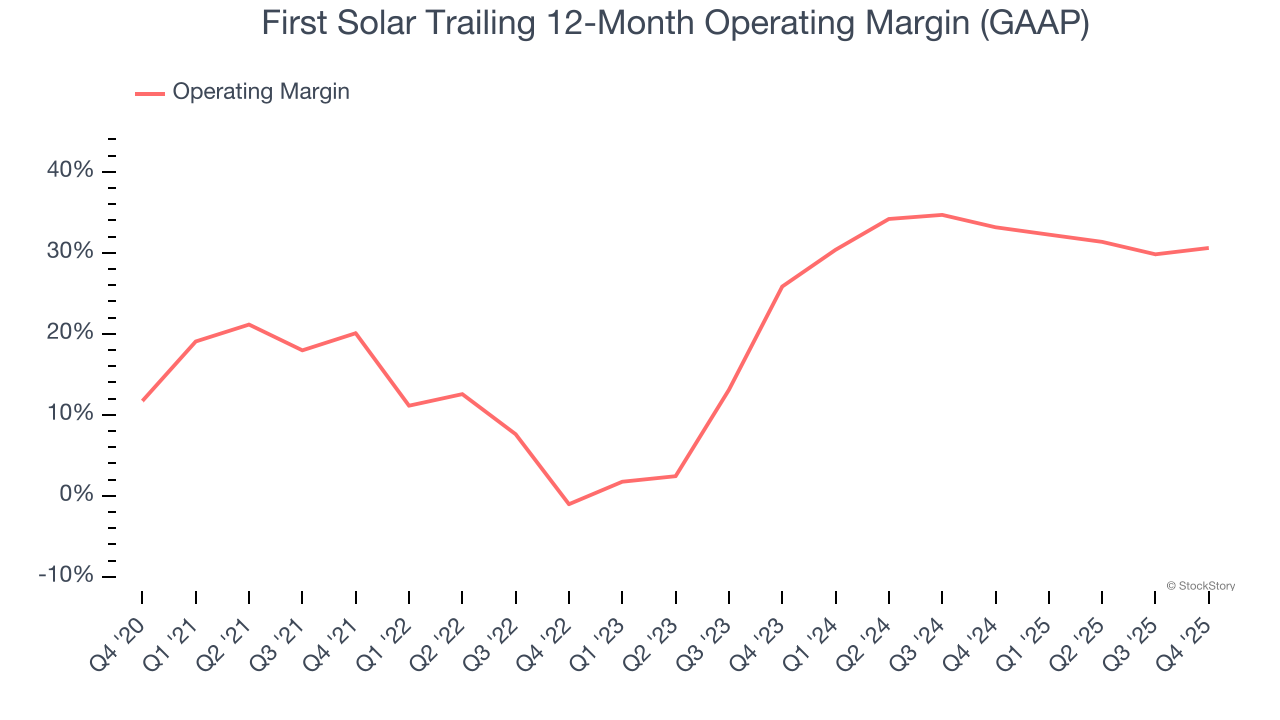
In Q4, First Solar generated an operating margin profit margin of 32.6%, up 2.4 percentage points year on year. The increase was encouraging, and because its operating margin rose more than its gross margin, we can infer it was more efficient with expenses such as marketing, R&D, and administrative overhead.
Earnings Per Share
Revenue trends explain a company’s historical growth, but the long-term change in earnings per share (EPS) points to the profitability of that growth – for example, a company could inflate its sales through excessive spending on advertising and promotions.
First Solar’s EPS grew at an astounding 30.6% compounded annual growth rate over the last five years, higher than its 14% annualized revenue growth. This tells us the company became more profitable on a per-share basis as it expanded.
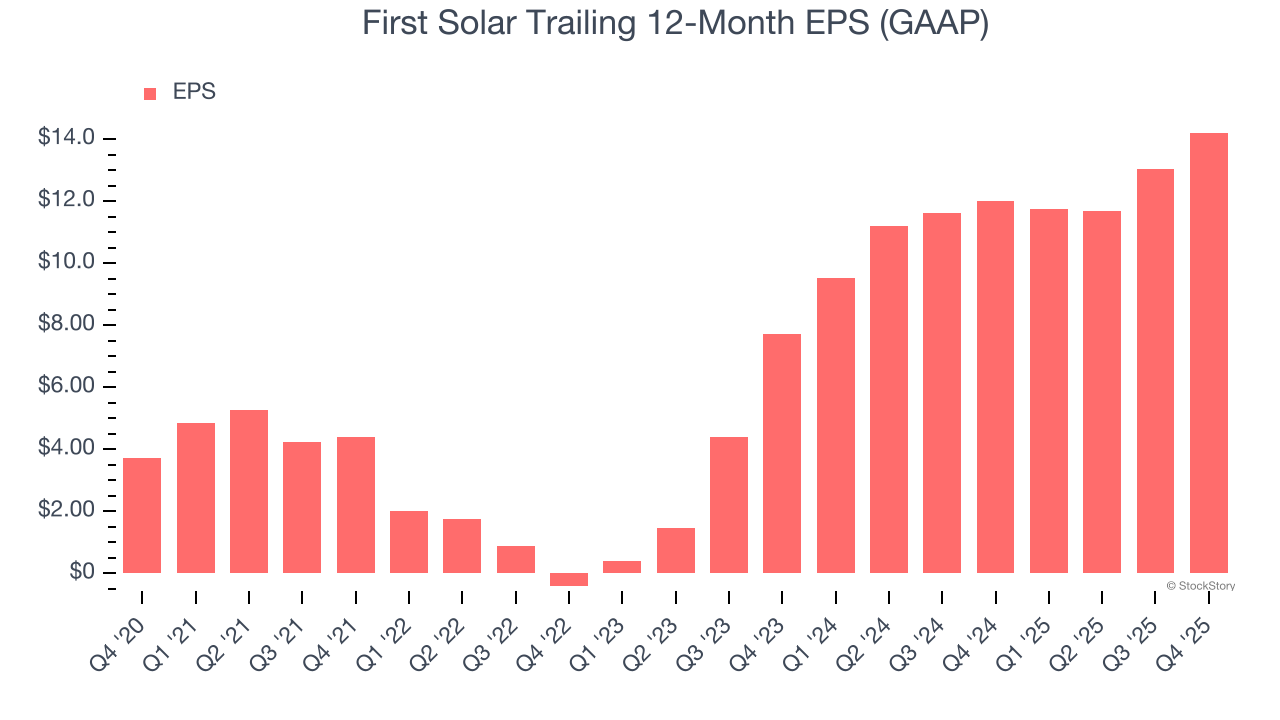
Diving into the nuances of First Solar’s earnings can give us a better understanding of its performance. As we mentioned earlier, First Solar’s operating margin expanded by 10.5 percentage points over the last five years. This was the most relevant factor (aside from the revenue impact) behind its higher earnings; interest expenses and taxes can also affect EPS but don’t tell us as much about a company’s fundamentals.
Like with revenue, we analyze EPS over a more recent period because it can provide insight into an emerging theme or development for the business.
For First Solar, its two-year annual EPS growth of 35.6% was higher than its five-year trend. We love it when earnings growth accelerates, especially when it accelerates off an already high base.
In Q4, First Solar reported EPS of $4.84, up from $3.65 in the same quarter last year. Despite growing year on year, this print missed analysts’ estimates, but we care more about long-term EPS growth than short-term movements. Over the next 12 months, Wall Street expects First Solar’s full-year EPS of $14.21 to grow 57.3%.
Key Takeaways from First Solar’s Q4 Results
We were impressed by how significantly First Solar blew past analysts’ revenue expectations this quarter. On the other hand, its full-year revenue guidance missed and its full-year EBITDA guidance fell short of Wall Street’s estimates. Overall, this was a weaker quarter. The stock traded down 10.2% to $219.25 immediately following the results.
First Solar underperformed this quarter, but does that create an opportunity to invest right now? We think that the latest quarter is only one piece of the longer-term business quality puzzle. Quality, when combined with valuation, can help determine if the stock is a buy. We cover that in our actionable full research report which you can read here (it’s free).