
Regional banking company F.N.B. Corporation (NYSE: FNB) missed Wall Street’s revenue expectations in Q1 CY2026, but sales rose 8.6% year on year to $450.3 million. Its GAAP profit of $0.38 per share was in line with analysts’ consensus estimates.
Is now the time to buy F.N.B. Corporation? Find out by accessing our full research report, it’s free.
F.N.B. Corporation (FNB) Q1 CY2026 Highlights:
- Net Interest Income: $359.3 million vs analyst estimates of $361.2 million (11.2% year-on-year growth, 0.5% miss)
- Net Interest Margin: 3.3% vs analyst estimates of 3.3% (in line)
- Revenue: $450.3 million vs analyst estimates of $456.4 million (8.6% year-on-year growth, 1.3% miss)
- Efficiency Ratio: 56.1% vs analyst estimates of 56.3% (21.1 basis point beat)
- EPS (GAAP): $0.38 vs analyst estimates of $0.38 (in line)
- Tangible Book Value per Share: $12.06 vs analyst estimates of $12.12 (11.4% year-on-year growth, in line)
- Market Capitalization: $6.36 billion
"F.N.B. Corporation's first quarter earnings increased 19% from the year-ago quarter to $0.38 per diluted common share. Pre-provision net revenue (non-GAAP) increased 17% as we generated positive operating leverage of 5% with continued solid non-interest income generation and growth in net interest income," said F.N.B. Corporation Chairman, President and Chief Executive Officer, Vincent J. Delie, Jr.
Company Overview
Tracing its roots back to 1864 during the Civil War era, F.N.B. Corporation (NYSE: FNB) is a diversified financial services holding company that provides banking, wealth management, and insurance services to consumers and businesses across seven states and Washington, D.C.
Sales Growth
In general, banks make money from two primary sources. The first is net interest income, which is interest earned on loans, mortgages, and investments in securities minus interest paid out on deposits. The second source is non-interest income, which can come from bank account, credit card, wealth management, investing banking, and trading fees. Regrettably, F.N.B. Corporation’s revenue grew at a tepid 7.8% compounded annual growth rate over the last five years. This fell short of our benchmark for the banking sector and is a poor baseline for our analysis.
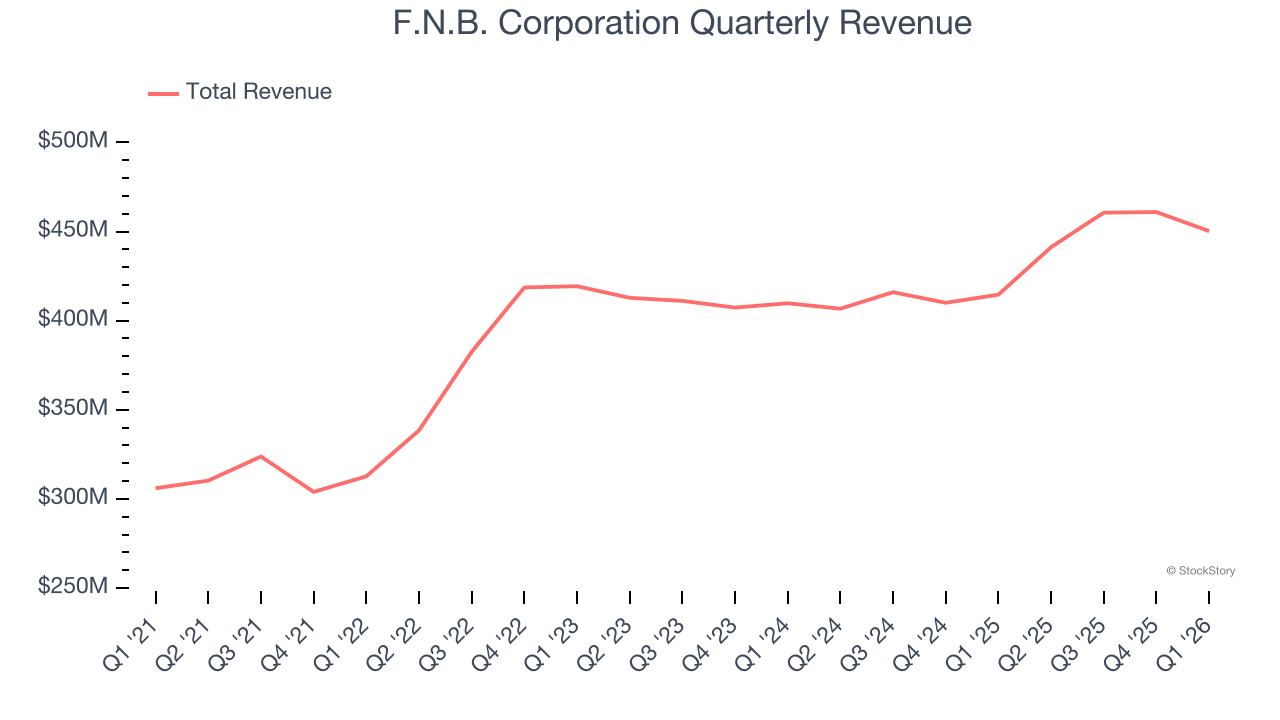
We at StockStory place the most emphasis on long-term growth, but within financials, a half-decade historical view may miss recent interest rate changes, market returns, and industry trends. F.N.B. Corporation’s recent performance shows its demand has slowed as its annualized revenue growth of 5.1% over the last two years was below its five-year trend. We’re wary when companies in the sector see decelerations in revenue growth, as it could signal changing consumer tastes aided by low switching costs. 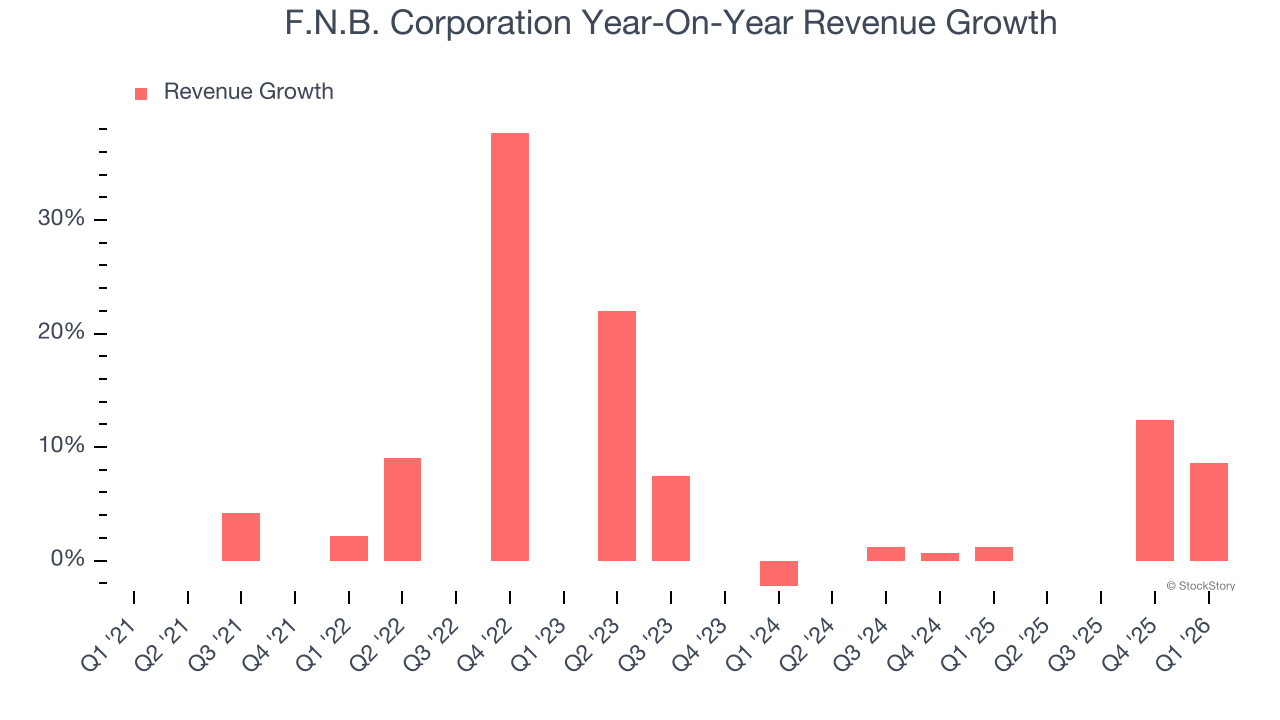 Note: Quarters not shown were determined to be outliers, impacted by outsized investment gains/losses that are not indicative of the recurring fundamentals of the business.
This quarter, F.N.B. Corporation’s revenue grew by 8.6% year on year to $450.3 million, missing Wall Street’s estimates.
Net interest income made up 77.5% of the company’s total revenue during the last five years, meaning lending operations are F.N.B. Corporation’s largest source of revenue.
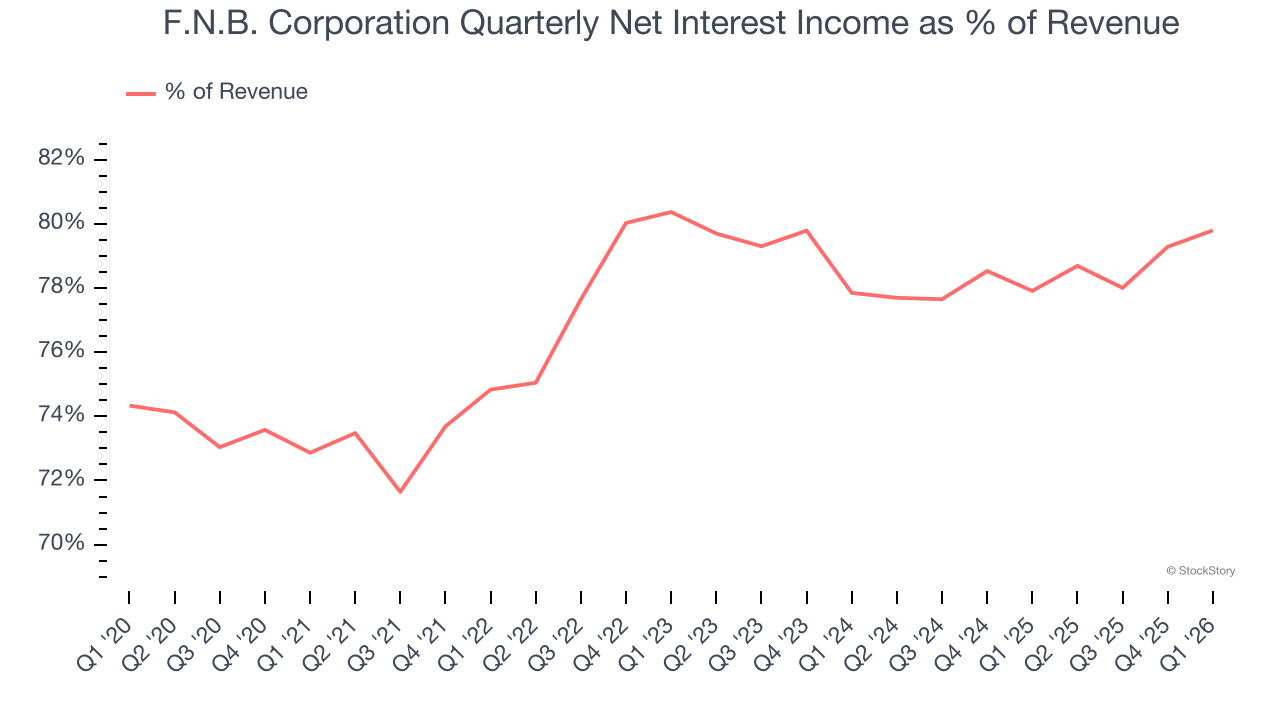
Our experience and research show the market cares primarily about a bank’s net interest income growth as non-interest income is considered a lower-quality and non-recurring revenue source.
ONE MORE THING: 3 Hidden Platforms Growing 3X Faster than Amazon, Google, and PayPal. Amazon, Google, and Meta all followed the same playbook: Dominate an ignored market. Build an unbeatable moat. Scale until you’re unstoppable.
These three platforms are running that exact playbook right now. The early investors in Amazon made fortunes. The early investors in these could do the same. Get All 3 Stocks Here for FREE.
Tangible Book Value Per Share (TBVPS)
Banks are balance sheet-driven businesses because they generate earnings primarily through borrowing and lending. They’re also valued based on their balance sheet strength and ability to compound book value (another name for shareholders’ equity) over time.
When analyzing banks, tangible book value per share (TBVPS) takes precedence over many other metrics. This measure isolates genuine per-share value by removing intangible assets of debatable liquidation worth. Other (and more commonly known) per-share metrics like EPS can sometimes be murky due to M&A or accounting rules allowing for loan losses to be spread out.
F.N.B. Corporation’s TBVPS grew at an excellent 8.5% annual clip over the last five years. TBVPS growth has also accelerated recently, growing by 11.9% annually over the last two years from $9.64 to $12.06 per share.
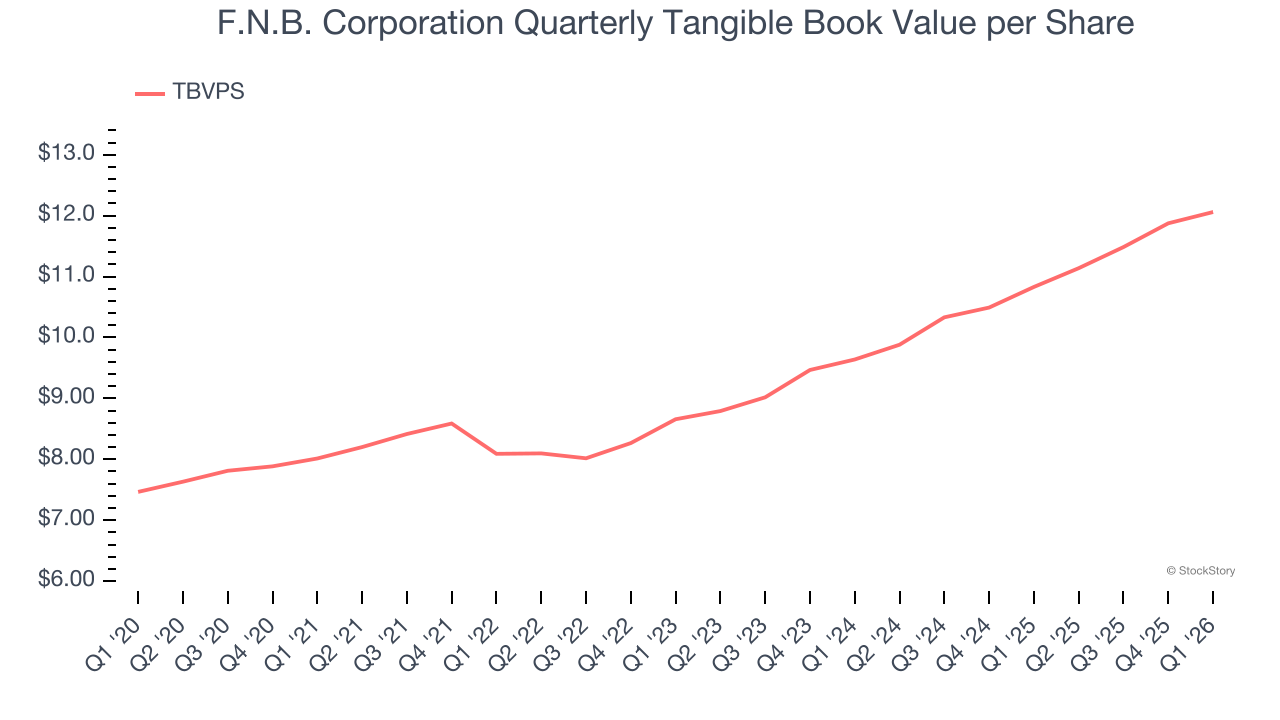
Over the next 12 months, Consensus estimates call for F.N.B. Corporation’s TBVPS to grow by 10.5% to $13.33, mediocre growth rate.
Key Takeaways from F.N.B. Corporation’s Q1 Results
We struggled to find many positives in these results. Its EPS was in line and its revenue fell slightly short of Wall Street’s estimates. Overall, this quarter could have been better. The stock traded up 1% to $17.56 immediately following the results.
So should you invest in F.N.B. Corporation right now? When making that decision, it’s important to consider its valuation, business qualities, as well as what has happened in the latest quarter. We cover that in our actionable full research report which you can read here (it’s free).