In a decisive move to centralize the United States' technological trajectory, Senator Marsha Blackburn (R-TN) has unveiled a comprehensive national policy framework that serves as the legislative backbone for the "Trump America AI Act." Following President Trump’s landmark Executive Order 14365, signed on December 11, 2025, the new framework seeks to establish federal supremacy over artificial intelligence regulation. The act is designed to dismantle a growing "patchwork" of state-level restrictions while simultaneously embedding protections for children, creators, and national security into the heart of American innovation.
The framework arrives at a critical juncture as the administration pivots away from the safety-centric regulations of the previous era toward a policy of "AI Proliferation." By preempting restrictive state laws—such as California’s SB 1047 and the Colorado AI Act—the Trump America AI Act aims to provide a unified "minimally burdensome" federal standard. Proponents argue this is a necessary step to prevent "unilateral disarmament" in the global AI race against China, ensuring that American developers can innovate at maximum speed without the threat of conflicting state-level litigation.
Technical Deregulation and the "Truthful Output" Standard
The technical core of the Trump America AI Act marks a radical departure from previous regulatory philosophies. Most notably, the act codifies the removal of the "compute thresholds" established in 2023, which previously required developers to report any model training run exceeding $10^{26}$ floating-point operations (FLOPS). The administration has dismissed these metrics as "arbitrary math regulation" that stifles scaling. In its place, the framework introduces a "Federal Reporting and Disclosure Standard" to be managed by the Federal Communications Commission (FCC). This standard focuses on market-driven transparency, allowing companies to disclose high-level specifications and system prompts rather than sensitive training data or proprietary model weights.
Central to the new framework is the technical definition of "Truthful Outputs," a provision aimed at eliminating what the administration terms "Woke AI." Under the guidance of the National Institute of Standards and Technology (NIST), new benchmarks are being developed to measure "ideological neutrality" and "truth-seeking" capabilities. Technically, this requires models to prioritize historical and scientific accuracy over "balanced" outputs that the administration claims distort reality for social engineering. Developers are now prohibited from intentionally encoding partisan judgments into a model’s base weights, with the Federal Trade Commission (FTC) (NASDAQ: FTC) authorized to classify state-mandated bias mitigation as "unfair or deceptive acts."
To enforce this federal-first approach, the act establishes an AI Litigation Task Force within the Department of Justice (DOJ). This unit is specifically tasked with challenging state laws that "unconstitutionally regulate interstate commerce" or compel AI developers to embed ideological biases. Furthermore, the framework leverages federal infrastructure funding as a "carrot and stick" mechanism; the Commerce Department is now authorized to withhold Broadband Equity, Access, and Deployment (BEAD) grants from states that maintain "onerous" AI regulatory environments. Initial reactions from the AI research community are polarized, with some praising the clarity of a single standard and others warning that the removal of safety audits could lead to unpredictable model behaviors.
Industry Winners and the Strategic "American AI Stack"
The unveiling of the Blackburn framework has sent ripples through the boardrooms of Silicon Valley. Major tech giants, including NVIDIA (NASDAQ: NVDA), Meta (NASDAQ: META), and Microsoft (NASDAQ: MSFT), have largely signaled their support for federal preemption. These companies have long argued that a 50-state regulatory landscape would make compliance prohibitively expensive for startups and cumbersome for established players. By establishing a single federal rulebook, the Trump America AI Act provides the "regulatory certainty" that venture capitalists and enterprise leaders have been demanding since the AI boom began.
For hardware leaders like NVIDIA, the act’s focus on infrastructure is particularly lucrative. The framework includes a "Permitting EO" that fast-tracks the construction of data centers and energy projects exceeding 100 MW of incremental load, bypassing traditional environmental hurdles. This strategic positioning is intended to accelerate the deployment of the "American AI Stack" globally. By rescinding "Know Your Customer" (KYC) requirements for cloud providers, the administration is encouraging U.S. firms to export their technology far and wide, viewing the global adoption of American AI as a primary tool of soft power and national security.
However, the act creates a complex landscape for AI startups. While they benefit from reduced compliance costs, they must now navigate the "Truthful Output" mandates, which could require significant re-tuning of existing models to avoid federal penalties. Companies like Alphabet (NASDAQ: GOOGL) and OpenAI, which have invested heavily in safety and alignment research, may find themselves strategically repositioning their product roadmaps to align with the new NIST "reliability and performance" metrics. The competitive advantage is shifting toward firms that can demonstrate high-performance, "unbiased" models that prioritize raw compute power over restrictive safety guardrails.
Balancing the "4 Cs": Children, Creators, Communities, and Censorship
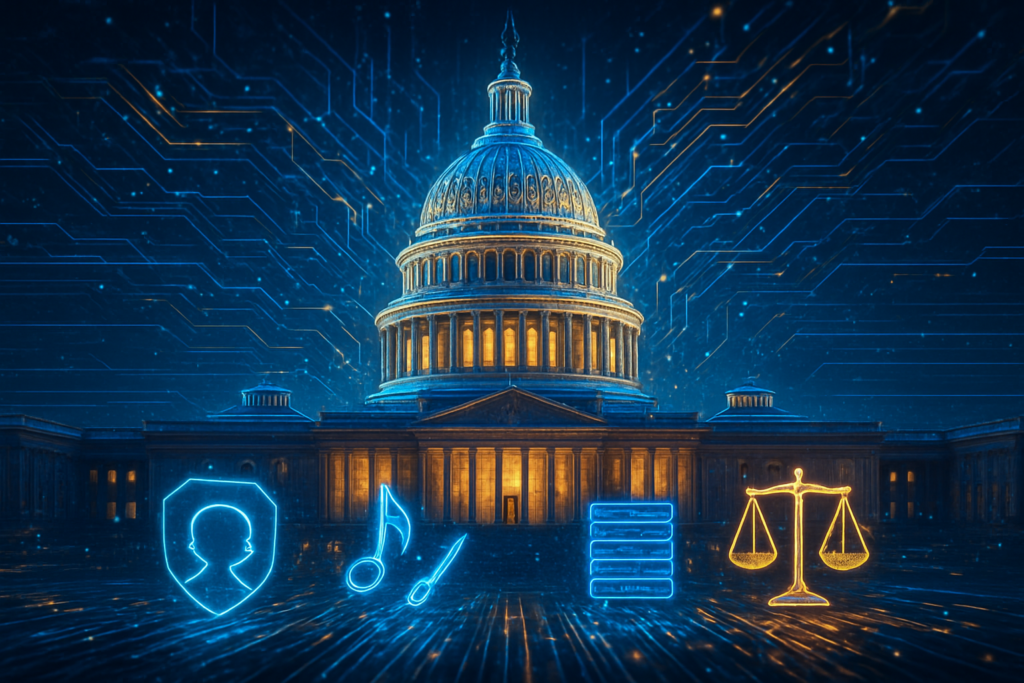
A defining feature of Senator Blackburn’s contribution to the act is the inclusion of the "4 Cs," a set of carve-outs designed to protect vulnerable groups without hindering technical progress. The framework explicitly preserves state authority to enforce laws like the Kids Online Safety Act (KOSA) and age-verification requirements. By ensuring that federal preemption does not apply to child safety, Blackburn has neutralized potential opposition from social conservatives who fear the impact of unbridled AI on minors. This includes strict federal penalties for the creation and distribution of AI-generated child sexual abuse material (CSAM) and deepfake exploitation.
The "Creators" pillar of the framework is a direct response to the concerns of the entertainment and music industries, particularly in Blackburn’s home state of Tennessee. The act seeks to codify the principles of the ELVIS Act at a federal level, protecting artists from unauthorized AI voice and likeness cloning. This move has been hailed as a landmark for intellectual property rights in the age of generative AI, providing a clear legal framework for "human-centric" creativity. By protecting the "right of publicity," the act attempts to strike a balance between the rapid growth of generative media and the economic rights of individual creators.
In the broader context of the AI landscape, this act represents a historic shift from "Safety and Ethics" to "Security and Dominance." For the past several years, the global conversation around AI has been dominated by fears of existential risk and algorithmic bias. The Trump America AI Act effectively ends that era in the United States, replacing it with a framework that views AI as a strategic asset. Critics argue that this "move fast and break things" approach at a national level ignores the very real risks of model hallucinations and societal disruption. However, supporters maintain that in a world where China is racing toward AGI, the greatest risk is not AI itself, but falling behind.
The Road Ahead: Implementation and Legal Challenges
Looking toward 2026, the implementation of the Trump America AI Act will face significant hurdles. While the Executive Order provides immediate direction to federal agencies, the legislative components will require a bruising battle in Congress. Legal experts predict a wave of litigation from states like California and New York, which are expected to challenge the federal government’s authority to preempt state consumer protection laws. The Supreme Court may ultimately have to decide the extent to which the federal government can dictate the "ideological neutrality" of private AI models.
In the near term, we can expect a flurry of activity from NIST and the FCC as they scramble to define the technical benchmarks for the new federal standards. Developers will likely begin auditing their models for "woke bias" to ensure compliance with upcoming federal procurement mandates. We may also see the emergence of "Red State AI Hubs," as states compete for redirected BEAD funding and fast-tracked data center permits. Experts predict that the next twelve months will see a massive consolidation in the AI industry, as the "American AI Stack" becomes the standardized foundation for global tech development.
A New Era for American Technology
The Trump America AI Act and Senator Blackburn’s policy framework mark a watershed moment in the history of technology. By centralizing authority and prioritizing innovation over caution, the United States has signaled its intent to lead the AI revolution through a philosophy of proliferation and "truth-seeking" objectivity. The move effectively ends the fragmented regulatory approach that has characterized the last two years, replacing it with a unified national vision that links technological progress directly to national security and traditional American values.
As we move into 2026, the significance of this development cannot be overstated. It is a bold bet that deregulation and federal preemption will provide the fuel necessary for American firms to achieve "AI Dominance." Whether this framework can successfully protect children and creators while maintaining the breakneck speed of innovation remains to be seen. For now, the tech industry has its new marching orders: innovate, scale, and ensure that the future of intelligence is "Made in America."
This content is intended for informational purposes only and represents analysis of current AI developments.
TokenRing AI delivers enterprise-grade solutions for multi-agent AI workflow orchestration, AI-powered development tools, and seamless remote collaboration platforms.
For more information, visit https://www.tokenring.ai/.