
I spent three hours last week watching a small manufacturer’s warehouse manager explain why their new WMS software was collecting dust. They’d bought the enterprise package with 47 features, took six weeks to set up, and nobody could figure out how to use half of it. This kind of thing happens all the time, but nobody talks about it. Small businesses get sold the same systems that Amazon uses, but they’re not Amazon.
You don’t have a team of IT specialists sitting around. Your warehouse manager is also handling customer service calls and probably doing some accounting on the side. You can’t shut down for a week to train people, but software vendors don’t care. They sell you the same bloated systems they push to companies with 200 employees.
The Real Numbers Behind it
Small businesses made up 52.8% of total net job creation between 2021 and 2024, yet most warehouse software gets built for large operations. Small businesses run on momentum, and every hour your warehouse spends confused about new software is an hour you’re not shipping products. I talked to a parts distributor who switched from a complex system to something dead simple.
The same day they flipped it on, they were faster. No training sessions, no consultants, just better results. The real test is watching what happens when your newest employee starts. If they can’t pick orders on day one without calling someone every ten minutes, your system is too complicated.
What Simple Actually Means
Simple systems do four things well: they track what you have, they tell you where it is, they log what goes out, and they connect to whatever accounting software you already use. Everything else is noise.
I’ve watched small operations waste months on implementations that require custom integrations, API configurations, and dedicated servers. One company added $40,000 in consulting fees to fix software that was supposed to save them money, which defeats the entire purpose of automation in the first place.
Growth That Makes Sense
Systems that start simple and grow with you actually work. The parts distributor I mentioned started with basic inventory tracking. Six months later, they added barcode scanning. A year after that, they connected it to their vertical lift modules. Each step made sense, and each step paid for itself within weeks.
The problem with complex systems goes beyond just the learning curve. Updates break things, features you don’t use still cause problems, and support tickets pile up. Meanwhile, simple systems just run without constant babysitting.
What Owners Actually Want
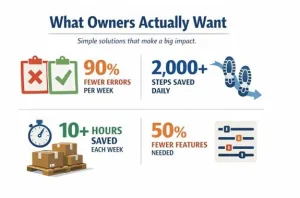
Small business owners tell me the same thing over and over. They don’t want bells and whistles. They want to know what’s in stock, where it is, and when it shipped. They want their team to stop walking thousands of steps a day looking for parts. They want fewer mistakes.
One medical supply company cut their picking errors from 30 a week to three by removing features instead of adding them. They stripped their interface down to exactly what pickers needed to see. Green means go, red means check. That was the whole system, and it worked better than the complicated one they replaced.
The Complexity Trap
The software industry loves selling complexity because more features mean higher prices. Small businesses aren’t enterprise warehouses, though. You don’t need demand forecasting algorithms when you know your customers by name. You don’t need multi-warehouse coordination when everything sits in one building.
90% of recent warehouse construction concentrated in just two California counties, but this expansion brought operational headaches when businesses discovered their workers couldn’t navigate the complicated systems installed in these new facilities.
Start with what breaks right now. If your team can’t find products, fix that first. If you’re counting inventory wrong, solve that next. Build from there instead of trying to implement everything at once.
The manufacturer I mentioned at the start ditched their enterprise system. They found something that did five things instead of fifty, got it running in two days, and workers actually liked it. Orders went out faster, and the problem was solved. Software should make your job easier instead of harder.
If you’re spending more time managing your warehouse system than managing your warehouse, something is fundamentally wrong. Simple wins because it works. It wins because your team can use it without a manual. It wins because when something breaks, you can fix it yourself instead of waiting three days for support. Your warehouse isn’t broken. Your software is just too complicated.