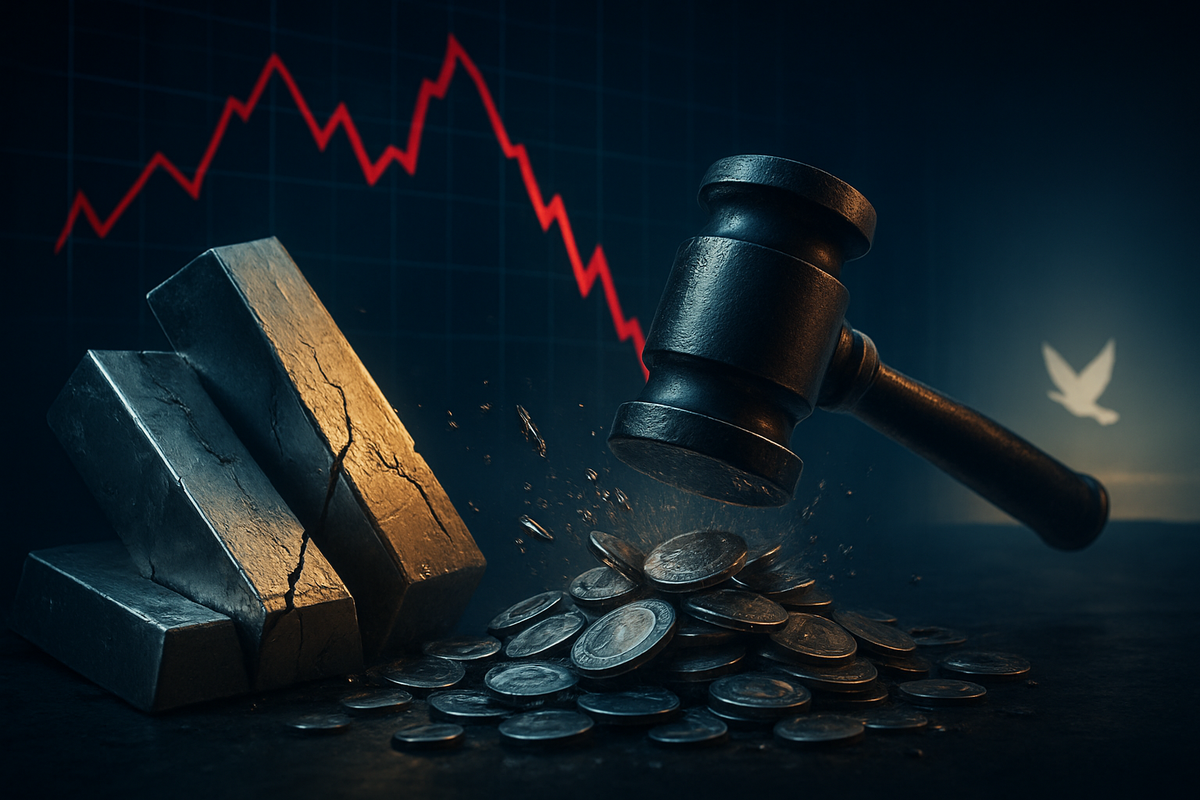
The multi-year bull run in precious metals hit a massive wall of resistance on December 29, 2025, as a "flash crash" erased billions in market value in a matter of hours. After a year of parabolic gains that saw silver nearly triple in price and gold reach unprecedented heights, the market experienced a violent reversal. The sell-off was ignited by a combination of aggressive regulatory intervention, a sudden de-escalation in geopolitical tensions, and a massive wave of year-end profit-taking that caught over-leveraged traders off guard.
As the trading day progressed, the initial cracks in the "hard asset super-cycle" widened into a chasm. Silver, the year’s top-performing commodity, plummeted as much as 14% intraday, while gold retreated from its record peak of $4,550 per ounce. This sudden shift suggests that the speculative "froth" is finally being flushed out of the system, signaling a transition from a momentum-driven frenzy to a more calculated, fundamentally-grounded market environment as 2026 approaches.
The Catalyst: Margin Hikes and the December 29 Flash Crash
The primary trigger for the liquidation was a decisive move by the CME Group Inc. (NASDAQ: CME). In a notice labeled Advisory No. 25-393, the exchange announced a substantial increase in margin requirements for silver and gold futures. For silver, the initial margin for March 2026 contracts was hiked by 13.6% to approximately $25,000 per contract. This regulatory "speed bump" was designed to curb the extreme volatility that had characterized the market throughout December, but its immediate effect was a forced liquidation of high-leverage positions.
The timeline of the crash began in the early morning hours of December 29. Silver had briefly breached a psychological resistance level of $84 per ounce during Asian trading before the CME's announcement hit the wires. By the time the New York floor opened, a "domino effect" of selling was in full swing. Stop-loss orders were triggered in rapid succession, sending silver prices tumbling to a low of $70.25—a staggering $14 drop in a single session. Gold followed suit, though with less relative carnage, sliding 4.6% to settle near $4,325 per ounce as investors scrambled for the exits.
Compounding the technical pressure was a sudden shift in the geopolitical landscape. Reports emerged of a significant breakthrough in peace negotiations between Russia and Ukraine, with President Trump indicating that a deal was "closer than ever" following high-level meetings. This effectively sucked the "fear premium" out of the market. For much of 2025, gold had served as the ultimate hedge against global instability; as the prospect of peace grew tangible, the urgency to hold safe-haven assets evaporated, leading to a massive rotation of capital back into "risk-on" equities.
Mining Giants and ETFs: The Winners and Losers
The carnage in the spot markets translated into a brutal day for the equities of major mining companies. Newmont Corporation (NYSE: NEM), the world’s largest gold producer, saw its shares tumble 6.0%, making it one of the worst performers in the S&P 500 for the day. Despite the drop, Newmont remains up over 150% for the year, and its All-In Sustaining Costs (AISC) of $1,500/oz mean it remains highly profitable even at these corrected prices. Similarly, Barrick Gold Corporation (NYSE: GOLD) fell 4.8%, as institutional investors used the volatility as an excuse to lock in generational gains before the 2025 tax year closed.
Silver-focused miners bore the brunt of the volatility. Pan American Silver Corp. (NASDAQ: PAAS) saw its stock price slide 7.0%, tracking the double-digit plunge in the underlying metal. The VanEck Gold Miners ETF (NYSEARCA:GDX) and the iShares Silver Trust (NYSEARCA:SLV) both recorded record-breaking trading volumes as retail investors, who had flocked to the "silver squeeze" narrative earlier in the year, faced margin calls and liquidated their holdings.
On the winning side of the ledger, the CME Group Inc. (NASDAQ: CME) itself may benefit from the surge in volatility and the resulting spike in transaction fees, even if its regulatory actions were the catalyst for the price drop. Additionally, the U.S. Dollar Index (ICE:DX) saw a late-day resurgence, stabilizing at 98.3 as capital fled the collapsing metals trade and sought the relative safety of the greenback. Investors who had pivoted into "risk-on" sectors like technology and small-cap stocks also saw a boost as the capital rotating out of gold found a new home in the broader equity markets.
A Structural Shift in Global Commodity Trends
This event marks a significant turning point in the broader commodity cycle. For most of 2025, the market was driven by a "perfect storm" of central bank buying, industrial demand from the AI and solar sectors, and a weakening dollar. However, the December 29 crash highlights the limits of parabolic growth. The 14-day Relative Strength Index (RSI) for both gold and silver had been pinned above 70 for weeks—a classic signal of technical exhaustion that historical precedents, such as the 1980 silver crash and the 2011 gold peak, suggest often ends in a sharp correction.
The regulatory response from the CME mirrors past actions taken during periods of "irrational exuberance." By raising margins, the exchange is effectively de-leveraging the market, which, while painful in the short term, often leads to a healthier price discovery process. Furthermore, the Bank of Japan’s (BoJ) decision to raise interest rates to 0.75% in December—the highest in three decades—has stabilized the Yen and reduced the appeal of the "carry trade" that had previously funneled liquidity into the commodities space.
The shift also reflects a change in the narrative surrounding industrial demand. While the long-term need for silver in photovoltaic (PV) cells and AI data centers remains robust, the "buy at any price" mentality of late 2025 has been replaced by a "wait and see" approach. China’s announcement of new silver export licenses effective January 1, 2026, also played a role; traders who had "bought the rumor" of a supply squeeze moved to "sell the fact" as the reality of the new regulatory environment set in.
The Path Ahead: 2026 and Beyond
In the short term, the market is likely to enter a period of consolidation. Technical analysts are closely watching the $4,300 level for gold and the $70 level for silver. If these support levels hold, the December 29 crash may be remembered as a "healthy correction" rather than the end of the bull market. However, a breach of these levels could signal a deeper retracement toward the $4,000 and $60 marks, respectively.
Strategic pivots will be required for both miners and investors. Mining companies may shift their focus from aggressive expansion to share buybacks and dividend increases to appease shareholders who are now wary of price volatility. For investors, the "easy money" of the 2025 parabolic run is likely over. The market in 2026 will likely reward a more selective approach, focusing on low-cost producers and companies with strong balance sheets that can weather a period of price stabilization.
One of the key scenarios to watch is the implementation of the rumored peace deal in Eastern Europe. If a lasting ceasefire is established, the "geopolitical risk premium" may never fully return to gold, forcing the metal to rely more heavily on its role as an inflation hedge and a central bank reserve asset. Conversely, if the peace talks falter, the safe-haven bid could return with a vengeance, potentially setting the stage for a new leg higher in late 2026.
Conclusion: A Necessary Cleansing
The sudden shift in the commodity markets on December 29, 2025, serves as a stark reminder that no asset class moves upward in a straight line forever. The combination of CME margin hikes, geopolitical breakthroughs, and massive profit-taking has effectively lanced the speculative bubble that had formed around gold and silver. While the 14% intraday drop in silver was jarring, it represents a necessary "technical cleansing" of the market, removing the "weak hands" and over-leveraged speculators who had driven prices to unsustainable levels.
Moving forward, the market is likely to find a new equilibrium. The structural deficits in silver and the continued diversification of central bank reserves into gold provide a solid floor for prices, but the era of 100%+ annual returns appears to be in the rearview mirror. Investors should spend the coming months watching for stabilization in the spot prices and paying close attention to the Federal Reserve’s reaction to the cooling commodity sector.
In summary, the luster of precious metals has not been lost, but it has certainly been dimmed by the reality of a changing macroeconomic and regulatory landscape. As the 2025 trading year closes, the market is entering a new phase—one defined by fundamentals rather than feverish speculation.
This content is intended for informational purposes only and is not financial advice.