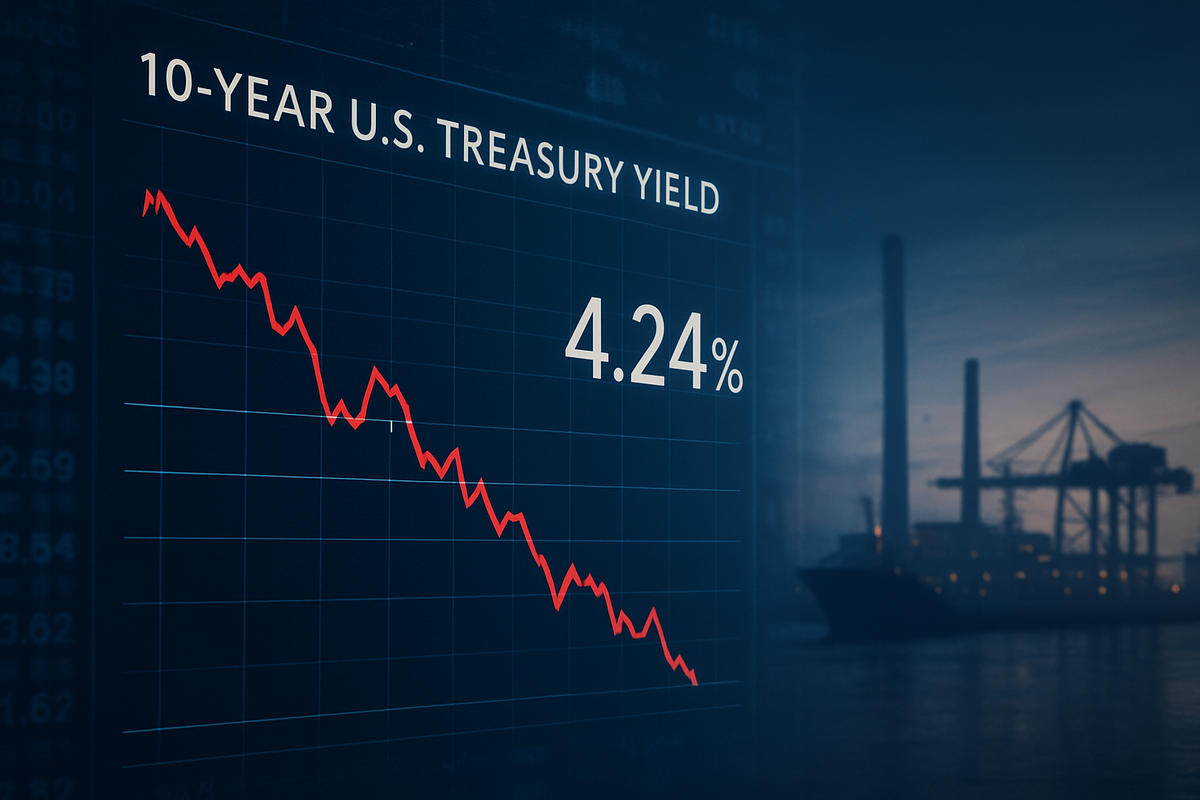
In a dramatic shift of market sentiment, the yield on the 10-year U.S. Treasury note tumbled to monthly lows in late February 2025, as a flurry of disappointing economic data and intensifying geopolitical tensions sparked fears of a significant domestic slowdown. After peaking near 4.79% in mid-January, the benchmark yield plummeted to approximately 4.24% by February 28, 2025, reflecting a classic "flight to quality" as investors sought the safety of government bonds amidst growing uncertainty.
The sharp retreat in yields underscores a growing divergence between persistent inflationary pressures and a rapidly cooling manufacturing sector. Market participants, who only weeks ago were bracing for "higher-for-longer" interest rates, are now pivotally focused on downside risks. This move has major implications for the broader economy, signaling that the aggressive fiscal and trade policies enacted in early 2025 may be beginning to weigh on consumer and business confidence.
Data Deluge: The "Tariff Storm" and Manufacturing Contraction
The primary catalyst for the February yield collapse was a series of alarming economic reports that painted a picture of an economy losing steam. The most striking of these was the ISM Manufacturing New Orders Index, which suffered a massive 6.5-point drop to 48.6% in February. This reading, firmly in contraction territory, marked the steepest single-month decline since the onset of the pandemic in 2020. Analysts attributed the slump to a "tariff storm," as businesses paused orders to navigate the uncertainty surrounding new 25% duties on steel and aluminum imports from key trading partners.
The timeline of the decline was swift. Following a "hot" inflation report earlier in the month, yields initially remained elevated. However, the momentum shifted in the final week of February when Personal Consumption Expenditures (PCE) data revealed that real consumer spending was "downshifting," even as personal income remained high. Investors also grew increasingly wary of the Department of Government Efficiency (DOGE) and its aggressive cost-cutting mandates, fearing that immediate reductions in public sector spending could trigger a near-term contraction in GDP growth.
Initial market reactions were swift and volatile. While the S&P 500 managed a slight recovery on the final day of the month, the tech-heavy Nasdaq Composite faced its worst week in months, losing nearly 3% in late February. The yield drop signaled that the market was beginning to decouple from Federal Reserve interest rate expectations, focusing instead on the potential for a recession in the coming twelve to eighteen months.
Winners and Losers: Rate Sensitivity Meets Growth Fears
The decline in yields created a complex environment for public companies, particularly those in the financial and technology sectors. For JPMorgan Chase & Co. (NYSE: JPM), the flattening of the yield curve presented a double-edged sword. While lower yields typically reduce the net interest margins that banks can earn, the "growth scare" in late February led to a sell-off in cyclical stocks, putting pressure on JPM’s share price despite the bank's robust earnings earlier in the year.
Conversely, the housing sector saw a nuanced reaction. Homebuilders like D.R. Horton, Inc. (NYSE: DHI) initially benefited from the prospect of lower mortgage rates, which track the 10-year Treasury yield. However, these gains were capped by concerns that a broader economic slowdown and eroding consumer purchasing power would dampen housing demand. By late February, DHI shares remained roughly 15% below their 2024 highs, as the market weighed the benefits of lower rates against the risks of a weakening labor market.
In the technology space, Apple Inc. (NASDAQ: AAPL) and NVIDIA Corp. (NASDAQ: NVDA) faced significant headwinds due to their exposure to international supply chains. Apple saw its shares dip toward the $237 level in the final week of February as investors fretted over the impact of trade tariffs on production costs. NVIDIA, which had been the darling of the AI boom, suffered a staggering $600 billion single-day loss in market value during the height of the February volatility, as investors questioned whether the "AI premium" could survive a period of stagnant economic growth.
The Broader Significance: A Shift in Policy Narratives
The events of late February 2025 represent a significant pivot in the post-2024 economic narrative. For much of the previous year, the market's primary concern was controlling inflation through restrictive monetary policy. However, the sudden drop in yields suggests that "growth risk" has overtaken "inflation risk" as the dominant market driver. This shift fits into a broader industry trend where fiscal policy—specifically trade and government spending—is now exerting as much influence on bond markets as Federal Reserve policy.
Historically, such sharp monthly drops in 10-year yields are often precursors to shifts in the credit cycle. Comparisons have been drawn to the late-2018 period, where a combination of trade tensions and tightening financial conditions forced a sudden change in market sentiment. Today, the added variable of the Department of Government Efficiency’s influence on the federal budget adds a layer of fiscal uncertainty that the market is still struggling to price correctly.
Regulatory and policy implications are also coming to the forefront. If the manufacturing slowdown persists, the current administration may face pressure to revisit its tariff strategy or provide targeted relief to impacted industries. Meanwhile, the Federal Reserve finds itself in a precarious position, needing to balance "sticky" core inflation with the undeniable signs of a cooling economy.
Outlook: Navigating the 2026 Horizon
Looking ahead from our current vantage point in January 2026, the "February Swoon" of 2025 appears to have been a critical turning point. In the short term, markets will be watching for the "lagged effects" of 2025's trade policies to fully permeate the labor market. Strategic pivots are already underway; many multinational corporations are diversifying their supply chains away from tariff-heavy corridors, a move that requires significant capital expenditure and may weigh on margins in the coming quarters.
Potential scenarios include a "soft landing" if the Federal Reserve can successfully cut rates to offset fiscal tightening, or a more pronounced recession if consumer spending continues to downshift. Market opportunities may emerge in defensive sectors like Utilities and Consumer Staples, which traditionally outperform during periods of lower yields and economic uncertainty. However, the high-growth tech sector remains vulnerable to any further escalation in global trade tensions.
Summary of the Market Pulse
The retreat of 10-year Treasury yields to monthly lows in late February 2025 serves as a stark reminder of the bond market's sensitivity to growth expectations. The combination of a manufacturing slump, tariff-related uncertainty, and shifting fiscal priorities has forced a repricing of risk across all asset classes. While lower yields offer some relief to borrowers, they also signal a lack of confidence in the durability of the current economic expansion.
As we move forward into 2026, investors should keep a close eye on labor market data and corporate guidance regarding margin pressures. The "growth scare" of early 2025 was not merely a blip but a fundamental adjustment to a new era of economic policy. The lasting impact of this period will likely be defined by how effectively businesses and policymakers can adapt to a landscape where growth is no longer guaranteed.
This content is intended for informational purposes only and is not financial advice.