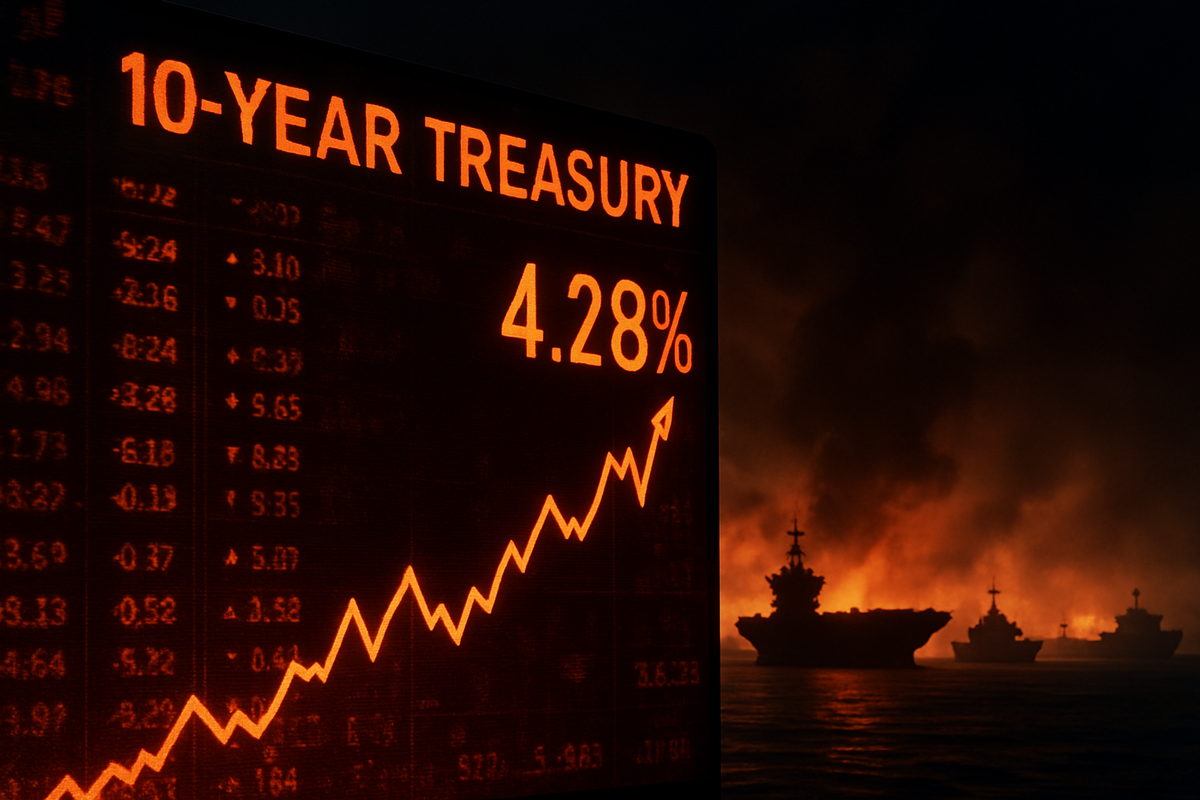
The global financial landscape has shifted violently over the past two weeks as the 10-year Treasury yield skyrocketed from a late-February low of 3.97% to a staggering 4.28% as of March 12, 2026. This rapid ascent is a direct consequence of the escalating military conflict involving Iran, which has injected a massive "war premium" into the bond market. Investors, once optimistic about a steady cycle of interest rate cuts, are now grappling with a dual threat: surging energy costs and a resurgence of inflationary pressure that could force the Federal Reserve to maintain high borrowing costs indefinitely.
The immediate implications of this yield spike are already echoing through the real economy. For American homebuyers, the move has pushed 30-year fixed mortgage rates back toward the psychologically critical 7% mark, effectively freezing a housing market that had only just begun to thaw. Simultaneously, corporate America is facing a sharp increase in the cost of servicing debt and issuing new bonds. As the "risk-free" rate of the 10-year Treasury moves higher, the benchmark for all other forms of credit moves with it, tightening financial conditions just as geopolitical uncertainty reaches its highest level in years.
The Rapid Ascent: From Stability to Geopolitical Crisis
The path to 4.28% began in late 2025, a period of relative calm where the 10-year yield hovered between 4.05% and 4.15%. Markets were operating under the assumption that inflation was largely tamed and that the Federal Reserve would proceed with gradual rate cuts throughout 2026. However, on February 27, 2026, the yield dipped to 3.97% as a "flight to safety" initially drove investors into government bonds amid rumors of rising friction in the Persian Gulf. That brief moment of safety-seeking was short-lived, quickly replaced by a far more aggressive repricing of risk.
The turning point occurred on February 28, following coordinated military strikes on Iranian territory. The situation escalated further on March 2, when Iran officially announced the closure of the Strait of Hormuz—a vital maritime artery through which roughly 20% of the world’s oil and liquefied natural gas (LNG) passes. The move sent shockwaves through the commodities market, with Brent crude prices leaping from $80 to over $126 per barrel in less than ten days. This sudden energy spike transformed the market's narrative from one of "disinflation" to one of "stagflationary risk."
Key institutional players, including BlackRock (NYSE: BLK) and other major asset managers, have reportedly been adjusting their portfolios by offloading long-dated Treasuries. The "war premium"—the extra yield investors demand to hold debt during times of high geopolitical and inflationary risk—has added an estimated 0.5 to 0.7 percentage points to headline inflation expectations. By March 13, 2026, the market consensus had shifted from hoping for a "soft landing" to preparing for a prolonged period of high energy prices and restrictive monetary policy.
Winners and Losers in a High-Yield Environment
The dramatic shift in the yield curve has created a sharp divide between market winners and losers. In the energy sector, the "war premium" has been a significant boon for major oil producers. Exxon Mobil (NYSE: XOM) and Chevron (NYSE: CVX) have seen their stock prices surge as they benefit from the highest crude prices in years. Similarly, Petrobras (NYSE: PBR) has gained traction as investors seek out energy exposure that can hedge against the inflationary impact of the Middle East conflict. These companies are now operating with massive cash flow expansion, which may lead to increased dividends or buybacks despite the broader market volatility.
Conversely, the housing and real estate sectors are bearing the brunt of the yield spike. Publicly traded homebuilders such as D.R. Horton (NYSE: DHI) and Lennar Corp. (NYSE: LEN) have seen their valuations pressured as rising Treasury yields drive mortgage rates higher. These companies are increasingly forced to offer "mortgage buydowns"—subsidizing interest rates for buyers—to keep sales volumes from collapsing, a move that directly eats into their profit margins. High-leverage Real Estate Investment Trusts (REITs), including data center giant Digital Realty (NYSE: DLR), are also facing headwinds as the cost of refinancing their capital-intensive operations becomes significantly more expensive.
The financial sector presents a mixed picture. While market volatility has spurred trading volumes, benefiting platforms like Tradeweb Markets (NASDAQ: TW) and the CME Group (NASDAQ: CME), regional banks like Zions Bancorp (NASDAQ: ZION) and Regions Financial (NYSE: RF) are under scrutiny. While higher yields can eventually expand Net Interest Margins (NIM), the rapid pace of the move and the potential for a "risk-off" environment in equities can lead to unrealized losses on existing bond portfolios, reviving memories of the banking stresses seen in previous years.
The Significance of the War Premium and Market Trends
This event marks a significant departure from the market trends of 2024 and 2025. The concept of the "war premium" is not merely about oil prices; it represents a fundamental repricing of the "term premium" in the bond market. For years, investors accepted lower yields because they believed inflation was a cyclical problem. The closure of the Strait of Hormuz and the resulting supply shock suggest that inflation may now be structural, driven by geopolitical fragmentation rather than just consumer demand.
The current situation bears a striking resemblance to the stagflationary periods of the 1970s, where energy shocks led to a "higher-for-longer" interest rate environment that persisted far longer than economists anticipated. This shift has massive ripple effects on global competitors and partners. European and Asian markets, which are even more dependent on Middle Eastern energy imports than the U.S., are seeing their own sovereign bond yields rise in tandem, threatening a global synchronized slowdown. Furthermore, the Federal Reserve now finds itself in a policy trap: cutting rates to support a slowing economy would risk further devaluing the dollar and stoking energy-driven inflation.
From a regulatory standpoint, the sudden spike in yields may prompt renewed calls for fiscal restraint in Washington. As the interest expense on U.S. national debt grows with every basis point increase in the 10-year yield, the "bond vigilantes"—investors who dump bonds to protest inflationary fiscal policies—have seemingly returned. This could limit the government’s ability to provide economic stimulus or additional military funding without further destabilizing the credit markets.
Navigating the Road Ahead: Scenarios and Strategic Pivots
In the short term, the market will remain fixated on the status of the Strait of Hormuz. If military efforts to reopen the waterway are successful, we could see a rapid "relief rally" where the 10-year yield retreats toward 4.00%. However, if the blockade persists or the conflict expands to include more regional actors, a move toward 5.00% is no longer considered a "tail risk" by many analysts. Corporations are already beginning to pivot, with some delaying capital expenditures (CAPEX) and others rushing to issue debt now before rates climb even higher.
Longer-term, this event is likely to accelerate the trend of "friend-shoring" and energy independence. The vulnerability of the global economy to a single geographic chokepoint has once again been exposed. This may lead to increased investment in domestic energy production and alternative energy sources, though these projects take years to come online and offer little immediate relief to the current yield spike. Investors should prepare for a period of heightened volatility where traditional "60/40" portfolios may struggle, as both stocks and bonds are currently being hit by the same inflationary hammer.
Market opportunities may emerge in "inflation-protected" assets and short-duration fixed income. As the 10-year yield stabilizes at these higher levels, it may eventually attract "yield seekers" who have been waiting for a more attractive entry point into the bond market. However, the timing of that entry will depend entirely on the trajectory of the Iran war and the Federal Reserve's response to the March CPI and PCE data.
Final Assessment and Key Takeaways
The rise of the 10-year Treasury yield to 4.28% is a clear signal that the "peace dividend" of the last decade has evaporated. The market is now pricing in a world where geopolitical risk is a primary driver of economic value, and where energy security is inextricably linked to borrowing costs. The primary takeaway for investors is that the era of predictable, low-inflation growth has been replaced by a more volatile, energy-dependent regime.
Moving forward, the market will likely experience a period of "wait-and-see" as the full impact of the higher rates filters through the economy. Investors should closely watch for signs of credit stress in the corporate sector and a potential slowdown in consumer spending as high mortgage and credit card rates begin to bite. The lasting impact of this "war premium" will be felt in the cost of everything from a new home to the capital required to build the next generation of technology.
In the coming months, the focus will remain on two fronts: the military developments in the Persian Gulf and the rhetoric coming from the Federal Reserve. Any sign of a de-escalation could bring immediate relief, but for now, the bond market is sounding an alarm that the world has entered a more expensive and more uncertain chapter.
This content is intended for informational purposes only and is not financial advice.