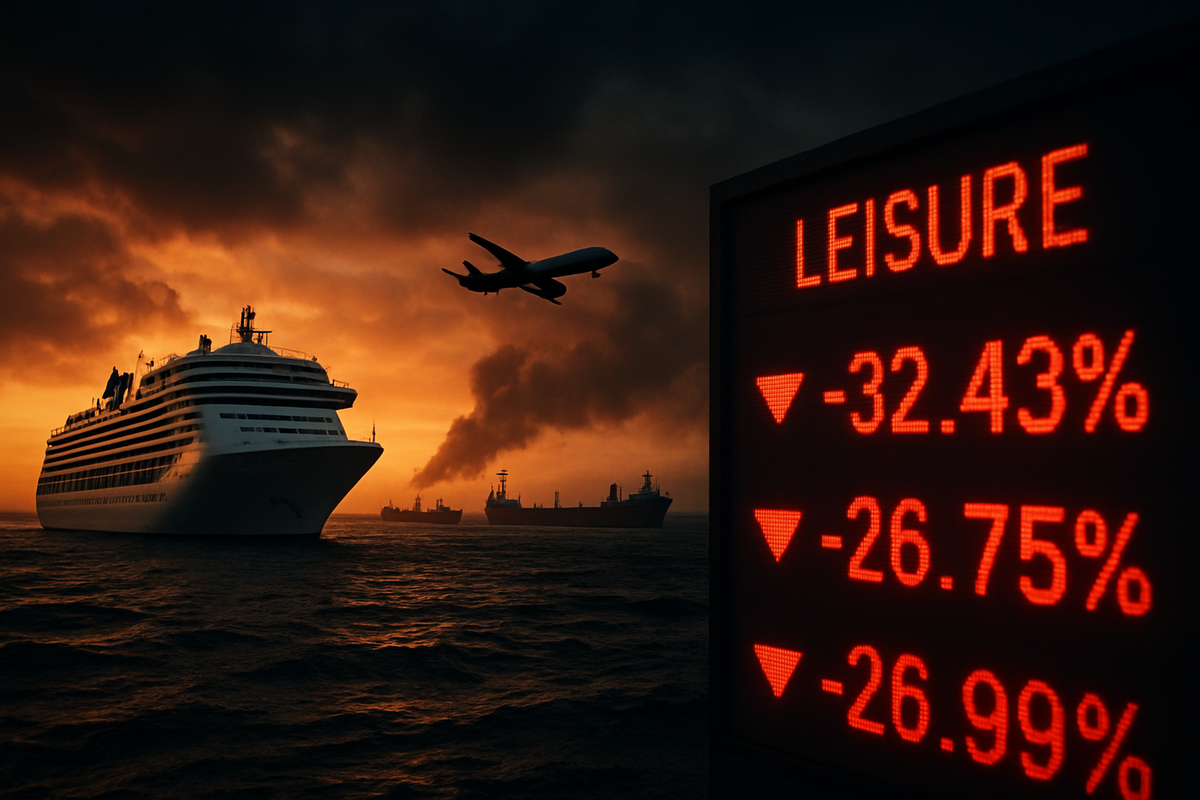
The global travel and leisure sector is facing a severe market correction today, as escalating geopolitical tensions and a sudden spike in energy prices threaten to derail the industry’s post-pandemic stabilization. Stocks across the cruise and aviation industries plummeted in early trading on March 2, 2026, driven by a sharp 6% to 8% increase in global fuel costs following a "de facto" closure of the Strait of Hormuz, a critical maritime chokepoint.
The immediate implications for the market are stark. Investors are aggressively offloading high-leverage travel stocks, fearing that the combination of sky-high operating expenses and dampened consumer sentiment will lead to a "lost summer" for the industry. With benchmark crude prices racing toward the $100 mark, the financial cushion that many of these companies spent years rebuilding is once again under immense pressure.
Global Conflict and the Energy Shock
The primary catalyst for today’s market rout is the rapid escalation of military conflict in the Middle East, involving the United States, Israel, and Iran. The sudden disruption of maritime traffic through the Strait of Hormuz—the artery through which 20% of the world’s oil flows—sent shockwaves through the commodities market. In just a few hours of trading, Brent crude and West Texas Intermediate (WTI) benchmarks surged by over 7%, forcing transportation-heavy industries to immediately re-evaluate their profit margins for the second and third quarters.
This crisis follows a period of relative stability but has been brewing for weeks as diplomatic efforts in the region stalled. The timeline reached a breaking point over the weekend, leading to the current blockade. Unlike previous localized disruptions, this event has effectively "offlined" a significant portion of global energy supply, leaving airlines and cruise lines—whose fuel costs typically account for 20% to 30% of total operating expenses—scrambling to adjust their hedging strategies.
The market reaction was swift and unforgiving. By mid-morning, Carnival Corporation (NYSE: CCL) saw its shares tumble by 6.42%, while Norwegian Cruise Line Holdings (NYSE: NCLH) suffered an even steeper decline of 9.8%. Major airline carriers were not spared, with American Airlines Group (NASDAQ: AAL) and United Airlines Holdings (NASDAQ: UAL) both recording losses exceeding 6% as they announced the suspension of several key international routes traversing Middle Eastern airspace.
The Winners and Losers of the Current Crisis
In the travel and leisure sector, the "losers" are clearly defined by their exposure to fuel volatility and international route dependency. Cruise operators like Carnival Corporation (NYSE: CCL) are particularly vulnerable because they cannot easily pivot their massive assets to avoid conflict zones without incurring massive cancellation costs and logistical nightmares. Furthermore, the rise in maritime insurance premiums, which have reportedly jumped by 50% for vessels in the Persian Gulf, adds a layer of unforecasted expense that many analysts believe will wipe out 2026 earnings per share.
Conversely, the "winners" in this environment are found in the defense and energy production sectors. As travel stocks bled, defense giants such as Lockheed Martin (NYSE: LMT) and RTX Corporation (NYSE: RTX) saw their stock prices rise by 3.1% and 4.3%, respectively, as investors anticipate increased government spending on regional security and missile defense systems. Domestic oil producers and renewable energy firms are also seeing a flight-to-safety bid, as the market looks for alternatives to Middle Eastern crude.
Major airlines are caught in a pincer movement. While they have more flexibility than cruise lines to re-route aircraft, the increased flight times required to bypass closed airspace significantly raise fuel burn and labor costs. This "double whammy" of higher costs and potential ticket price hikes could lead to a rapid cooling of the "revenge travel" trend that has buoyed the industry for the last several years.
A Distant Echo of 2022
The current market turmoil bears a striking resemblance to the geopolitical shock of March 2022, when the onset of the Russia-Ukraine conflict sent oil prices past $110 per barrel. Then, as now, the travel sector was the first to feel the impact of "risk-off" sentiment. However, analysts point out that the 2026 crisis may be more structurally damaging. While the 2022 crisis primarily affected European corridors, the current blockade of the Strait of Hormuz threatens the primary energy "aorta" of the global economy, affecting transit between the West and the rapidly growing markets of the Indo-Pacific.
This event fits into a broader trend of "perpetual volatility" that has defined the mid-2020s. The industry is already grappling with the tail-end of a post-2025 inflation crisis and a series of trade tariffs that have made global operations more expensive. The current warfare serves as a tipping point, potentially forcing a consolidation within the airline industry as smaller, less-liquid carriers find it impossible to survive sustained $100+ oil prices without government intervention.
Historically, such events lead to a rapid repricing of consumer behavior. In 2022, the surge in gasoline and jet fuel prices eventually led to a "travel recession" in certain segments. Today’s investors are concerned that if the blockade persists for more than 30 days, the ripple effects on global supply chains and discretionary spending will be felt well into 2027.
Navigating the Fog: What Comes Next
In the short term, the market will be hyper-focused on the duration of the Hormuz blockade and any signs of military de-escalation. If the conflict remains localized and the Strait is reopened within the week, we may see a "relief rally" in travel stocks. However, the long-term outlook requires a strategic pivot for companies like Carnival Corporation (NYSE: CCL) and its peers. This may involve a more aggressive shift toward fuel-efficient LNG-powered vessels and a permanent reduction in itineraries that transit through geopolitical hotspots.
Airlines may be forced to implement "war surcharges" on international tickets, a move that could test the price elasticity of the modern traveler. We should also watch for a potential increase in domestic travel demand as consumers avoid international uncertainty, which could provide a slight buffer for carriers with strong domestic networks. The market opportunity may lie in companies that provide logistics and data analytics for route optimization, helping carriers mitigate the costs of longer flight paths.
Final Assessment: A Crucible for the Travel Industry
The slump in travel and leisure stocks on March 2, 2026, serves as a stark reminder of how interconnected global commerce is with regional stability. The 6.42% drop in Carnival Corporation (NYSE: CCL) and the broader airline sell-off reflect a market that is pricing in not just a temporary fuel spike, but a structural shift in the cost of global mobility.
As we move forward, the key takeaway for investors is the importance of "energy resilience." Companies that have successfully hedged their fuel costs or modernized their fleets will likely emerge as the survivors of this crisis. For the next several months, the market will remain volatile, and all eyes will be on the Persian Gulf. Investors should closely monitor daily crude oil settlements and maritime insurance updates, as these will be the primary indicators for when the travel sector might finally reach its floor.
This content is intended for informational purposes only and is not financial advice