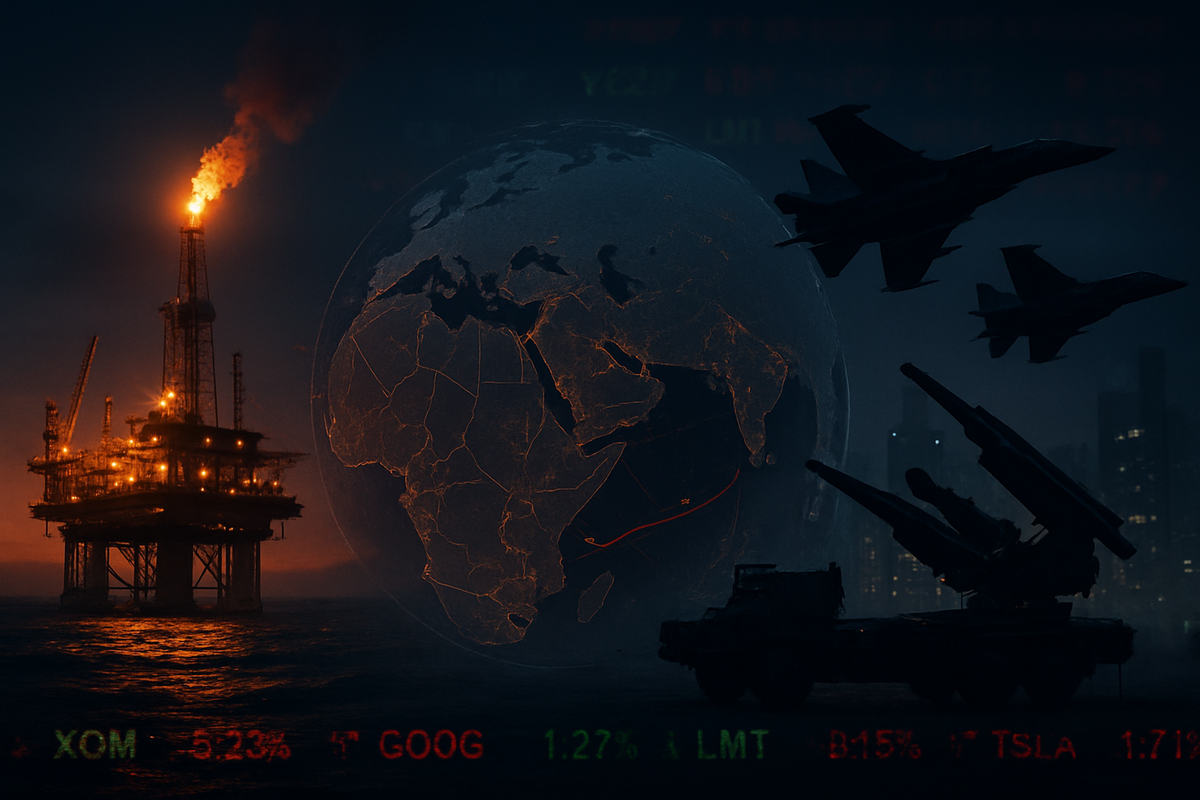
As the smoke clears—literally and figuratively—from the dramatic military escalations in the Persian Gulf this week, the global financial landscape is undergoing its most violent structural shift in years. Investors, spooked by the sudden specter of a prolonged conflict in the Middle East, are aggressively rotating out of high-flying technology and luxury sectors, funnelling billions into the "physical security" playbooks of Energy and Aerospace & Defense.
The rotation, which accelerated on Monday, March 2, 2026, marks a definitive end to the "consumption-at-all-costs" era that defined the early 2020s. Analysts at Bank of America (NYSE: BAC) and Merrill Lynch are calling this the "Bits to Atoms" transition, arguing that in an era of geopolitical fragmentation, the tangible value of a barrel of oil or a missile interceptor far outweighs the speculative multiples of software-as-a-service or high-end handbags.
A Weekend of Fire and Global Repercussions
The catalyst for this seismic market shift was a series of joint U.S.-Israeli military strikes launched on February 28, 2026, aimed at degrading Iran’s strategic capabilities. The operation, which reportedly included the assassination of high-ranking Iranian leadership, prompted an immediate and severe retaliation. By Sunday evening, Iran had declared the Strait of Hormuz—the world’s most critical oil chokepoint—effectively closed to "hostile" shipping.
The immediate market reaction on Monday morning was nothing short of chaotic. Brent crude oil prices spiked 13% in a single trading session, reaching $82 per barrel, as energy analysts warned of a "perpetual risk premium" returning to the market. This timeline of escalation has forced institutional desks to abandon the "disinflation" narrative that had supported tech valuations throughout late 2025. Instead, the focus has shifted to the immediate needs of a wartime economy: energy independence and military readiness.
Key stakeholders, including the U.S. Department of Defense and major OPEC+ members, are now locked in a high-stakes game of chicken. While the Biden administration has signaled a record $1.5 trillion defense budget proposal to support active operations, the sudden closure of the Strait has paralyzed 20% of the world's liquefied natural gas (LNG) and crude flows, creating a supply-side shock that markets are still struggling to price accurately.
The Winners of the "Physical" Economy and the Luxury Fallout
In this new reality, the "Physical" sectors are seeing unprecedented inflows. Lockheed Martin (NYSE: LMT) saw its shares surge over 15% in the wake of the strikes, as its interceptor and tactical missile divisions are expected to see immediate replenishment orders. Similarly, RTX Corporation (NYSE: RTX) and Northrop Grumman (NYSE: NOC) have become the go-to shelters for capital, with RTX benefiting from the surge in demand for Gulf-based defense systems.
The energy sector is witnessing a "rotational bull market" that has been long predicted by BofA’s commodity strategists. ExxonMobil (NYSE: XOM) and Chevron (NYSE: CVX) have seen their market caps swell as investors hunt for dividends protected by rising crude prices. Occidental Petroleum (NYSE: OXY) has also emerged as a winner, given its significant domestic production profile which remains insulated from Middle Eastern shipping disruptions.
Conversely, the "Growth and Glamour" trade is bleeding. Nvidia (NASDAQ: NVDA), the darling of the AI boom, has tumbled nearly 14% from its February highs as concerns mount that hyperscalers like Microsoft (NASDAQ: MSFT) and Meta (NASDAQ: META) will be forced to divert capital toward rising energy costs rather than AI infrastructure. The luxury sector is perhaps the hardest hit; LVMH (OTC:LVMUY) and Richemont (SWX:CFR) have seen their shares crater as the "Ramadan rush"—a critical spending period for the Middle Eastern elite—has been effectively canceled by the conflict, and fears of a global recession dampen the "feel-good" consumer sentiment required for $5,000 handbags.
A Deeper Shift: Moving Beyond the Virtual
This rotation is not merely a knee-jerk reaction to a news headline; it represents a broader industrial trend toward "Resilient Realism." For years, the market has rewarded companies that exist primarily in the digital realm. However, the events of early 2026 have highlighted the vulnerability of a globalized, "just-in-time" economy. The ripple effect is extending to competitors and partners alike; as energy costs rise, transport and logistics firms are seeing their margins evaporate, further pushing investors toward the self-insuring nature of the Energy and Defense sectors.
Historically, this mirrors the stagflationary shocks of the 1970s, where resource scarcity and geopolitical tension rendered traditional growth models obsolete. The regulatory environment is also shifting; governments are now prioritizing "Strategic Autonomy," moving away from the free-market principles that allowed tech and luxury to dominate. We are seeing a return to "Industrial Policy," where the state directs capital toward sectors deemed essential for national survival—energy, defense, and domestic manufacturing.
Scenarios for the Coming Quarters
What comes next depends largely on the duration of the Strait of Hormuz closure. In a short-term scenario—a reopening within 30 days—we might see a "relief rally" in Tech and Luxury, though BofA analysts warn that the "geopolitical genie is out of the bottle." A more protracted conflict would likely cement the Energy/Defense dominance for the remainder of 2026, potentially leading to a "Lost Year" for the S&P 500's tech-heavy indices.
Strategic pivots will be required for companies like Apple (NASDAQ: AAPL), which may need to aggressively re-evaluate its supply chain exposure to regions now considered active war zones. Market opportunities may emerge in "Secondary Defensives" like Gold—which has already crossed $5,300 an ounce—and Consumer Staples, as shoppers cut back on discretionary "wants" to afford inflationary "needs."
Navigating a High-Volatility World
The key takeaway for the first quarter of 2026 is clear: the era of "easy growth" in tech and luxury is being challenged by the harsh realities of global conflict and resource constraints. The rotation into Energy and Defense is more than a defensive hedge; it is a fundamental re-allocation of capital toward the sectors that provide the literal and metaphorical power for the modern world.
Moving forward, the market will be hyper-sensitive to any de-escalation signals from the Gulf. Investors should watch for the "energy-inflation-interest rate" loop; if oil stays above $80, central banks may be forced to keep rates higher for longer, further punishing high-multiple tech stocks. The lasting impact of this week’s events may be a permanent re-rating of what "quality" means in a portfolio—shifting from the "virtual" to the "tangible."
This content is intended for informational purposes only and is not financial advice.