The global retail landscape was jolted this week as a massive "China Ripple Effect" swept through the consumer staples and discretionary sectors. On April 1, 2026, the market responded with a sharp sell-off following a dire financial outlook from Nike (NYSE: NKE), which signaled a deeper-than-expected cooling of Chinese demand for the footwear giant. The news initially triggered a wave of sympathy selling across the industry, but as the dust settles, a fascinating bifurcation is emerging.
While Nike struggles to maintain its footing in the world's second-largest economy, investors are recalibrating their portfolios to favor resilient "lifestyle" and "attainable luxury" brands. Specifically, Lululemon (NASDAQ: LULU) and Tapestry (NYSE: TPR) have become the focal points of a new market thesis: Chinese consumers haven't stopped spending; they have simply stopped spending on Nike. This shift marks a pivotal moment in the post-pandemic recovery narrative, where brand prestige and local relevance are trumping historical market dominance.
A "Pneumonic" Forecast: Nike’s Stumble in the Middle Kingdom
The catalyst for this market turbulence was Nike’s fiscal third-quarter earnings report, released after the bell on March 31, 2026. While the company technically beat earnings per share estimates, the underlying data for Greater China was what analysts described as "pneumonic." Revenue in the region fell between 7% and 10% year-over-year, marking the seventh consecutive quarter of stagnation or decline. More alarmingly, Nike’s management issued guidance for the upcoming quarter projecting a 20% plunge in Chinese sales.
The fallout was immediate. On April 1, Nike shares plummeted by 15.8%, dragging the Dow Jones Industrial Average lower and wiping billions off the company’s market capitalization. CEO Elliott Hill attributed the decline to a "structural shift" in consumer behavior and the continued rise of the "Guochao" movement—a trend where Chinese youth prioritize home-grown brands like Anta Sports (HKG:2020) and Li-Ning (HKG:2331) over Western staples. For the first time in history, these local players are expected to rival Nike’s market share by the end of 2026.
Industry insiders suggest that Nike is currently in the "middle innings" of a massive four-year operational reset. The company is grappling with an oversupply of inventory and a brand identity that many Chinese Gen Z consumers now view as "utility" rather than "aspirational." The timeline of this decline has been gradual but compounding, starting with supply chain disruptions in 2024 and culminating in the current guidance that suggests Nike is no longer the "must-have" brand in Tier 1 Chinese cities.
The Bifurcation: Winners and Losers in the New Retail Order
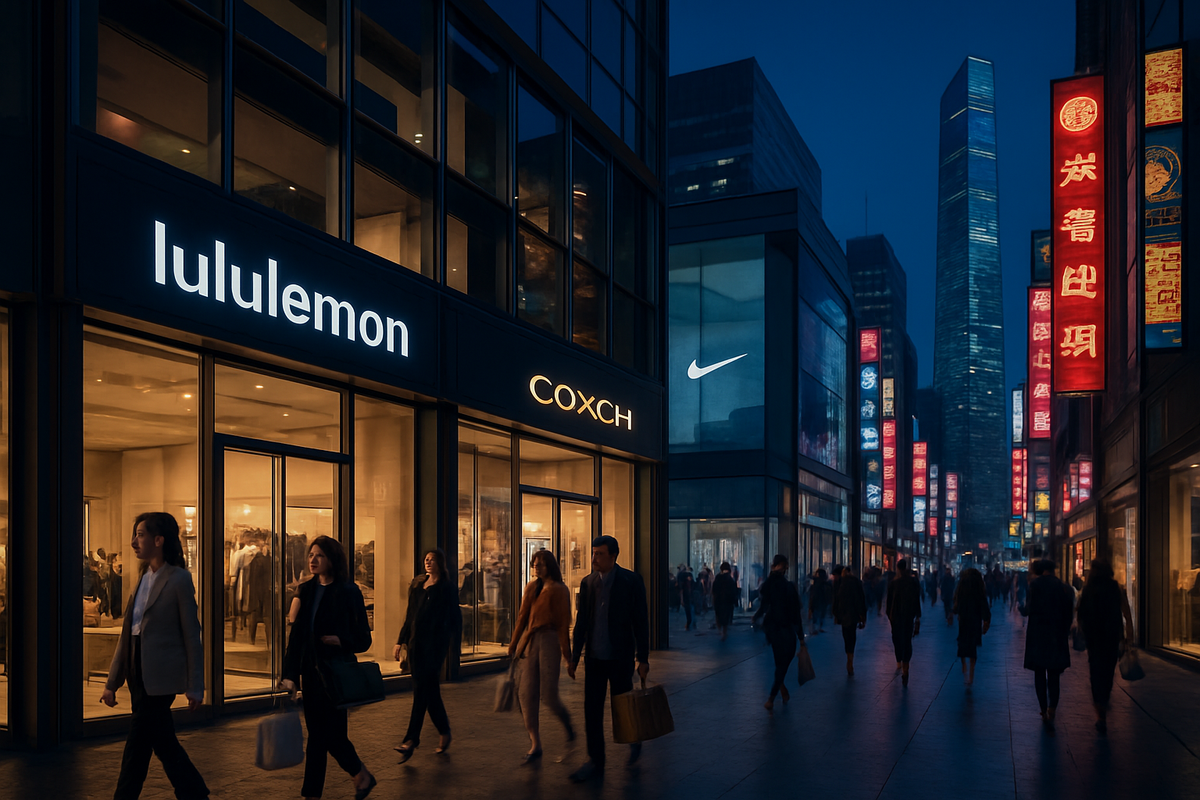
The "China Ripple Effect" has created a stark divide between "mass-market utility" and "premium lifestyle." While Nike represents the former, Lululemon (NASDAQ: LULU) has emerged as a clear winner. In its most recent report from mid-March 2026, Lululemon revealed that its China Mainland revenue surged nearly 28%, reaching $528 million for the quarter. Despite a slowing North American market, Lululemon's 2026 guidance projects 20% growth in China, fueled by a localized marketing strategy that focuses on yoga communities and high-end outerwear.
Similarly, Tapestry (NYSE: TPR), the parent company of Coach and Kate Spade, is proving that "accessible luxury" remains a high-growth category. Tapestry reported a 35% increase in Greater China revenue in early 2026, leading the company to raise its full-year outlook to over $7.75 billion. The success of Coach in particular highlights a trend where Chinese consumers are trading down from ultra-luxury European houses but trading up from general apparel, finding a "sweet spot" in Tapestry’s portfolio.
Conversely, brands that occupy the same "mid-tier" space as Nike, such as Under Armour (NYSE: UA) and VF Corporation (NYSE: VFC), are facing increased scrutiny. These companies are being forced to navigate a market where they lack the "prestige" of Lululemon and the "value" or "nationalistic appeal" of local Chinese competitors. The loser in this scenario is not just Nike, but any Western brand that has failed to evolve beyond a 2010s-era "mass-export" model.
Wider Significance: Beyond the Swoosh
The broader significance of this event lies in what it reveals about the health of the global consumer. For much of 2025, analysts feared that Nike’s weakness was a "canary in the coal mine" for a total Chinese economic collapse. However, the strong performance of Tapestry and Lululemon suggests a more nuanced reality: the Chinese middle class is still spending, but they are becoming increasingly discerning and brand-loyal. This "flight to quality" is a trend that is reshaping global retail.
Furthermore, the "Guochao" movement is no longer just a fringe political sentiment; it is a permanent fixture of the market. Regulatory and policy implications are also at play, as the Chinese government continues to encourage domestic consumption and the growth of local champions. This puts Western companies in a difficult position, requiring them to localize their supply chains and marketing efforts at a level of granularity never before seen.
Historically, this event draws parallels to the early 2010s when luxury brands first realized that a "one-size-fits-all" approach to China was doomed to fail. The current situation with Nike is a more aggressive version of that realization, as it involves the core sportswear sector—a category that was once thought to be recession-proof and immune to local competition.
The Road Ahead: Strategic Pivots and Market Realities
In the short term, Nike must execute a painful "reset," which will likely involve heavy discounting to clear inventory and a radical overhaul of its product pipeline to re-engage Chinese youth. The market will be watching for any signs of a turnaround in Nike’s fiscal 2027 outlook, but the path is fraught with challenges, including increased competition and potential geopolitical headwinds like the tariff tensions mentioned in Lululemon's recent reports.
For Lululemon and Tapestry, the challenge will be maintaining their current momentum. As they become the new "targets" for local competitors, they must avoid the complacency that arguably led to Nike’s current predicament. We may see these companies double down on "China-exclusive" product lines and deeper partnerships with local digital platforms like Tmall and Douyin. Market opportunities will likely emerge in "niche" fitness and lifestyle segments—such as outdoor trekking and professional tennis apparel—where Western brands still hold a perceived technical advantage.
Closing Thoughts for the Informed Investor
The "China Ripple Effect" of 2026 serves as a stark reminder that market dominance is never permanent. Nike’s disappointing guidance was the spark that ignited a long-overdue re-evaluation of Western brands' standing in the East. The key takeaway for investors is that the "China story" is not over; it has simply changed. The era of easy growth through expansion is gone, replaced by a cutthroat environment where localized relevance is the only currency that matters.
As we move through the remainder of 2026, investors should keep a close eye on quarterly revenue growth rates in Tier 2 and Tier 3 Chinese cities, as these will be the next battlegrounds for Lululemon and Tapestry. Additionally, any shift in the "Guochao" sentiment or changes in trade policy could rapidly alter the current trajectory. For now, the pivot away from Nike and toward its more agile competitors seems not just like a trend, but a fundamental realignment of the global retail power structure.
This content is intended for informational purposes only and is not financial advice