
Hospitality and casino entertainment company MGM Resorts (NYSE: MGM) reported Q1 CY2026 results beating Wall Street’s revenue expectations, with sales up 4.2% year on year to $4.45 billion. Its non-GAAP profit of $0.49 per share was 7.8% below analysts’ consensus estimates.
Is now the time to buy MGM Resorts? Find out by accessing our full research report, it’s free.
MGM Resorts (MGM) Q1 CY2026 Highlights:
- Revenue: $4.45 billion vs analyst estimates of $4.37 billion (4.2% year-on-year growth, 2% beat)
- Adjusted EPS: $0.49 vs analyst expectations of $0.53 (7.8% miss)
- Adjusted EBITDA: $580.2 million vs analyst estimates of $1.18 billion (13% margin, 50.9% miss)
- Operating Margin: 6.8%, down from 9% in the same quarter last year
- Market Capitalization: $10.17 billion
"We are pleased to report record 1Q consolidated net revenues driven primarily by MGM China and MGM Digital, as well as growth at our BetMGM North America Venture," said Bill Hornbuckle, President and CEO of MGM Resorts International.
Company Overview
Operating several properties on the Las Vegas Strip, MGM Resorts (NYSE: MGM) is a global hospitality and entertainment company known for its resorts and casinos.
Revenue Growth
Examining a company’s long-term performance can provide clues about its quality. Any business can put up a good quarter or two, but many enduring ones grow for years. Over the last five years, MGM Resorts grew its sales at a 31.2% annual rate. Though this growth is acceptable on an absolute basis, we need to see more than just topline growth for the consumer discretionary sector, which can display significant earnings volatility. This means our bar for the sector is particularly high, reflecting the non-essential and hit-driven nature of the products and services offered. Additionally, five-year CAGR starts around Covid, when revenue was depressed then rebounded.
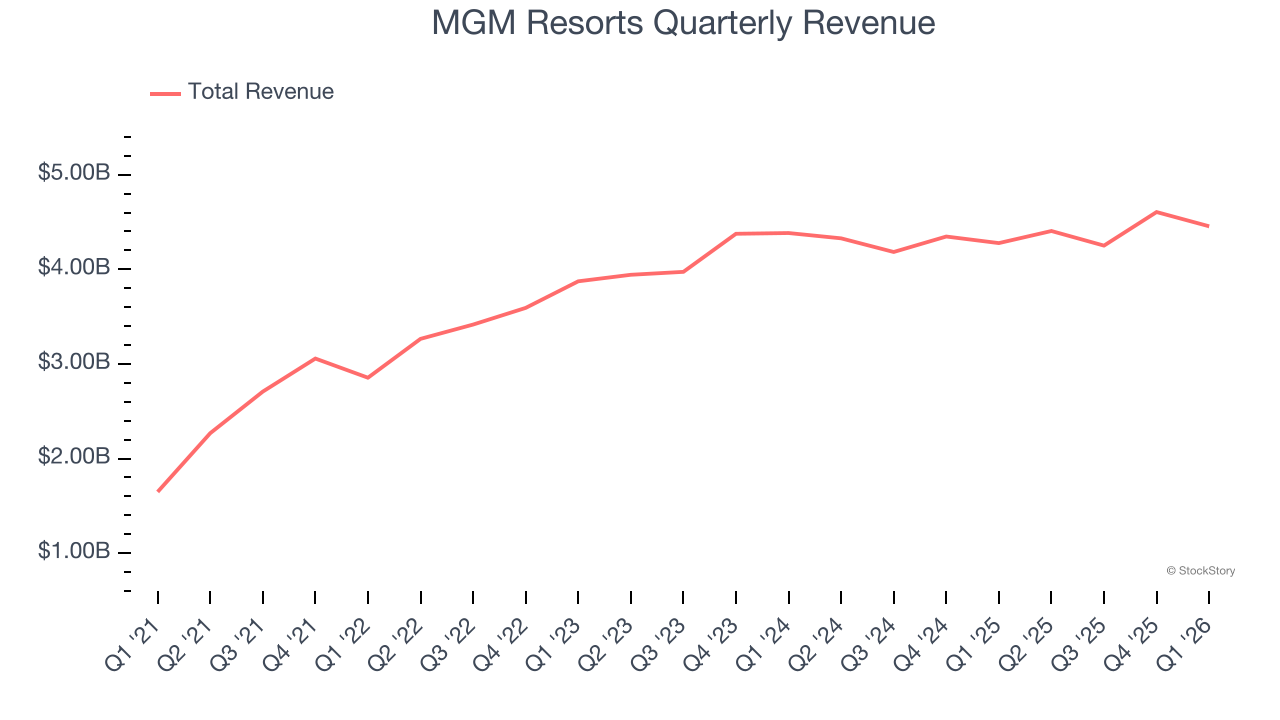
We at StockStory place the most emphasis on long-term growth, but within consumer discretionary, a stretched historical view may miss a company riding a successful new product or trend. MGM Resorts’s recent performance shows its demand has slowed as its annualized revenue growth of 3.1% over the last two years was below its five-year trend. We’re wary when companies in the sector see decelerations in revenue growth, as it could signal changing consumer tastes aided by low switching costs. Note that COVID hurt MGM Resorts’s business in 2020 and part of 2021, and it bounced back in a big way thereafter. 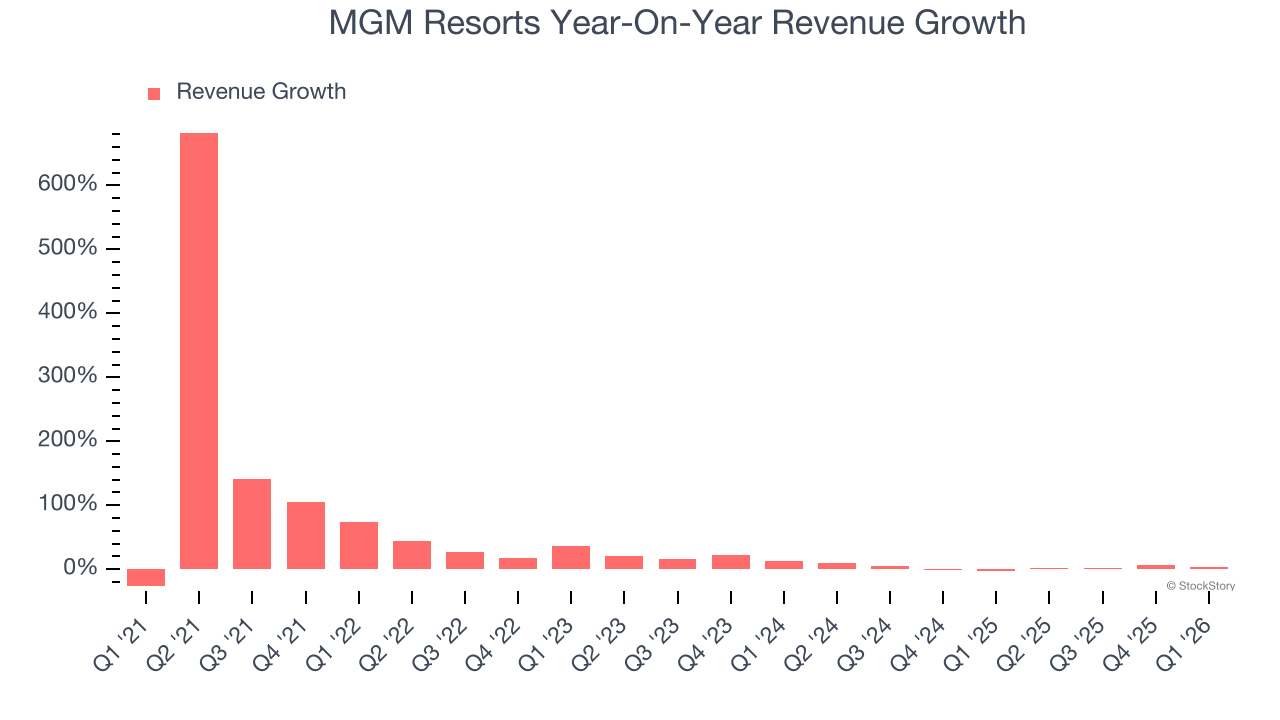
We can dig further into the company’s revenue dynamics by analyzing its most important segment, Casino. Over the last two years, MGM Resorts’s Casino revenue (Poker, sports betting) averaged 5.7% year-on-year growth. This segment has outperformed its total sales during the same period, lifting the company’s performance. 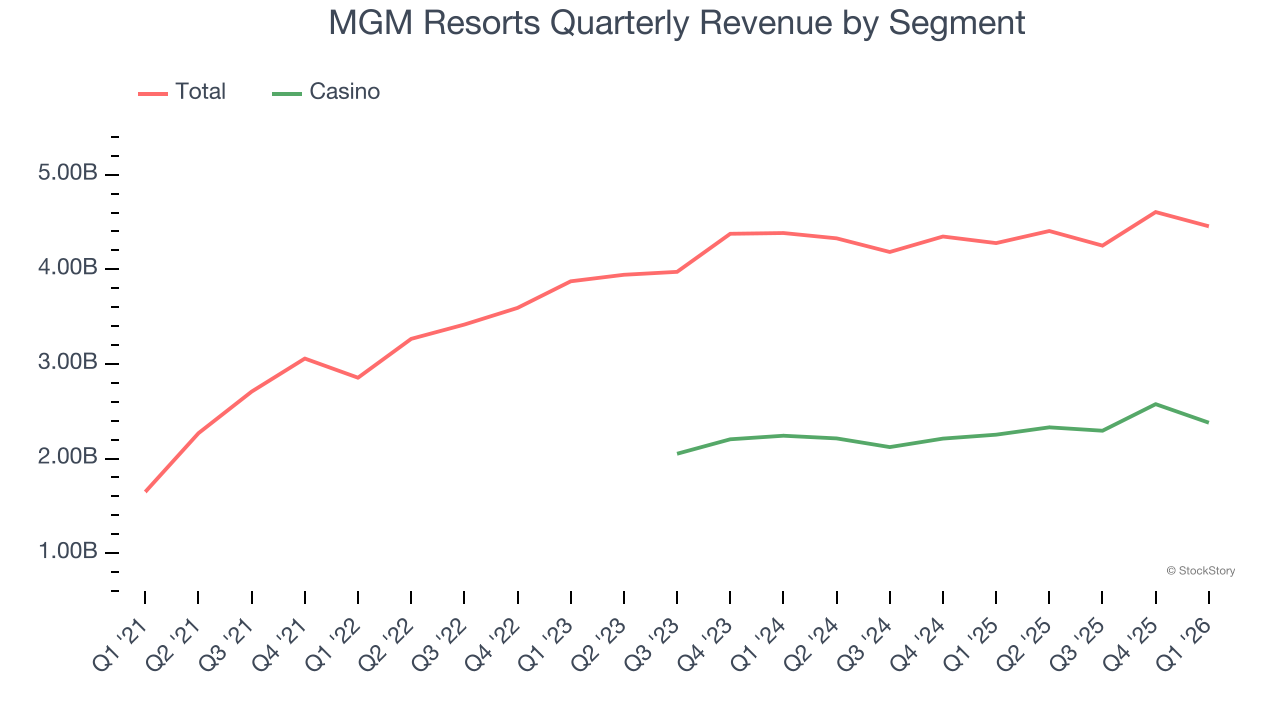
This quarter, MGM Resorts reported modest year-on-year revenue growth of 4.2% but beat Wall Street’s estimates by 2%.
Looking ahead, sell-side analysts expect revenue to remain flat over the next 12 months, a deceleration versus the last two years. This projection doesn't excite us and implies its products and services will face some demand challenges.
WHILE YOU’RE HERE: The Next Palantir? One satellite company captures images of every point on Earth. Every single day. The Pentagon wants it. Hedge funds are using it to beat earnings. You’ve probably never heard of it.
This is what the early days of Palantir looked like before it became a $437 billion giant. Same playbook. Different technology. If you missed Palantir, you need to see this. Claim The Stock Ticker for Free HERE.
Operating Margin
Operating margin is a key measure of profitability. Think of it as net income - the bottom line - excluding the impact of taxes and interest on debt, which are less connected to business fundamentals.
MGM Resorts’s operating margin has shrunk over the last 12 months and averaged 6.7% over the last two years. The company’s profitability was mediocre for a consumer discretionary business and shows it couldn’t pass its higher operating expenses onto its customers.
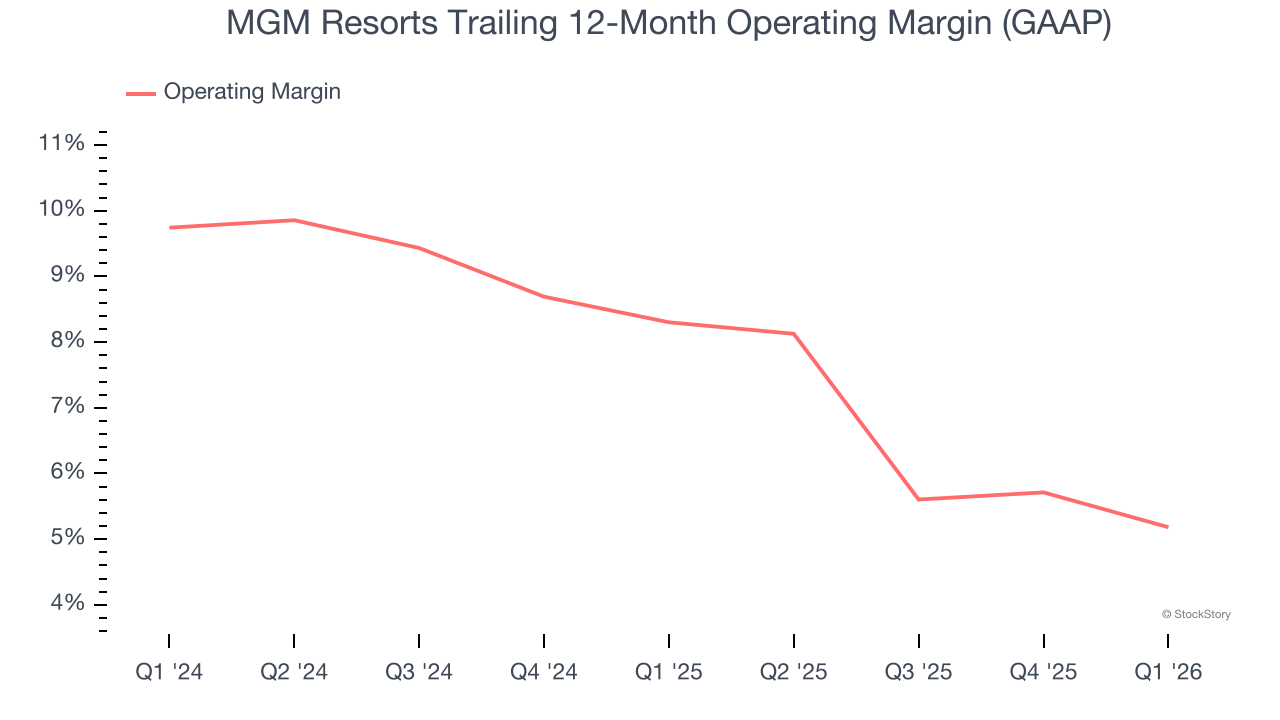
This quarter, MGM Resorts generated an operating margin profit margin of 6.8%, down 2.2 percentage points year on year. This contraction shows it was less efficient because its expenses grew faster than its revenue.
Earnings Per Share
We track the long-term change in earnings per share (EPS) for the same reason as long-term revenue growth. Compared to revenue, however, EPS highlights whether a company’s growth is profitable.
MGM Resorts’s full-year EPS flipped from negative to positive over the last five years. This is encouraging and shows it’s at a critical moment in its life.
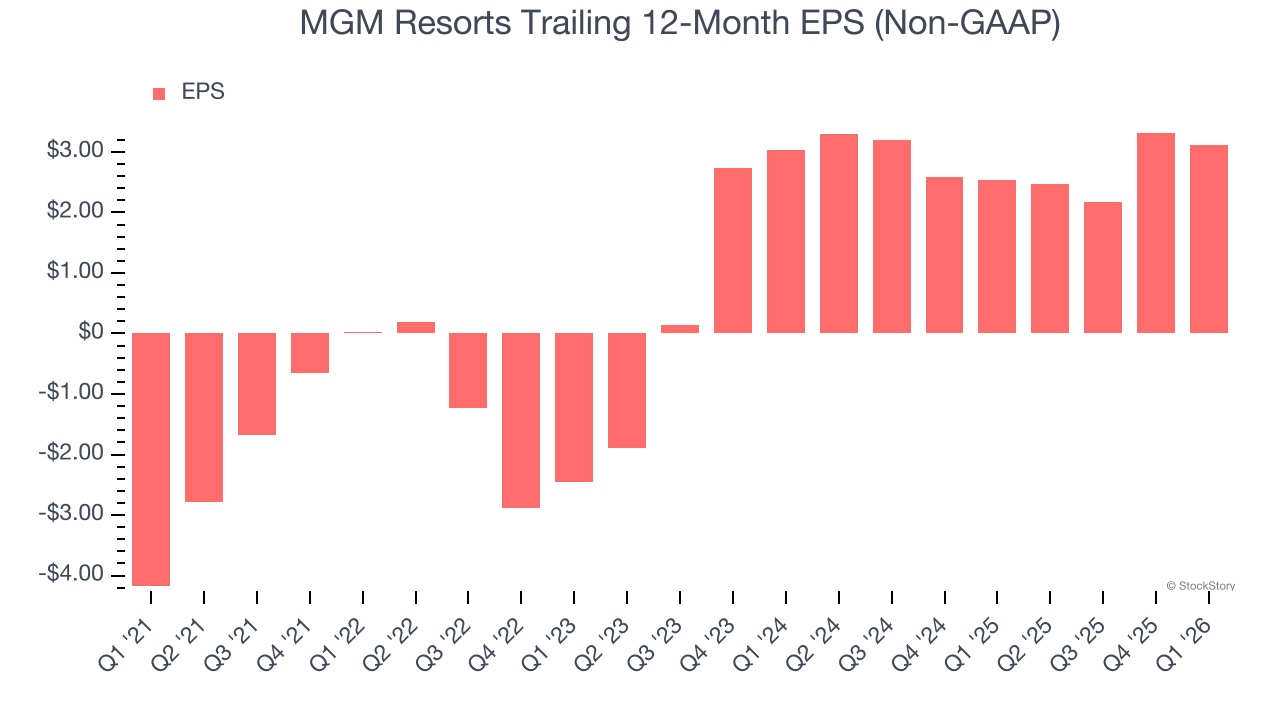
In Q1, MGM Resorts reported adjusted EPS of $0.49, down from $0.69 in the same quarter last year. This print missed analysts’ estimates. Over the next 12 months, Wall Street expects MGM Resorts’s full-year EPS of $3.12 to shrink by 38.3%.
Key Takeaways from MGM Resorts’s Q1 Results
It was encouraging to see MGM Resorts beat analysts’ revenue expectations this quarter. On the other hand, its EBITDA missed and its adjusted operating income fell short of Wall Street’s estimates. Overall, this quarter could have been better. The stock traded up 1.1% to $39.69 immediately following the results.
Big picture, is MGM Resorts a buy here and now? If you’re making that decision, you should consider the bigger picture of valuation, business qualities, as well as the latest earnings. We cover that in our actionable full research report which you can read here (it’s free).