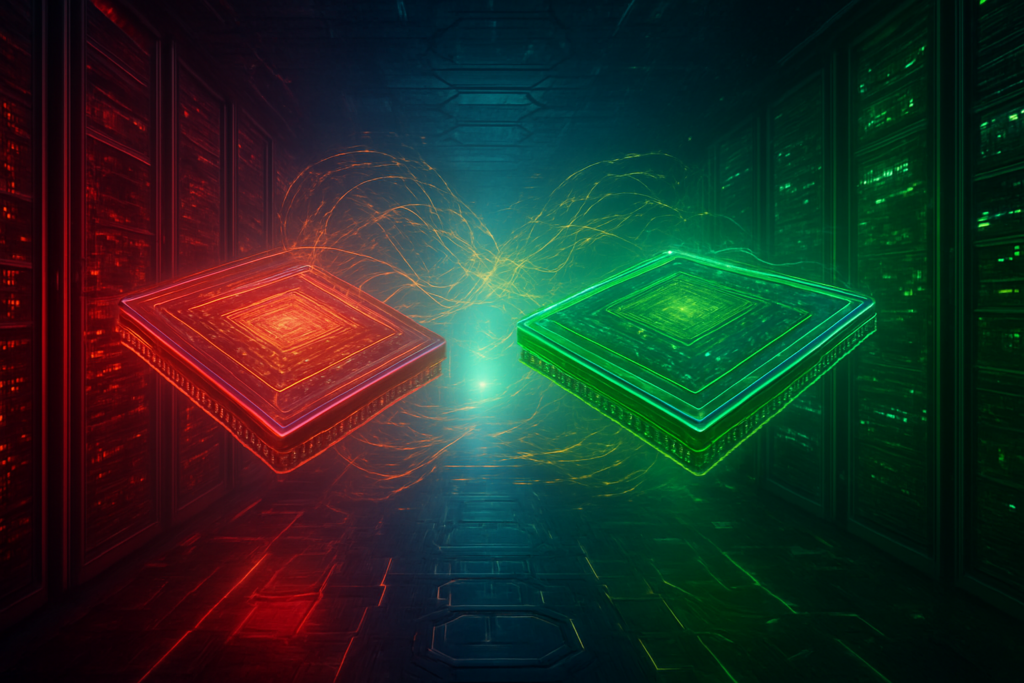
As of late 2025, the artificial intelligence landscape has reached a critical inflection point. While Nvidia (NASDAQ: NVDA) remains the undisputed titan of the AI hardware world, a seismic shift is occurring in the data centers of the world’s largest tech companies. Advanced Micro Devices, Inc. (NASDAQ: AMD) has transitioned from a distant second to a formidable "wartime" competitor, leveraging a strategy centered on massive memory capacity and open-source software integration. This evolution marks the beginning of what many analysts are calling "The Great Decoupling," as hyperscalers move away from total dependence on proprietary stacks toward a more balanced, multi-vendor ecosystem.
The immediate significance of this shift cannot be overstated. For the first time since the generative AI boom began, the hardware bottleneck is being addressed not just through raw compute power, but through architectural efficiency and cost-effectiveness. AMD’s aggressive annual roadmap—matching Nvidia’s own rapid-fire release cycle—has fundamentally changed the procurement strategies of major AI labs. By offering hardware that matches or exceeds Nvidia's memory specifications at a significantly lower total cost of ownership (TCO), AMD is positioning itself to capture a massive slice of the projected $1 trillion AI accelerator market by 2030.
Breaking the Memory Wall: The Technical Ascent of the Instinct MI350
The core of AMD’s challenge lies in its newly released Instinct MI350 series, specifically the flagship MI355X. Built on the 3nm CDNA 4 architecture, the MI355X represents a direct assault on Nvidia’s Blackwell B200 dominance. Technically, the MI355X is a marvel of chiplet engineering, boasting a staggering 288GB of HBM3E memory and 8.0 TB/s of memory bandwidth. In comparison, Nvidia’s Blackwell B200 typically offers between 180GB and 192GB of HBM3E. This 1.6x advantage in VRAM is not just a vanity metric; it allows for the inference of massive models, such as the upcoming Llama 4, on significantly fewer nodes, reducing the complexity and energy consumption of large-scale deployments.
Performance-wise, the MI350 series has achieved what was once thought impossible: raw compute parity with Nvidia. The MI355X delivers roughly 10.1 PFLOPS of FP8 performance, rivaling the Blackwell architecture's sparse performance metrics. This parity is achieved through a hybrid manufacturing approach, utilizing Taiwan Semiconductor Manufacturing Company (NYSE: TSM)'s advanced CoWoS (Chip on Wafer on Substrate) packaging. Unlike Nvidia’s more monolithic designs, AMD’s chiplet-based approach allows for higher yields and greater flexibility in scaling, which has been a key factor in AMD's ability to keep prices 25-30% lower than its competitor.
The reaction from the AI research community has been one of cautious optimism. Early benchmarks from labs like Meta (NASDAQ: META) and Microsoft (NASDAQ: MSFT) suggest that the MI350 series is remarkably easy to integrate into existing workflows. This is largely due to the maturation of ROCm 7.0, AMD’s open-source software stack. By late 2025, the "software moat" that once protected Nvidia’s CUDA has begun to evaporate, as industry-standard frameworks like PyTorch and OpenAI’s Triton now treat AMD hardware as a first-class citizen.
The Hyperscaler Pivot: Strategic Advantages and Market Shifts
The competitive implications of AMD’s rise are being felt most acutely in the boardrooms of the "Magnificent Seven." Companies like Oracle (NYSE: ORCL) and Alphabet (NASDAQ: GOOGL) are increasingly adopting AMD’s Instinct chips to avoid vendor lock-in. For these tech giants, the strategic advantage is twofold: pricing leverage and supply chain security. By qualifying AMD as a primary source for AI training and inference, hyperscalers can force Nvidia to be more competitive on pricing while ensuring that a single supply chain disruption at one fab doesn't derail their multi-billion dollar AI roadmaps.
Furthermore, the market positioning for AMD has shifted from being a "budget alternative" to being the "inference workhorse." As the AI industry moves from the training phase of massive foundational models to the deployment phase of specialized, agentic AI, the demand for high-memory inference chips has skyrocketed. AMD’s superior memory capacity makes it the ideal choice for running long-context window models and multi-agent workflows, where memory throughput is often the primary bottleneck. This has led to a significant disruption in the mid-tier enterprise market, where companies are opting for AMD-powered private clouds over Nvidia-dominated public offerings.
Startups are also benefiting from this shift. The increased availability of AMD hardware in the secondary market and through specialized cloud providers has lowered the barrier to entry for training niche models. As AMD continues to capture market share—projected to reach 20% of the data center GPU market by 2027—the competitive pressure will likely force Nvidia to accelerate its own roadmap, potentially leading to a "feature war" that benefits the entire AI ecosystem through faster innovation and lower costs.
A New Paradigm: Open Standards vs. Proprietary Moats
The broader significance of AMD’s potential outperformance lies in the philosophical battle between open and closed ecosystems. For years, Nvidia’s CUDA was the "Windows" of the AI world—ubiquitous, powerful, but proprietary. AMD’s success is intrinsically tied to the success of open-source initiatives like the Unified Accelerator Foundation (UXL). By championing a software-agnostic approach, AMD is betting that the future of AI will be built on portable code that can run on any silicon, whether it's an Instinct GPU, an Intel (NASDAQ: INTC) Gaudi accelerator, or a custom-designed TPU.
This shift mirrors previous milestones in the tech industry, such as the rise of Linux in the server market or the adoption of x86 architecture over proprietary mainframes. The potential concern, however, remains the sheer scale of Nvidia’s R&D budget. While AMD has made massive strides, Nvidia’s "Rubin" architecture, expected in 2026, promises a complete redesign with HBM4 memory and integrated "Vera" CPUs. The risk for AMD is that Nvidia could use its massive cash reserves to simply "out-engineer" any advantage AMD gains in the short term.
Despite these concerns, the momentum toward hardware diversification appears irreversible. The AI landscape is moving toward a "heterogeneous" future, where different chips are used for different parts of the AI lifecycle. In this new reality, AMD doesn't need to "kill" Nvidia to outperform it in growth; it simply needs to be the standard-bearer for the open-source, high-memory alternative that the industry is so desperately craving.
The Road to MI400 and the HBM4 Era
Looking ahead, the next 24 months will be defined by the transition to HBM4 memory and the launch of the AMD Instinct MI400 series. Predicted for early 2026, the MI400 is being hailed as AMD’s "Milan Moment"—a reference to the EPYC CPU generation that finally broke Intel’s stranglehold on the server market. Early specifications suggest the MI400 will offer over 400GB of HBM4 memory and nearly 20 TB/s of bandwidth, potentially leapfrogging Nvidia’s Rubin architecture in memory-intensive tasks.
The future will also see a deeper integration of AI hardware into the fabric of edge computing. AMD’s acquisition of Xilinx and its strength in the PC market with Ryzen AI processors give it a unique "end-to-end" advantage that Nvidia lacks. We can expect to see seamless workflows where models are trained on Instinct clusters, optimized via ROCm, and deployed across millions of Ryzen-powered laptops and edge devices. The challenge will be maintaining this software consistency across such a vast array of hardware, but the rewards for success would be a dominant position in the "AI Everywhere" era.
Experts predict that the next major hurdle will be power efficiency. As data centers hit the "power wall," the winner of the AI race may not be the company with the fastest chip, but the one with the most performance-per-watt. AMD’s focus on chiplet efficiency and advanced liquid cooling solutions for the MI350 and MI400 series suggests they are well-prepared for this shift.
Conclusion: A New Era of Competition
The rise of AMD in the AI sector is a testament to the power of persistent execution and the industry's innate desire for competition. By focusing on the "memory wall" and embracing an open-source software philosophy, AMD has successfully positioned itself as the only viable alternative to Nvidia’s dominance. The key takeaways are clear: hardware parity has been achieved, the software moat is narrowing, and the world’s largest tech companies are voting with their wallets for a multi-vendor future.
In the grand history of AI, this period will likely be remembered as the moment the industry matured from a single-vendor monopoly into a robust, competitive market. While Nvidia will likely remain a leader in high-end, integrated rack-scale systems, AMD’s trajectory suggests it will become the foundational workhorse for the next generation of AI deployment. In the coming weeks and months, watch for more partnership announcements between AMD and major AI labs, as well as the first public benchmarks of the MI350 series, which will serve as the definitive proof of AMD’s new standing in the AI hierarchy.
This content is intended for informational purposes only and represents analysis of current AI developments.
TokenRing AI delivers enterprise-grade solutions for multi-agent AI workflow orchestration, AI-powered development tools, and seamless remote collaboration platforms.
For more information, visit https://www.tokenring.ai/.