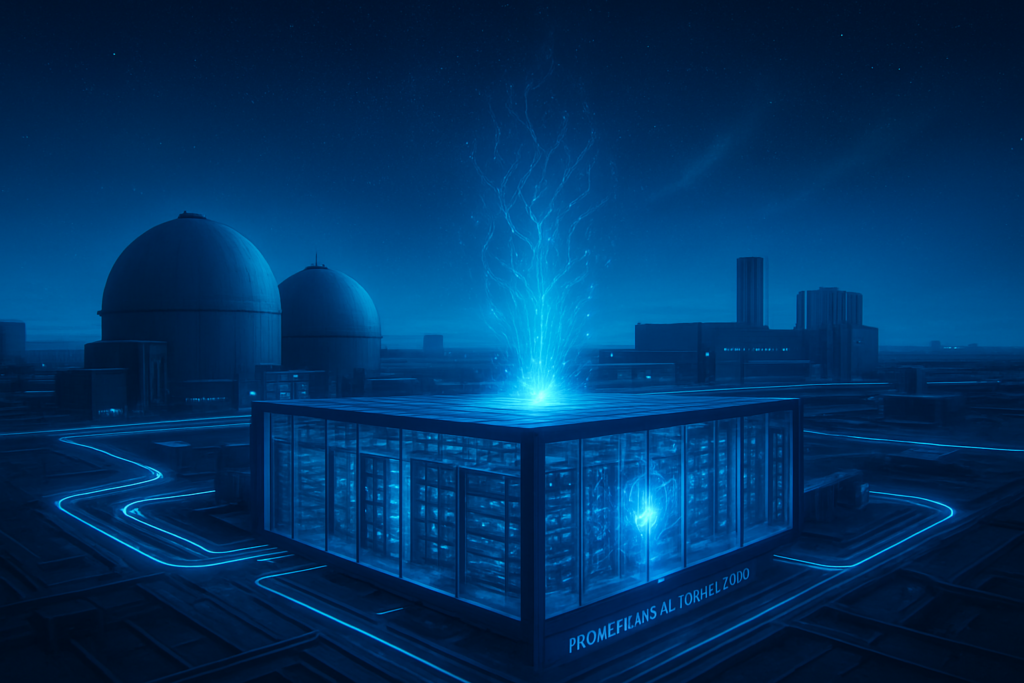
In a move that signals the dawn of the "gigawatt-scale" AI era, Meta Platforms (NASDAQ: META) has announced a historic trifecta of nuclear energy agreements with Vistra (NYSE: VST), TerraPower, and Oklo (NYSE: OKLO). The deals, totaling a staggering 6.6 gigawatts (GW) of carbon-free capacity, are designed to solve the single greatest bottleneck in modern computing: the massive power requirements of next-generation AI training. This unprecedented energy pipeline is specifically earmarked to power Meta's "Prometheus" AI supercluster, a facility that marks the company's most aggressive push yet toward achieving artificial general intelligence (AGI).
The announcement, made in early January 2026, represents the largest corporate procurement of nuclear energy in history. By directly bankrolling the revival of American nuclear infrastructure and the deployment of advanced Small Modular Reactors (SMRs), Meta is shifting from being a mere consumer of electricity to a primary financier of the energy grid. This strategic pivot ensures that Meta’s roadmap for "Superintelligence" is not derailed by the aging US power grid or the increasing scarcity of renewable energy credits.
Engineering the Prometheus Supercluster: 500,000 GPUs and the Quest for 3.1 ExaFLOPS
At the heart of this energy demand is the Prometheus AI supercluster, located in New Albany, Ohio. Prometheus is Meta’s first 1-gigawatt data center complex, housing an estimated 500,000 GPUs at full capacity. The hardware configuration is a high-performance tapestry, integrating NVIDIA (NASDAQ: NVDA) Blackwell GB200 systems alongside AMD (NASDAQ: AMD) MI300 accelerators and Meta’s proprietary MTIA (Meta Training and Inference Accelerator) chips. This heterogenous architecture allows Meta to optimize for various stages of the model lifecycle, pushing peak performance beyond 3.1 ExaFLOPS. To handle the unprecedented heat density—reaching up to 140 kW per rack—Meta is utilizing its "Catalina" rack design and Air-Assisted Liquid Cooling (AALC), a hybrid system that allows for liquid cooling efficiency without the need for a full facility-wide plumbing overhaul.
The energy strategy to support this beast is divided into immediate and long-term phases. To power Prometheus today, Meta’s 2.6 GW deal with Vistra leverages existing nuclear assets, including the Perry and Davis-Besse plants in Ohio and the Beaver Valley plant in Pennsylvania. Crucially, the deal funds "uprates"—technical upgrades to existing reactors that will add 433 MW of new capacity to the grid by the early 2030s. For its future needs, Meta is betting on the next generation of nuclear technology. The company has secured up to 2.8 GW from TerraPower’s Natrium sodium-cooled fast reactors and 1.2 GW from Oklo’s Aurora powerhouse "power campus." This ensures that as Meta scales from Prometheus to its even larger 5 GW "Hyperion" cluster in Louisiana, it will have dedicated, carbon-free baseload power that operates independently of weather-dependent solar or wind.
A Nuclear Arms Race: How Meta’s Power Play Reshapes the AI Industry
This massive commitment places Meta in a direct competitive standoff with Microsoft (NASDAQ: MSFT) and Google (NASDAQ: GOOGL), both of whom have also explored nuclear options but on a significantly smaller scale. By securing 6.6 GW, Meta has effectively locked up a significant portion of the projected SMR production capacity for the next decade. This "first-mover" advantage in energy procurement could leave rivals struggling to find locations for their own gigawatt-scale clusters, as grid capacity becomes the new gold in the AI economy. Companies like Arista Networks (NYSE: ANET) and Broadcom (NASDAQ: AVGO), who provide the high-speed networking fabric for Prometheus, also stand to benefit as these massive data centers transition from blueprints to operational reality.
The strategic advantage here is not just about sustainability; it is about "sovereign compute." By financing its own power sources, Meta reduces its reliance on public utility commissions and the often-glacial pace of grid interconnection queues. This allows the company to accelerate its development cycles, potentially releasing "Superintelligence" models months or even years ahead of competitors who remain tethered to traditional energy constraints. For the broader AI ecosystem, Meta's move signals that the entry price for frontier-model training is no longer just billions of dollars in chips, but billions of dollars in dedicated energy infrastructure.
Beyond the Grid: The Broader Significance of the Meta-Nuclear Alliance
The broader significance of these deals extends far beyond Meta's balance sheet; it represents a fundamental shift in the American industrial landscape. For decades, the US nuclear industry has struggled with high costs and regulatory hurdles. By providing massive "pre-payments" and guaranteed long-term contracts, Meta is acting as a private-sector catalyst for a nuclear renaissance. This fits into a larger trend where "Big Tech" is increasingly taking on the roles traditionally held by governments, from funding infrastructure to driving fundamental research in physics and materials science.
However, the scale of this project also raises significant concerns. The concentration of such massive energy resources for AI training comes at a time when global energy transitions are already under strain. Critics argue that diverting gigawatts of carbon-free power to train LLMs could slow the decarbonization of other sectors, such as residential heating or transportation. Furthermore, the reliance on unproven SMR technology from companies like Oklo and TerraPower carries inherent project risks. If these next-gen reactors face delays—as nuclear projects historically have—Meta’s "Superintelligence" timeline could be at risk, creating a high-stakes dependency on the success of the advanced nuclear sector.
Looking Ahead: The Road to Hyperion and the 10-Gigawatt Data Center
In the near term, the industry will be watching the first phase of the Vistra deal, as power begins flowing to the initial stages of Prometheus in New Albany. By late 2026, we expect to see the first frontier models trained entirely on nuclear-backed compute. These models are predicted to exhibit reasoning capabilities far beyond current iterations, potentially enabling breakthroughs in drug discovery, climate modeling, and autonomous systems. The success of Prometheus will serve as a pilot for "Hyperion," Meta's planned 5-gigawatt site in Louisiana, which aims to be the first truly autonomous AI city, powered by a dedicated fleet of SMRs.
The technical challenges remain formidable. Integrating modular reactors directly into data center campuses requires navigating complex NRC (Nuclear Regulatory Commission) guidelines and developing new safety protocols for "behind-the-meter" nuclear generation. Experts predict that if Meta successfully integrates Oklo’s Aurora units by 2030, it will set a new blueprint for industrial energy consumption. The ultimate goal, as hinted by Meta leadership, is a 10-gigawatt global compute footprint that is entirely self-sustaining and carbon-neutral, a milestone that could redefine the relationship between technology and the environment.
Conclusion: A Defining Moment in the History of Computing
Meta's 6.6 GW nuclear commitment is more than just a power purchase agreement; it is a declaration of intent. By tying its future to the atom, Meta is ensuring that its pursuit of AGI will not be limited by the physical constraints of the 20th-century power grid. This development marks a transition in the AI narrative from one of software and algorithms to one of hardware, energy, and massive-scale industrial engineering. It is a bold, high-risk bet that the path to superintelligence is paved with nuclear fuel.
As we move deeper into 2026, the success of these partnerships will be a primary indicator of the health of the AI industry. If Meta can successfully bring these reactors online and scale its Prometheus supercluster, it will have built an unassailable moat in the race for AI supremacy. For now, the world watches as the tech giant attempts to harness the power of the stars to build the minds of the future. The next few years will determine whether this nuclear gamble pays off or if the sheer scale of the AI energy appetite is too great even for the atom to satisfy.
This content is intended for informational purposes only and represents analysis of current AI developments.
TokenRing AI delivers enterprise-grade solutions for multi-agent AI workflow orchestration, AI-powered development tools, and seamless remote collaboration platforms.
For more information, visit https://www.tokenring.ai/.