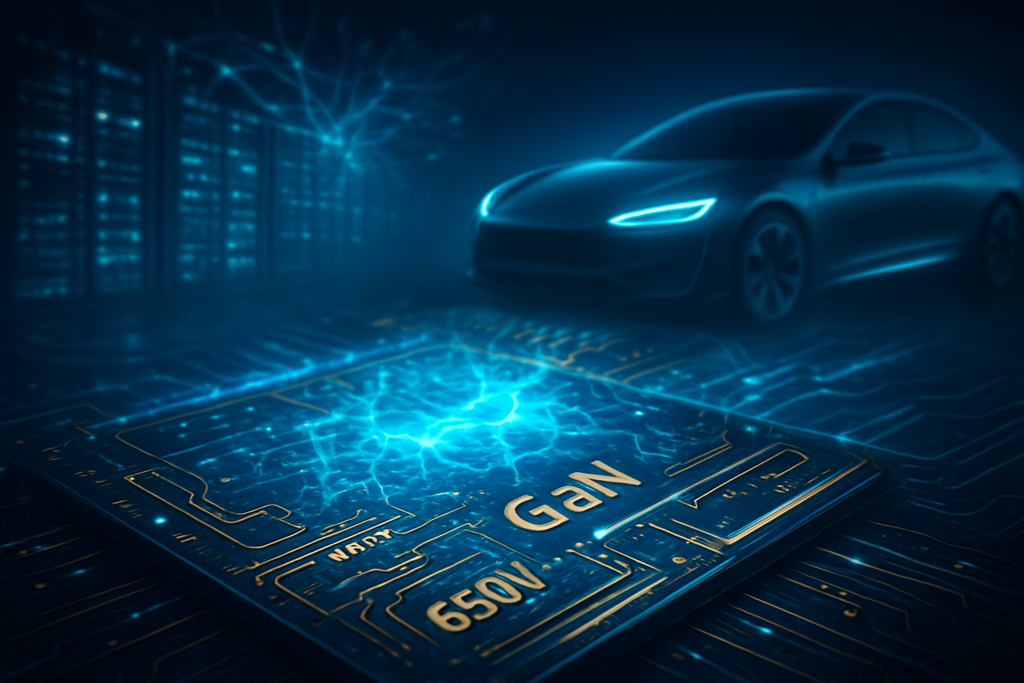
In a move that signals a tectonic shift in the semiconductor landscape, power electronics giant onsemi (NASDAQ: ON) and contract manufacturing leader GlobalFoundries (NASDAQ: GFS) have announced a strategic partnership to develop and mass-produce 650V Gallium Nitride (GaN) power devices. Announced in late December 2025, this collaboration is designed to tackle the two most pressing energy challenges of 2026: the insatiable power demands of AI-driven data centers and the need for higher efficiency in the rapidly maturing electric vehicle (EV) market.
The partnership represents a significant leap forward for wide-bandgap (WBG) materials, which are quickly replacing traditional silicon in high-performance applications. By combining onsemi's deep expertise in power systems and packaging with GlobalFoundries’ high-volume, U.S.-based manufacturing capabilities, the two companies aim to provide a resilient and scalable supply of GaN chips. As of January 7, 2026, the industry is already seeing the first ripples of this announcement, with customer sampling scheduled to begin in the first half of this year.
The technical core of this partnership centers on a 200mm (8-inch) enhancement-mode (eMode) GaN-on-silicon manufacturing process. Historically, GaN production was limited to 150mm wafers, which constrained volume and kept costs high. The transition to 200mm wafers at GlobalFoundries' Malta, New York, facility allows for significantly higher yields and better cost-efficiency, effectively moving GaN from a niche, premium material to a mainstream industrial standard. The 650V rating is particularly strategic, as it serves as the "sweet spot" for devices that interface with standard electrical grids and the 400V battery architectures currently dominant in the automotive sector.
Unlike traditional silicon transistors, which struggle with heat and efficiency at high frequencies, these 650V GaN devices can switch at much higher speeds with minimal energy loss. This capability allows engineers to use smaller passive components, such as inductors and capacitors, leading to a dramatic reduction in the overall size and weight of power supplies. Furthermore, onsemi is integrating these GaN FETs with its proprietary silicon drivers and controllers in a "system-in-package" (SiP) architecture. This integration reduces electromagnetic interference (EMI) and simplifies the design process for engineers, who previously had to manually tune discrete components from multiple vendors.
Initial reactions from the semiconductor research community have been overwhelmingly positive. Analysts note that while Silicon Carbide (SiC) has dominated the high-voltage (1200V+) EV traction inverter market, GaN is proving to be the superior choice for the 650V range. Dr. Aris Silvestros, a leading power electronics researcher, commented that the "integration of gate drivers directly with GaN transistors on a 200mm line is the 'holy grail' for power density, finally breaking the thermal barriers that have plagued high-performance computing for years."
For the broader tech industry, the implications are profound. AI giants and data center operators stand to be the biggest beneficiaries. As Large Language Models (LLMs) continue to scale, the power density of server racks has become a critical bottleneck. Traditional silicon-based power units are no longer sufficient to feed the latest AI accelerators. The onsemi-GlobalFoundries partnership enables the creation of 12kW power modules that fit into the same physical footprint as older 3kW units. This effectively quadruples the power density of data centers, allowing companies like NVIDIA (NASDAQ: NVDA) and Microsoft (NASDAQ: MSFT) to pack more compute power into existing facilities without requiring massive infrastructure overhauls.
In the automotive sector, the partnership puts pressure on established players like Wolfspeed (NYSE: WOLF) and STMicroelectronics (NYSE: STM). While these competitors have focused heavily on Silicon Carbide, the onsemi-GF alliance's focus on 650V GaN targets the high-volume "onboard charger" (OBC) and DC-DC converter markets. By making these components smaller and more efficient, automakers can reduce vehicle weight and extend range—or conversely, use smaller, cheaper batteries to achieve the same range. The bidirectional capability of these GaN devices also facilitates "Vehicle-to-Grid" (V2G) technology, allowing EVs to act as mobile batteries for the home or the electrical grid, a feature that is becoming a standard requirement in 2026 model-year vehicles.
Strategically, the partnership provides a major "Made in America" advantage. By utilizing GlobalFoundries' New York fabrication plants, onsemi can offer its customers a supply chain that is insulated from geopolitical tensions in East Asia. This is a critical selling point for U.S. and European automakers and government-linked data center projects that are increasingly prioritized by domestic content requirements and supply chain security.
The broader significance of this development lies in the global "AI Power Crisis." As of early 2026, data centers are projected to consume over 1,000 Terawatt-hours of electricity annually. The efficiency gains offered by GaN—reducing heat loss by up to 50% compared to silicon—are no longer just a cost-saving measure; they are a prerequisite for the continued growth of artificial intelligence. If the world is to meet its sustainability goals while expanding AI capabilities, the transition to wide-bandgap materials like GaN is non-negotiable.
This milestone also marks the end of the "Silicon Era" for high-performance power conversion. Much like the transition from vacuum tubes to transistors in the mid-20th century, the shift from Silicon to GaN and SiC represents a fundamental change in how we manage electrons. The partnership between onsemi and GlobalFoundries is a signal that the manufacturing hurdles that once held GaN back have been cleared. This mirrors previous AI milestones, such as the shift to GPU-accelerated computing; it is an enabling technology that allows the software and AI models to reach their full potential.
However, the rapid transition is not without concerns. The industry must now address the "talent gap" in power electronics engineering. Designing with GaN requires a different mindset than designing with Silicon, as the high switching speeds can create complex signal integrity issues. Furthermore, while the U.S.-based manufacturing is a boon for security, the global industry must ensure that the raw material supply of Gallium remains stable, as it is often a byproduct of aluminum and zinc mining and is subject to its own set of geopolitical sensitivities.
Looking ahead, the roadmap for 650V GaN is just the beginning. Experts predict that the success of this partnership will lead to even higher levels of integration, where the power stage and the logic stage are combined on a single chip. This would enable "smart" power systems that can autonomously optimize their efficiency in real-time based on the workload of the AI processor they are feeding. In the near term, we expect to see the first GaN-powered AI server racks hitting the market by late 2026, followed by a wave of 2027 model-year EVs featuring integrated GaN onboard chargers.
Another horizon for this technology is the expansion into consumer electronics and 5G/6G infrastructure. While 650V is the current focus, the lessons learned from this high-volume 200mm process will likely be applied to lower-voltage GaN for smartphones and laptops, leading to even smaller "brickless" chargers. In the long term, we may see GaN-based power conversion integrated directly into the cooling systems of supercomputers, further blurring the line between electrical and thermal management.
The primary challenge remaining is the standardization of GaN testing and reliability protocols. Unlike silicon, which has decades of reliability data, GaN is still building its long-term track record. The industry will be watching closely as the first large-scale deployments of the onsemi-GF chips go live this year to see if they hold up to the rigorous 10-to-15-year lifespans required by the automotive and industrial sectors.
The partnership between onsemi and GlobalFoundries is more than just a business deal; it is a foundational pillar for the next phase of the technological revolution. By scaling 650V GaN to high-volume production, these two companies are providing the "energy backbone" required for both the AI-driven digital world and the electrified physical world. The key takeaways are clear: GaN has arrived as a mainstream technology, U.S. manufacturing is reclaiming a central role in the semiconductor supply chain, and the "power wall" that threatened to stall AI progress is finally being dismantled.
As we move through 2026, this development will be remembered as the moment when the industry stopped talking about the potential of wide-bandgap materials and started delivering them at the scale the world requires. The long-term impact will be measured in gigawatts of energy saved and miles of EV range gained. For investors and tech enthusiasts alike, the coming weeks and months will be a critical period to watch for the first performance benchmarks from the H1 2026 sampling phase, which will ultimately prove if GaN can live up to its promise as the fuel for the future.
This content is intended for informational purposes only and represents analysis of current AI developments.
TokenRing AI delivers enterprise-grade solutions for multi-agent AI workflow orchestration, AI-powered development tools, and seamless remote collaboration platforms.
For more information, visit https://www.tokenring.ai/.