We have all been there. It’s Friday night, and you are struck by a bolt of lightning—a startup idea that feels so obvious, so necessary, that you can’t believe it doesn’t exist yet. The adrenaline kicks in. You open your laptop, ready to build. But then, reality sets in. You spend three hours configuring your development environment, another two hours wrestling with database migrations, and by Sunday evening, you have a login screen and a half-broken dashboard. The dream fades, and the repository becomes another graveyard in your GitHub profile.
This used to be the standard lifecycle of a side project. But in the last twelve months, the rules of the game have completely changed. The timeline for building a Minimum Viable Product (MVP) has compressed from weeks to hours. We are entering an era where the barrier to entry is no longer technical skill or time—it is purely imagination and execution.
The Death of "Boilerplate Fatigue"
The biggest killer of early-stage ideas is "Boilerplate Fatigue." This is the energy you lose setting up the plumbing before you ever get to the feature that actually solves a user’s problem. In the traditional workflow, you are a construction worker laying every brick by hand. You have to be the frontend engineer, the backend architect, the database administrator, and the DevOps guy all at once. It is exhausting, and it kills momentum.
AI has effectively automated the plumbing. But to truly accelerate from idea to prototype in hours, you need to stop treating AI as just a fancy autocomplete that helps you write a function faster. You need to treat it as a co-founder.
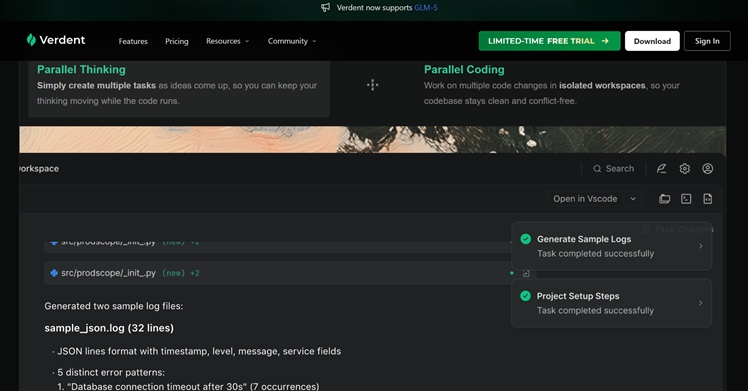
This requires a shift in how you orchestrate your work. Instead of serial tasking (finish A, then start B), you need to embrace parallel execution. This is where modern AI-native environments shine. For example, by utilizing Verdent, developers can effectively clone themselves. You can instruct one AI agent to scaffold the entire frontend component library while simultaneously having a second, isolated agent write the backend API endpoints in a separate Git worktree. Because Verdent manages these parallel streams without conflict, you aren't just typing faster; you are building multiple layers of your application at the exact same time.
This parallel workflow is the secret to the "4-Hour MVP." While the AI handles the repetitive labor of connecting your database to your API, you are free to focus on the high-level logic that actually differentiates your product.
The 4-Hour MVP Roadmap
So, how do you actually do it? How do you go from a napkin sketch to a deployable link before the coffee gets cold? You need a ruthless strategy. Here is a blueprint for the AI-accelerated build.
Hour 1: The "Spec" (Plan First, Code Later)
The biggest mistake developers make with AI is diving straight into the code. If you tell an AI to "build me a To-Do app," you will get a generic, useless toy.
Spend the first hour writing a detailed specification. In AI-native tools, this is often called "Plan Mode." You need to articulate:
- The User Flow: Step-by-step, what does the user do?
- The Data Model: What does the database schema look like?
- The Tech Stack: Be specific (e.g., "Use Next.js 14, Tailwind CSS, and Supabase").
Treat this document as the "constitution" of your project. The AI will refer back to this constantly. A well-written spec prevents the AI from hallucinating features or getting stuck in logic loops later on.
Hour 2: The Infrastructure Sprint
This is where you leverage the parallel agents mentioned earlier. Instead of writing SQL by hand, you delegate the infrastructure setup to multiple agents running simultaneously.
- Agent A (Database): Task it with generating the SQL initialization scripts based on your data model.
- Agent B (Backend): Task it with setting up the basic CRUD API routes.
- Agent C (Frontend): Task it with creating the shell of the application—navigation, layout, and global styles.
To ensure Agent A gives you exactly what you need without back-and-forth, you need to use a specific, constraint-heavy prompt. Here is an example of what you would feed into Verdent to get a production-ready database schema in one shot:
Prompt for Agent A: "Review the 'Data Model' section of the project spec file. Generate a Supabase-compatible PostgreSQL initialization script.
- Create tables for Users, Listings, and Bookings.
- Enable Row Level Security (RLS) on all tables.
- Write a policy that ensures Users can only view Bookings connected to their own user_id.
- Add foreign key constraints and create indexes on the status and created_at columns for performance. Do not explain the code, just output the SQL file."
While Agent A is executing this SQL generation in a background worktree, you immediately switch to Agent B and instruct it to build the API endpoints that will consume that schema.
Your role here is "Reviewer." You aren't writing code; you are merging pull requests. You are checking that the database schema matches the spec and that the API routes are secure. This feels different than coding. It feels like managing a small, hyper-efficient team.
Hour 3: The Core Feature (The "Meat")
Now that the skeleton is built, you focus on the one thing your app does that is special. If you are building a "Tinder for Dog Walkers," this is where you build the matching logic.
This is where you pair-program with the AI. You guide it through the complex business logic. Because you didn't waste energy on the boilerplate in Hour 2, you have the mental clarity to solve the hard problems here. This is the hour where "Viable" is put into the MVP.
Hour 4: Polish and Deploy
The final hour is for the "DiffLens" review—scanning the code for obvious bugs, cleaning up the UI glitches, and pushing to production. Modern AI tools can often handle the deployment configuration for you, generating the Dockerfiles or Vercel configurations automatically.
The Mental Trap: Perfectionism
The speed at which AI generates code introduces a new danger: Feature Creep. When adding a "Dark Mode" takes 30 seconds of prompting, it is tempting to add everything.
You must resist this. The goal is an MVP, not a mature SaaS platform. The danger of AI is that it makes creating "stuff" so easy that you end up with a bloated mess of features that nobody wants.
You have to be the editor. You have to say "No." The AI will happily build a settings page, a user profile editor, and a complex notification system. But if your core value proposition is "one-click image resizing," none of that matters for version 1.0. Use the speed of AI to iterate on the core value, not to broaden the scope unnecessarily.
Why This Matters for Founders
Speed is the ultimate competitive advantage. In the past, testing a hypothesis cost thousands of dollars or months of weekends. If the idea failed, it was a painful, expensive lesson.
Today, the cost of failure is essentially zero. You can have an idea in the morning, build it by the afternoon, and put it in front of users by dinner. If they hate it? You delete the repo and start over the next day. You haven't lost months of your life; you've lost a Saturday.
This encourages a culture of experimentation. It allows you to be bolder, to try weirder ideas, and to pivot instantly.
Conclusion: The New Creator Economy
We are moving away from a world where "Technical Co-Founder" was the hardest position to fill. Now, the technology is the co-founder.
The ability to accelerate from idea to prototype in hours isn't just a productivity hack; it is a liberation of creativity. It means that the only thing stopping you from building your dream project isn't your inability to configure Webpack or your lack of knowledge in SQL—it’s simply whether you are willing to sit down, open your editor, and tell the machine what to build.
The tools are ready. The agents are standing by. Don't let another idea die in your backlog. Try building your next MVP with Verdent's parallel agents this weekend.
Media Contact
Company Name: Verdent
Email: Send Email
Country: United States
Website: https://www.verdent.ai/